
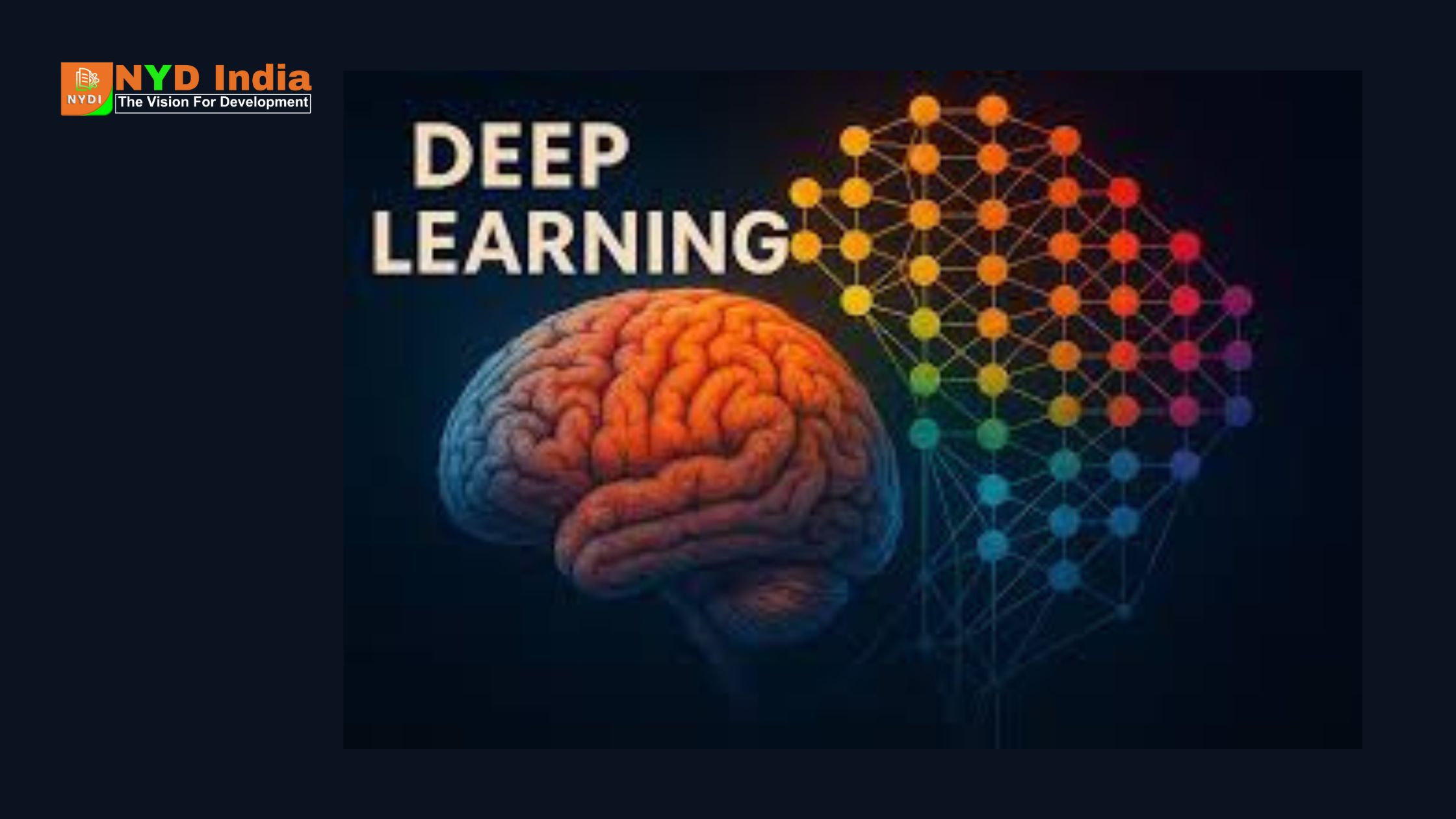
Deep Learning : How Deep Learning works and implement in AI
Deep learning is a subset of machine learning driven by multilayered neural systems whose plan is propelled by the structure of the human brain. Deep learning models control most state-of-the-art artificial intelligence (AI) nowadays, from computer vision and generative AI to self-driving cars and robotics.
Unlike the unequivocally characterized numerical rationale of conventional machine learning calculations, the manufactured neural systems of profound learning models contain numerous interconnected layers of “neurons” that each perform a numerical operation. By utilizing machine learning to alter the quality of the associations between person neurons in adjoining layers—in other words, the changing demonstrate weights and biases—the organize can be optimized to abdicate more precise yields. Whereas neural systems and profound learning have ended up inseparably related with one another, they are not entirely synonymous: “deep learning” alludes to the preparing of models with at slightest 4 layers (in spite of the fact that present day neural organize designs are regularly much “deeper” than that).
What is deep learning?

Deep learning is a sort of machine learning that can recognize complex designs and make affiliations in a comparable way to people. Its capacities can extend from recognizing things in a photo or recognizing a voice to driving a car or making an outline. Basically, a profound learning show is a computer program that can display insights, much appreciated to its complex and modern approach to preparing data.
Deep learning is one kind of fake insights (AI), and it is center to how numerous AI administrations and models work. Huge dialect models (LLMs) such as ChatGPT, Poet, and Bing Chat, and picture generators such as Midjourney and DALL-E, depend on profound learning to learn dialect and setting, and to create reasonable reactions. Prescient AI models utilize profound learning to pick up conclusions from sprawling collections of authentic data.
How deep learning works
Artificial neural systems are, broadly talking, propelled by the workings of the human brain’s neural circuits, whose working is driven by the complex transmission of chemical and electrical signals over dispersed systems of nerve cells (neurons). In profound learning, the closely resembling “signals” are the weighted yields of numerous settled numerical operations, each performed by an manufactured “neuron” (or hub), that collectively include the neural network.
In brief, a profound learning demonstrate can be caught on as an complex arrangement of settled conditions that maps an input to an yield. Altering the relative impact of person conditions inside that arrange utilizing specialized machine learning forms can, in turn, change the way the organize maps inputs to outputs.
While that system is exceptionally capable and flexible, it’s comes at the cost of interpretability. There’s regularly small, if any, natural explanation—beyond a crude scientific one—for how the values of person demonstrate parameters learned by a neural organize reflect real-world characteristics of information. For that reason, profound learning models are frequently alluded to as “black boxes,” particularly when compared to conventional sorts of machine learning models educated by manual include engineering.
Relative to classic machine learning strategies, profound learning requires an exceedingly huge sum of information and computational assets for preparing. Given the fetched and complexity of the enterprise-level equipment required to create and actualize modern profound learning applications, cloud computing administrations have gotten to be an progressively indispensably portion of the profound learning ecosystem.
Deep neural network structure
Artificial neural systems include interconnected layers of manufactured “neurons” (or hubs), each of which performs its possess scientific operation (called an “activation function”). There exist numerous diverse enactment capacities; a neural arrange will regularly join numerous enactment capacities inside its structure, but ordinarily all of the neurons in a given layer of the arrange will be set to perform the same actuation work. In most neural systems, each neuron in the input layer is associated to each of the neurons in the taking after layer, which are themselves each associated to the neurons in layer after that, and so on.
The yield of each node’s enactment work contributes portion of the input given to each of the hubs of the taking after layer. Significantly, the actuation capacities performed at each hub are nonlinear, empowering neural systems to show complex designs and conditions. It’s the utilize of nonlinear actuation capacities that recognizes a profound neural arrange from a (exceptionally complex) straight relapse model.
While a few specialized neural arrange models, such as blend of master models or convolutional neural systems, involve varieties, augmentations or special cases to this course of action, all neural systems utilize a few adaptation of this center structure. The particular number of layers, number of hubs inside each layer, and the actuation capacities chosen for each layer’s hubs are hyperparameters to be decided physically earlier to training.
Training deep neural networks

While the hypothetical potential of profound neural systems was continuously clear, it was not at first known how to proficiently prepare them. The objective of optimizing show parameters through preparing is to decrease the mistake of the network’s last outputs—but independently confining and calculating how each of a neural network’s thousands, if not millions or billions, of interconnected weights contributed to by and large blunder is altogether impractical.
This deterrent was overcome by the presentation of two basic calculations: backpropagation and slope descent.
Backpropagation
Backpropagation, brief for “backward engendering of error,” is an exquisite strategy to calculate how changes to any person weight or inclination in a neural organize will influence the precision of show predictions.
Recall that an counterfeit neural organize is basically a arrangement of settled numerical capacities: the yields of one layer’s neurons serve as the inputs to the another layer’s neurons, and so on. Amid preparing, those interconnected conditions are settled into however another work: a misfortune work that measures the normal contrast (or “loss”) between the wanted yield (or “ground truth”) for a given input and the neural network’s real yield for each forward pass.
Once the model’s starting hyperpameters have been decided, preparing ordinarily starts with a arbitrary initialization of demonstrate parameters. The show makes expectations on a bunch of illustrations from the preparing dataset and the misfortune work tracks the blunder of each forecast. The objective of preparing is to iteratively optimize parameters until normal misfortune has been decreased to underneath a few worthy threshold.
Backpropagation involves a single end-to-end in reverse pass through the arrange, starting with the yield of the misfortune work and working all the way back to the input layer. Utilizing the chain run the show of calculus, backpropagation calculates the “gradient” of the misfortune work: a vector of halfway subordinates of the misfortune work with regard to each variable in each condition that eventually homes into the calculation of the misfortune work. In other words, it depicts how expanding or diminishing the yield of any person neuron’s actuation work will influence by and large loss—which, by expansion, depicts how any changes to the any of the weights those yields are duplicated by (or to the predisposition terms included to those yields) will increment or diminish loss.
Gradient descent
The slope computed amid backpropagation at that point serves an input to a angle plunge algorithm.
Moving down—descending—the angle of the misfortune work will diminish misfortune (and subsequently increment precision). Since the slope calculated amid backpropagation contains the halfway subordinates of the misfortune work with regard to each demonstrate parameter, we know which heading to “step” the esteem of each of parameter to diminish loss.
Each step involves an overhaul of the model’s parameters, and reflects the show “learning” from its preparing information. Our objective is to iteratively overhaul weights until we have come to the least slope. The protest of slope plummet calculations is to discover the particular parameter alterations that will “descend” the angle most proficiently.
Implementing deep learning models
There are a number of open source systems for creating profound learning models, whether preparing a demonstrate from scratch or fine-tuning a pretrained show. These machine learning libraries offer a assortment of preconfigured modules and workflows for building, preparing and assessing neural systems, disentangling and streamlining the prepare of improvement process
Among the most prevalent open source systems for working with profound learning calculations are PyTorch, TensorFlow and (especially for LLMs) the Embracing Confront Transformers library. It’s prescribed to learn Python earlier to working with these frameworks.
Types of deep learning models

Despite their inborn control and potential, satisfactory execution on certain errands remains either inconceivable or unreasonable for ordinary (“vanilla”) profound neural systems. Later decades have seen a few developments to the standard neural arrange design, each pointed at upgraded execution on specific assignments and sorts of data.
It’s worth noticing that a given sort of neural organize might loan itself to different sorts of profound learning models, and bad habit versa. For occasion, an autoencoder show utilized for picture errands might use a convolutional neural network-based engineering; dissemination models can utilize CNN-based or transformer-based architectures.
Convolutional neural networks (CNNs)
Convolutional neural systems (CNNs) are basically (but not only) related with computer vision errands such as question discovery, picture acknowledgment, picture classification and picture division, as they exceed expectations at “local” design acknowledgment (such as connections between adjoining pixels in an image).
The instinct behind the advancement of CNNs was that for certain assignments and information modalities—like classifying high-resolution pictures with hundreds or thousands of pixels—sufficiently measured neural systems comprising as it were standard, completely associated layers would have distant as well numerous parameters to generalize well to unused information post-training. In other words, they’d be computationally wasteful and inclined to overfitting preparing information or maybe than learning truly valuable real-world patterns.
In hypothesis, a neural organize that can identify particular shapes and other significant highlights might spare computational control by extricating said highlights from the crude picture for advance handling (and disposing of data around locales of the picture without important highlights). One way to do so would be to utilize channels: little, 2-dimensional clusters of numbers whose values compare to the shape of valuable features.
CNNs include convolution layers, containing distant less hubs than standard completely associated layers that act as such channels. Or maybe than requiring a one of a kind hub (with a interesting weight) comparing to each person pixel in the picture, a convolution layer’s channel strides along the whole picture, handling one correspondingly-sized lattice of pixels at a time. This not as it were extricates valuable data, but too altogether diminishes the number of one of a kind demonstrate parameters required to prepare the entire image.
CNNs are regularly much “deeper” (in terms of number of layers) than standard neural systems, but, since convolution layers contain relative few neurons, still effective in terms of add up to parameter tally. As information navigates the CNN, each convolutional layer extricates dynamically more granular highlights, amassing a “feature map.” The last highlight outline is in the long run passed to a standard completely associated layer that performs last expectations. In preparing, the demonstrate normally learns weights for the convolution layers that result in their channels capturing highlights conducive to exact last predictions.
Recurrent neural networks (RNNs)
Recurrent neural systems (RNNs) are utilized for assignments including consecutive information, such as time-series estimating, discourse acknowledgment or normal dialect preparing (NLP).
Whereas ordinary feedforward neural systems outline a single input to a single yield, RNNs outline a arrangement of inputs to an yield by working in a repetitive circle in which the yield for a given step in the input grouping serves as input to the computation for the taking after step. In impact this makes an inside “memory” of past inputs, called the covered up state. Upgraded after each time step, this covered up state permits an RNN to keep up an understanding of setting and order.
While the idea of a single “rolled up” layer is valuable for understanding the concept, this repeat can too be caught on as information navigating a arrangement of different layers that share indistinguishable weights.
This leads to a few essential inadequacies of routine RNNs, especially with respect to preparing. Review that backpropagation calculates the angle of the misfortune work, which decides how each person demonstrate parameter ought to be either expanded or diminished. When each of these parameter overhauls is rehashed over as well numerous “identical” repetitive layers, these upgrades scale exponentially: broadening parameters can lead to detonating angle , and minimizing parameters can lead to vanishing slopes . Both issues can present insecurity in preparing, moderate preparing or indeed through and through end preparing. Standard RNNs are in this way restricted to preparing moderately brief sequences.
Various improvements to the fundamental RNN engineering, such as long short-term memory (LSTM) systems or gated repetitive units (GRUs), relieve these issues and increment the model’s capacity to show long-range dependencies.
Autoencoders
Autoencoders are outlined to compress (or encode) input information, at that point reproduce (interpret) the unique input utilizing this compressed representation. In preparing, they’re optimized to minimize remaking misfortune: the uniqueness between the recreated information point and the unique input information. In spite of the fact that this sort of profound learning employments unlabeled, unstructured information, autoencoders are by and large considered to be an prototype case of self-supervised learning.
In pith, this powers the demonstrate to learn weights that result in the compressed representation holding as it were the most fundamental, significant subset of the input data’s highlights. In machine learning speech, autoencoders demonstrate the idle space.
Autoencoders have a assortment of utilize cases, such as information compression, dimensionality diminishment, highlight extraction, denoising undermined information, and extortion detection.
In most cases, the decoder arrange serves as it were to offer assistance prepare the encoder and is disposed of after preparing. In variational autoencoders (VAEs), a sort of generative show, the decoder is held and utilized to create unused information focuses by including a few arbitrary commotion to the inactive representations learned by the encoder some time recently reconstruction.
Transformer models
The approach of transformer models, to begin with presented in a seminal 2017 paper from Google DeepMind titled “Attention is all you need” (PDF), was a watershed minute in profound learning that driven straightforwardly to the current time of generative AI.
Like RNNs, transformers are inalienably outlined to work with successive information. The characterizing include of transformer models is their interesting self-attention component, from which transformers determine their amazing capacity to perceive the connections (or conditions) between each portion of an input grouping. More critically, this consideration instrument empowers transformers to specifically center on (or “attend to”) the parts of an input grouping that are most important at any given moment.
Attention components were to begin with presented in the settings of RNNs utilized for machine interpretation. But not at all like RNNs, transformers don’t utilize repetitive layers; a standard transformer design employments as it were consideration layers and standard feedforward layers, leveraging a novel structure propelled by the rationale of social databases.
Transformers are most commonly related with huge dialect models (LLMs) and, by affiliation, NLP utilize cases such as content era, chatbots and estimation examination. But they’re amazingly flexible models competent of preparing any consecutive information methodology, counting sound or time arrangement information. Indeed information modalities like picture information can be handled by vision transformers (ViTs) through intelligent workarounds to speak to them as a sequence.
Though transformer models have yielded state-of-the-art comes about over about each space of profound learning, they are not essentially the ideal choice for any and all utilize cases. For occurrence, whereas ViTs have accomplished beat execution positions over benchmarks for computer vision assignments, CNNs are altogether speedier and more computationally proficient. For errands like question discovery or picture division, the choice between a transformer or CNN frequently comes down to whether a given profound learning application must prioritize greatest exactness or real-time feedback.
Mamba models
First presented in 2023, Mamba models are a novel profound learning engineering for successive information. Determined from a variety of state space models (SSMs), Mamba has curiously hypothetical associations to RNNs, CNNs and transformer models. Most vitally, Mamba offers with transformers the capacity to specifically prioritize (or dispose of) past data based on its significance at a given moment—albeit with an completely interesting component for doing so.
To date, Mamba is maybe the as it were engineering to definitively match transformers in the space of LLMs, advertising comparable execution with altogether more prominent computational proficiency due to its much less memory-intensive algorithm.
Generative adversarial networks (GANs)
Like VAEs, generative ill-disposed systems (GANs) are neural systems are utilized to make unused information taking after the unique preparing information. GANs are a joint engineering combining two profound learning systems prepared adversarially in a zero-sum game.
The generator organize makes unused information focuses, such as unique pictures. Any generative design able of creating the craved yield can be utilized for a GANs generator organize. Its sole characterizing characteristic is how it interatomic with the discriminator, and its sole necessity is that calculation be differentiable (and in this way able to optimized through backpropagation and slope descent).
The discriminator is given both “real” pictures from the preparing dataset and “fake” pictures yield by the generator and entrusted with deciding of a given picture is genuine or fake. Like the generator, the discriminator can take the shape of any appropriate design.
First, the discriminator is prepared to accurately classify fake pictures. Amid that time, the generator’s weights are frozen.
Next, the weights of the discriminator are solidified and criticism from the discriminator is utilized to prepare the generator. The generator’s weights are optimized to abdicate pictures more likely to trick the discriminator.
The handle is rehashed: the discriminator gets another combination of “real” pictures from preparing information and “fake” pictures from the generator—which are presently, probably, more persuading. The discriminator once once more predicts whether each picture is genuine or fake and is once once more updated.
Once once more, input from the (probably harder-to-fool) discriminator is utilized to assist prepare the generator.
The prepare proceeds iteratively until the discriminator is no longer able to observe between genuine and fake samples.
GANs are competent of learning to create fantastically precise cases, but the ill-disposed nature of the prepare makes preparing intrinsically dubious and unstable.
Diffusion models
Diffusion models are among the most noticeable neural arrange designs in generative AI. They’re both viable and performant, offer the preparing soundness of VAEs and the yield constancy of GANs. They’re most commonly utilized for picture era, but are too competent of creating content, video and sound data.
Like autoencoders, dissemination models are basically prepared to destruct an picture and at that point precisely recreate it, though in an completely distinctive way. In preparing, dissemination models learn to continuously diffuse a information point step-by-step with Gaussian clamor, at that point switch that handle to remake the unique input. In doing so, they pick up the capacity to produce unused tests (taking after the unique preparing information) by “denoising” a test of arbitrary noise.
Latent dissemination models are basically a half breed of VAEs and dissemination models: they to begin with compress (encode) input information down to idle space, at that point perform the dissemination prepare, and at that point bolster the result to a decoder that upsamples it to the craved picture size.
While dissemination models ordinarily utilize a CNN-based architecture—specifically, the U-net design utilized conspicuously for division in restorative imaging—some use a transformer-based engineering instead.
Graph neural networks
Graph neural systems (GNNs) are planned for errands that require modeling more complex connections between diverse substances than are commonplace of most information modalities.
Consider picture information, in which the pixels of an picture are orchestrated in a 2-dimensional framework: any one pixel is specifically associated to, at most, 8 adjoining pixels. A standard CNN is well-suited to modeling such connections. But that capability amplifies ineffectively to modeling the connections inside, for case, a social media arrange in which a given client may be associated specifically to thousands of other clients and by implication to numerous thousands more.
The structure of chart neural systems permits for more complex and sporadic representations of information than are conceivable in the unidirectional stream of information inborn to other neural arrange models.