
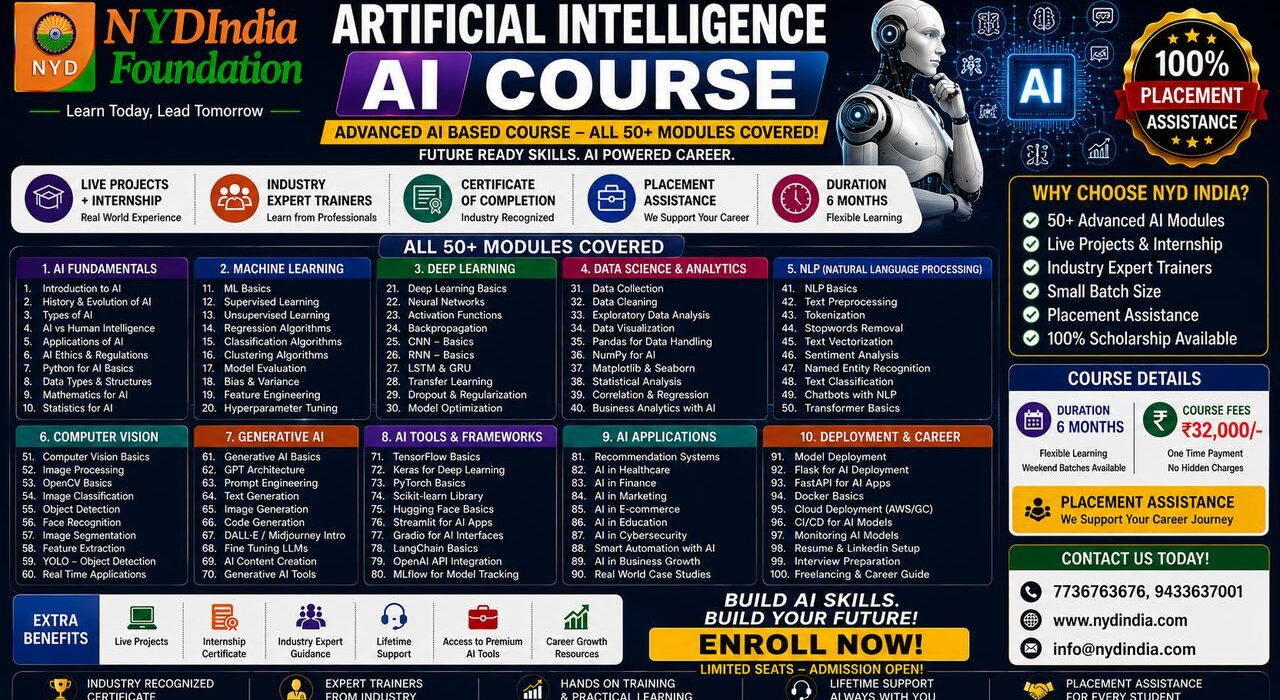
Artificial Intelligence Course by NYD India: Build Job-Ready AI Skills for the Future
Artificial Intelligence is no longer a concept limited to research laboratories or large technology companies. From chatbots and recommendation engines to content creation, business analytics, automation, and software development, AI is becoming part of everyday professional life.
As businesses increasingly adopt AI-based technologies, the demand for professionals who understand how to use and implement AI tools is growing. For students, graduates, working professionals, and career changers, learning Artificial Intelligence can open the door to a wide range of opportunities.
NYD India’s Artificial Intelligence Course is designed for learners who want to develop practical AI skills and understand how modern AI technologies are used in real-world applications. Instead of focusing only on theory, the course aims to give learners exposure to practical concepts, tools, projects, and industry-oriented applications.
Why Learn Artificial Intelligence Today?
Artificial Intelligence is changing the way companies work. Businesses are using AI to automate repetitive tasks, analyze large amounts of information, improve customer experiences, generate content, detect patterns, and support decision-making.
This transformation has created a new category of professionals who can work alongside AI systems and use them effectively.
Learning AI can be valuable if you are interested in:
- Artificial Intelligence and Machine Learning
- Generative AI
- ChatGPT and AI assistants
- AI automation
- Prompt engineering
- Data analysis
- AI-powered content creation
- Business applications of AI
- Software and technology
- Digital transformation
The important point is that AI education is not only for computer science students. With the right learning approach, beginners from different educational and professional backgrounds can start building their understanding of AI.
Artificial Intelligence Course by NYD India
NYD India offers an Artificial Intelligence course aimed at helping learners understand both the fundamentals and practical applications of AI.
The course is structured around an industry-oriented learning approach, allowing students to gradually move from basic concepts toward more advanced AI applications.
Rather than simply memorizing definitions, students can focus on understanding how AI works, where it can be used, and how businesses and professionals can apply AI tools to solve practical problems.
This makes the course relevant for students as well as professionals looking to add AI skills to their existing careers.
What Can You Learn in an AI Course?
A good Artificial Intelligence program should cover more than just the definition of AI. Learners need exposure to different technologies and applications that are shaping the modern AI ecosystem.
Depending on the learning path, important areas can include:
1. Introduction to Artificial Intelligence
The course begins with the fundamentals of AI. Students can learn what Artificial Intelligence means, how AI systems work, and how AI differs from traditional software.
Understanding these fundamentals creates a strong foundation before moving into more advanced concepts.
2. Machine Learning Fundamentals
Machine Learning is one of the most important areas within Artificial Intelligence.
Students can learn basic machine learning concepts, algorithms, data preparation, model training, and the general process used to develop machine learning solutions.
3. Generative AI
Generative AI has become one of the fastest-growing areas of technology.
Learners can explore how AI systems can generate:
- Text
- Images
- Ideas
- Marketing content
- Summaries
- Business documents
- Creative concepts
Understanding Generative AI can help professionals incorporate AI into their daily workflows.
4. Prompt Engineering
Knowing how to communicate effectively with AI systems has become an important modern skill.
Prompt engineering teaches learners how to structure instructions so that AI tools can produce more relevant and useful results.
Students can learn techniques for creating prompts for different professional requirements, including content, research, analysis, productivity, and automation.
5. AI Tools and Applications
The modern AI ecosystem contains hundreds of tools designed for different purposes.
An industry-oriented course can help students understand how AI tools are applied to areas such as:
- Marketing
- Business
- Education
- Content creation
- Research
- Productivity
- Customer support
- Data analysis
- Automation
This practical perspective can be particularly useful for professionals who want to use AI in their existing jobs.
Practical Learning Approach
One of the biggest differences between learning AI from random online resources and following a structured course is the learning process.
Beginners often find Artificial Intelligence confusing because there are so many tools, technologies, and concepts available.
A structured course can provide a clear progression:
Fundamentals → Tools → Practical Applications → Projects → Industry Skills
NYD India focuses on an application-oriented learning approach so that students can move beyond theoretical knowledge and understand how AI skills can be used in practical situations.
Why Practical Projects Matter
Reading about Artificial Intelligence is one thing. Building or working on an AI-based project is completely different.
Projects allow learners to understand how concepts work in realistic scenarios.
For example, an AI learner could work on projects involving:
- AI content generation
- Chatbot concepts
- Data analysis
- AI automation
- Prompt-based applications
- AI-powered business solutions
- Machine learning use cases
Project-based learning can also help students develop material that demonstrates their skills during interviews.
Who Should Join an Artificial Intelligence Course?
An AI course can be useful for a wide range of learners.
Students
Students who want to enter the technology industry can begin developing AI knowledge alongside their academic education.
Fresh Graduates
Graduates can use AI skills to differentiate themselves when applying for entry-level technology and business roles.
Working Professionals
Professionals can learn AI to improve productivity and introduce AI-based solutions into their existing work.
Entrepreneurs
Business owners can understand how AI can be used for automation, customer service, marketing, research, and business operations.
Digital Marketers
AI is transforming digital marketing. Marketers can use AI for content planning, keyword research, campaign ideas, customer analysis, and workflow automation.
Career Changers
People considering a career transition into technology can use an AI course as a starting point for developing relevant skills.
Career Opportunities After Learning AI
Artificial Intelligence is connected to several technology and business roles. Depending on a learner’s background, specialization, and additional skills, possible career directions include:
- AI Specialist
- AI/ML Associate
- Machine Learning Professional
- Prompt Engineer
- Generative AI Specialist
- AI Automation Specialist
- Data Analyst
- AI Content Specialist
- AI Consultant
- Business AI Specialist
- AI Product Support Professional
It’s important to remember that completing a course alone does not guarantee a particular job title or salary. Career outcomes depend on skills, projects, experience, interview performance, and the requirements of individual employers.
Why Choose NYD India for an Artificial Intelligence Course?
Choosing an institute is an important decision because the quality of learning can influence how effectively you build your skills.
NYD India’s AI program can be considered by learners looking for a structured and practical learning environment.
Some of the factors learners may consider include:
Industry-Oriented Curriculum:
The course focuses on concepts and applications relevant to today’s AI ecosystem.
Practical Exposure:
Learners can focus on applying AI concepts instead of limiting their learning to classroom theory.
Project-Based Learning:
Practical projects can help students understand how AI concepts translate into real-world solutions.
Beginner-Friendly Learning:
A structured approach can make complex AI concepts easier to understand for newcomers.
Career-Focused Skills:
The curriculum is designed to help learners develop skills that can be useful in today’s technology-driven workplace.
Artificial Intelligence Is More Than Just a Technical Skill
One of the biggest misconceptions about AI is that it is useful only for programmers.
Today, AI is influencing almost every industry.
A marketing professional can use AI for campaign research. A business owner can use AI for customer support. A content creator can use AI during ideation. A developer can use AI to improve productivity. A data professional can use AI for analysis.
This means AI literacy is becoming a valuable professional advantage across multiple fields.
How to Start Your AI Learning Journey
If you are completely new to Artificial Intelligence, don’t worry about learning everything at once.
Start with the basics.
Understand what AI is, learn how modern AI systems are used, experiment with popular AI tools, and gradually move toward more advanced concepts.
Most importantly, practice regularly.
A simple project that you actually understand can be more valuable than completing dozens of tutorials without applying what you have learned.
Final Thoughts
Artificial Intelligence is reshaping industries, workplaces, and professional skills. As organizations continue exploring AI-powered solutions, professionals who understand how to work with these technologies can position themselves for new opportunities.
NYD India’s Artificial Intelligence Course provides a structured pathway for learners who want to explore AI, Generative AI, machine learning concepts, prompt engineering, AI tools, and practical applications.
Whether you are a student, graduate, working professional, entrepreneur, marketer, or someone planning a career change, developing AI skills today can be a meaningful investment in your professional future.
The best time to start learning AI is not when every technology becomes familiar. It is when you decide to start experimenting, practicing, and building your skills.
Frequently Asked Questions
Q1. Is an Artificial Intelligence course suitable for beginners?
Yes. Beginners can start with fundamental AI concepts and gradually progress toward more advanced topics.
Q2. Do I need programming knowledge to learn AI?
Not necessarily. Many AI applications, particularly Generative AI and AI tools, can be explored without advanced programming. Programming becomes more important for technical AI and machine learning roles.
Q3. What can I do after completing an AI course?
You can explore different AI-related career paths depending on your skills and specialization, including AI tools, Generative AI, automation, data, machine learning, and AI-support roles.
Q4. Is Artificial Intelligence a good career option?
AI is an expanding technology field with applications across many industries. However, career growth depends on continuously developing practical skills and keeping up with changing technologies.
Q5. Why choose NYD India for Artificial Intelligence training?
NYD India focuses on structured, practical, and industry-oriented AI learning, helping students understand both AI concepts and their real-world applications.
Understanding the Future of Artificial Intelligence
Artificial Intelligence is moving from being an emerging technology to becoming an important part of modern business. Companies are increasingly looking at AI not simply as a technology experiment, but as a practical way to improve productivity, reduce repetitive work, understand customers, and create better products and services.
This change is creating opportunities for people who know how to work with AI.
The future of AI will not necessarily belong only to people who build complex algorithms. It will also create opportunities for professionals who understand how to apply AI to real business problems.
That is why learning Artificial Intelligence from a practical perspective can be valuable.
AI and the Changing Job Market
The workplace is changing rapidly. Many routine activities that once required considerable manual effort can now be supported by AI-powered tools.
For example, professionals can use AI to:
- Summarize lengthy documents
- Analyze information
- Generate initial content drafts
- Automate repetitive processes
- Create reports
- Assist with research
- Generate ideas
- Improve customer communication
- Support business decisions
- Organize large amounts of information
This does not mean that every job will disappear. Instead, many roles are evolving.
Professionals who know how to combine their existing expertise with AI tools may be able to work more efficiently and take on new responsibilities.
For students and fresh graduates, this creates another reason to start developing AI literacy early.
Why AI Skills Can Give Students an Advantage
Students entering the job market today are competing in an environment where employers increasingly value practical skills.
A degree can provide an academic foundation, but additional technology skills can help candidates demonstrate what they can actually do.
Learning Artificial Intelligence can help students develop:
- Problem-solving ability
- Technology awareness
- Analytical thinking
- Practical project experience
- AI tool knowledge
- Automation skills
- Research skills
- Digital productivity
When these skills are combined with communication and domain knowledge, students can create a stronger professional profile.
AI for Working Professionals
Artificial Intelligence is not only useful for people planning a career in technology.
A working professional can learn AI to improve their existing role.
For example, a marketing professional can use AI for campaign ideas and content planning. A sales professional can use AI to organize customer information and prepare communication. An HR professional can use AI for documentation and workflow support. A business owner can explore AI automation for repetitive operational tasks.
This makes AI learning particularly interesting for professionals who don’t necessarily want to change their career but want to become more productive.
Generative AI: A Major Part of Modern AI Learning
Generative AI has changed the way people interact with Artificial Intelligence.
Traditional software generally follows predefined instructions. Generative AI systems can create new outputs based on the instructions and information provided to them.
This has made AI accessible to a much larger audience.
People without advanced technical backgrounds can now interact with AI tools using natural language.
Generative AI can support tasks such as:
- Writing
- Brainstorming
- Research
- Summarization
- Image generation
- Presentation creation
- Data interpretation
- Coding assistance
- Business communication
Understanding how to use these systems effectively is becoming an important workplace skill.
The Importance of Prompt Engineering
One of the most useful skills within Generative AI is prompt engineering.
A simple instruction may produce a basic answer, while a well-structured prompt can provide a much more useful result.
Effective prompting generally involves understanding:
- The objective
- Context
- Desired format
- Audience
- Constraints
- Examples
- Expected output
Students can practice creating prompts for different professional situations rather than simply using AI for casual questions.
This practical approach can make prompt engineering more useful in real workplace environments.
AI Automation and Productivity
Another important area of AI education is automation.
Businesses perform many repetitive tasks every day. When these workflows are properly designed, AI and automation tools can help reduce manual effort.
Examples include:
- Automated customer responses
- Lead qualification
- Content workflows
- Data processing
- Report generation
- Email assistance
- Document processing
- Task management
Learning how AI can connect with business workflows gives students a broader understanding of the technology.
Instead of asking only, “What can AI generate?”, learners can begin asking a more valuable question:
“What process can AI improve?”
That shift in thinking is important for anyone who wants to use AI professionally.
Building a Portfolio During AI Training
A strong AI portfolio can help learners demonstrate their practical knowledge.
Instead of simply listing “Artificial Intelligence” on a resume, students can showcase projects that demonstrate how they have used AI.
A portfolio could include projects such as:
AI Chatbot Concept
Create a basic chatbot concept designed to answer frequently asked questions for a business or educational organization.
AI Content Workflow
Develop a workflow showing how AI can support content research, planning, drafting, editing, and optimization.
AI Business Assistant
Create a conceptual AI assistant that helps organize information, generate summaries, or support routine business tasks.
AI Data Analysis Project
Work with a dataset and explore how AI or machine learning techniques can help identify patterns and insights.
Prompt Engineering Portfolio
Create a collection of well-designed prompts for marketing, research, business, productivity, and creative applications.
Projects like these can provide useful talking points during interviews.
How NYD India Can Help Learners Build Practical Knowledge
For many beginners, one of the biggest challenges is knowing where to start.
There are countless AI tools, tutorials, videos, courses, and online resources available. Without a structured learning path, students can easily jump between topics without developing a strong foundation.
NYD India’s Artificial Intelligence Course is positioned around a structured learning experience where students can explore important AI concepts and applications in a progressive manner.
The goal should not simply be to collect certificates. The real objective of AI training should be to develop skills that can actually be applied.
Learning AI Through Real-World Examples
Artificial Intelligence becomes easier to understand when concepts are connected to situations people already know.
For example, recommendation systems can explain how AI helps platforms suggest content or products.
Chatbots demonstrate how AI can support customer service.
Image-generation tools show how Generative AI can assist creative professionals.
Predictive analytics demonstrates how data can be used to identify potential trends.
Automation shows how AI can reduce repetitive work.
These examples make abstract AI concepts easier to understand and remember.
What Makes a Good Artificial Intelligence Institute?
Before choosing an AI training institute, students should look beyond advertisements and compare the actual learning experience.
Consider questions such as:
- Is the curriculum regularly updated?
- Does the course include practical learning?
- Are real-world applications discussed?
- Are projects included?
- Is the course suitable for beginners?
- Does the institute provide trainer guidance?
- Can students practice the concepts?
- Does the institute offer career-oriented support?
- Are the tools and technologies being taught relevant?
These questions can help students make a more informed decision.
Artificial Intelligence Course in Kolkata
For students and professionals in Kolkata, learning Artificial Intelligence locally can provide the advantage of structured classroom or institute-based training while still allowing learners to explore modern AI technologies.
NYD India is one option for learners searching for an Artificial Intelligence course in Kolkata with a practical and career-oriented approach.
The growing use of AI across marketing, technology, finance, education, e-commerce, healthcare, and business operations means that AI skills can be relevant across multiple sectors.
AI Skills Combined With Other Career Skills
Artificial Intelligence does not have to replace your existing skill set.
In many cases, the strongest combination is:
Existing Professional Skill + AI Knowledge = Greater Practical Value
For example:
Digital Marketing + AI
Can support faster content research, campaign planning, analysis, and automation.
Data Analysis + AI
Can improve how professionals explore datasets and identify patterns.
Business + AI
Can help entrepreneurs understand automation and AI-powered workflows.
Software Development + AI
Can help developers work with AI-assisted development and intelligent applications.
Content Creation + AI
Can support ideation, research, drafting, editing, and creative workflows.
This is why AI education can be useful even when it is not your primary career field.
How to Become Successful in AI
Completing an Artificial Intelligence course is only the beginning.
Technology changes quickly, so successful AI learners should continue experimenting and updating their knowledge.
A practical learning strategy can include:
Step 1: Understand the fundamentals
Learn the basic concepts behind AI, machine learning, and Generative AI.
Step 2: Experiment with AI tools
Use different tools and understand what each one does well.
Step 3: Practice prompting
Learn how to communicate clearly with AI systems.
Step 4: Work on projects
Build practical examples instead of relying only on theoretical learning.
Step 5: Develop a portfolio
Document your best projects and experiments.
Step 6: Keep learning
Follow new developments and experiment with emerging technologies.
Step 7: Combine AI with your existing skills
Look for ways to apply AI to the career field you already understand.
Is an Artificial Intelligence Course Worth It?
For someone genuinely interested in technology and willing to practice, an AI course can be a worthwhile learning investment.
However, expectations should be realistic.
AI is a broad field. Watching a few videos or completing a short course does not automatically make someone an AI expert.
Real progress comes from a combination of:
- Structured learning
- Regular practice
- Problem-solving
- Project experience
- Curiosity
- Continuous learning
The value of a course ultimately depends on how effectively the learner applies what they learn.
Final Takeaway
Artificial Intelligence is changing the professional world, and its influence is expected to continue expanding across industries.
For students, graduates, professionals, entrepreneurs, and career changers, developing practical AI knowledge can provide a valuable addition to their existing skill set.
NYD India’s Artificial Intelligence Course offers learners an opportunity to explore AI fundamentals, Generative AI, machine learning concepts, prompt engineering, AI tools, automation, and practical applications through a structured learning path.
If your goal is to understand AI rather than simply follow the latest trend, focus on learning the fundamentals, practicing with real tools, building projects, and understanding how AI can solve real problems.
The future of Artificial Intelligence is not just about machines becoming smarter. It is also about people learning how to work smarter with intelligent technology.