
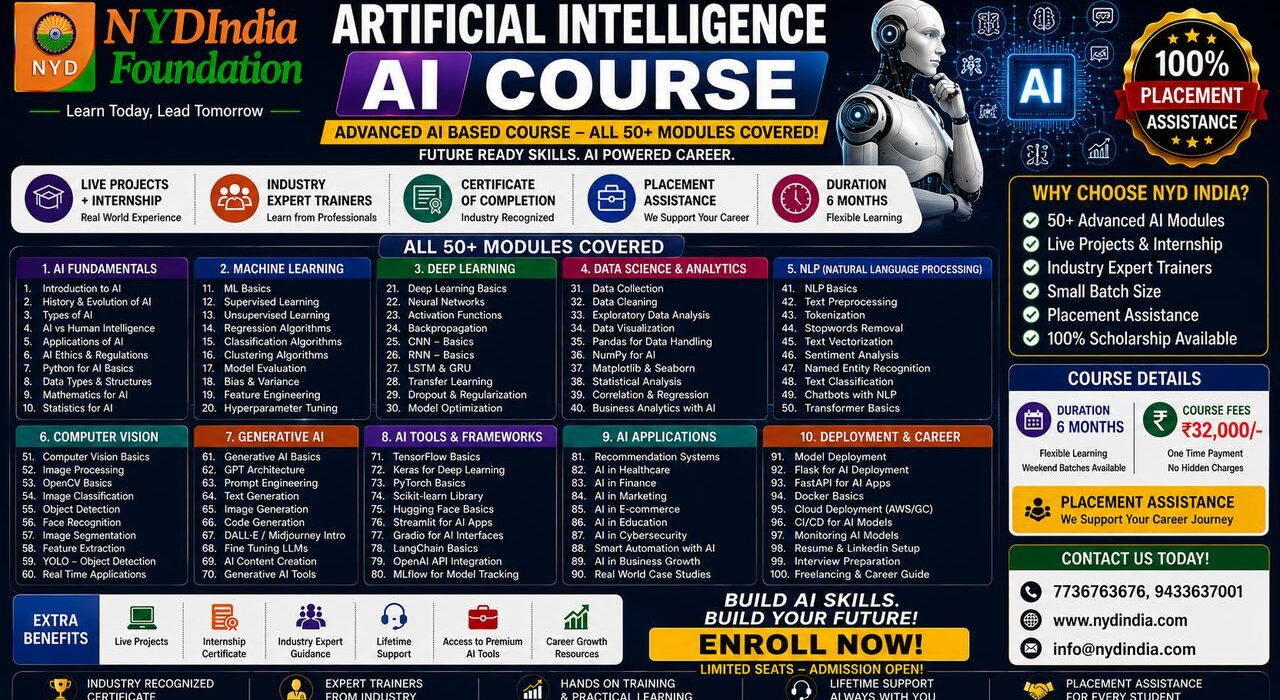
Artificial Intelligence Course by NYD India: Build the Skills for Tomorrow’s Technology
Artificial Intelligence (AI) is no longer a concept limited to science-fiction movies or research laboratories. From chatbots and recommendation systems to self-driving technologies, healthcare applications, automation, and business analytics, AI is becoming part of everyday life.
As companies increasingly adopt AI-powered solutions, the demand for professionals who understand artificial intelligence, machine learning, data analysis, and modern AI tools is growing rapidly. For students, graduates, working professionals, and technology enthusiasts, learning AI can be an important step toward building a future-ready career.
NYD India offers an industry-oriented Artificial Intelligence Course designed to help learners understand the fundamentals of AI and develop practical skills through structured learning, projects, and hands-on training.
What Is Artificial Intelligence?
Artificial Intelligence refers to the technology that enables computers and machines to perform tasks that traditionally require human intelligence.
These tasks can include:
- Understanding natural language
- Recognising images and patterns
- Analysing large amounts of data
- Making predictions
- Automating repetitive processes
- Generating text, images, and other content
- Learning from historical data
- Supporting business decision-making
AI is now being used across industries such as finance, healthcare, education, e-commerce, marketing, manufacturing, transportation, and entertainment.
For someone starting a technology career today, understanding AI can provide a valuable advantage.
Why Learn Artificial Intelligence?
The technology landscape is changing quickly. Businesses are not simply using computers to store information anymore; they are increasingly using intelligent systems to analyse information, automate processes, and assist employees.
Learning artificial intelligence can help students and professionals understand how these systems work and how they can be applied to real-world problems.
An AI course can be particularly useful if you want to:
- Build a career in emerging technology
- Understand machine learning concepts
- Work with AI tools and applications
- Develop practical technology projects
- Improve your programming and analytical skills
- Explore data-driven careers
- Add AI knowledge to your existing profession
- Prepare for future technology opportunities
The biggest advantage of learning AI is not just knowing the terminology. It is learning how to use AI concepts to solve practical problems.
Artificial Intelligence Course by NYD India
NYD India’s Artificial Intelligence Course focuses on combining theoretical knowledge with practical learning. The course is designed for learners who want to develop an understanding of AI while working with modern technologies and real-world applications.
Instead of treating AI as a purely theoretical subject, practical training can help learners understand how different concepts are applied to actual projects.
The learning journey can cover important areas of artificial intelligence, programming, machine learning, data handling, AI tools, and project development.
Key Areas Covered in Artificial Intelligence Training
A comprehensive AI learning programme can introduce students to several important concepts.
1. Introduction to Artificial Intelligence
Students begin by understanding the fundamentals of AI, its history, applications, and role in modern businesses.
This foundation makes it easier to understand more advanced AI technologies later in the course.
2. Python for Artificial Intelligence
Python is widely used in AI and machine learning because of its simple syntax and extensive ecosystem of libraries.
Students can learn programming fundamentals and understand how Python can be used for data processing, automation, machine learning, and AI development.
3. Machine Learning
Machine learning is one of the most important areas within artificial intelligence.
Students can learn how machines use data to identify patterns and make predictions. Topics may include supervised learning, unsupervised learning, classification, regression, clustering, and model evaluation.
4. Data Handling and Analysis
AI systems depend heavily on data.
Understanding how to collect, clean, organise, analyse, and interpret data is therefore an important part of AI education.
Students can learn how data preparation affects the performance of machine learning models.
5. Deep Learning
Deep learning uses neural networks to solve complex problems involving large datasets.
It has applications in areas such as image recognition, speech processing, natural language processing, and recommendation systems.
6. Natural Language Processing
Natural Language Processing, or NLP, focuses on enabling computers to work with human language.
Chatbots, virtual assistants, translation systems, sentiment analysis, and text-generation applications are examples of NLP technologies.
7. Generative AI
Generative AI has become one of the most widely discussed developments in modern technology.
It can generate text, images, code, audio, and other forms of content based on user instructions.
Understanding generative AI can help learners explore how modern AI applications are created and used in businesses.
8. AI Tools and Automation
Modern professionals increasingly use AI tools to automate repetitive tasks, analyse information, generate content, and improve productivity.
Learning how to use these tools responsibly can be valuable across technical and non-technical careers.
Why Choose NYD India for an AI Course?
Choosing an AI training institute is an important decision. A good learning environment should provide more than classroom theory.
NYD India focuses on practical, career-oriented learning to help students develop relevant technical skills.
Some of the factors learners may consider when choosing NYD India include:
Practical Learning
AI becomes easier to understand when learners can apply concepts through exercises and projects. Practical assignments can help students connect classroom concepts with real-world applications.
Industry-Relevant Curriculum
The AI field evolves continuously. Training should therefore focus on technologies and concepts that are relevant to the current digital environment.
Project-Based Experience
Working on projects gives students an opportunity to practise what they have learned. It can also help them create a portfolio that demonstrates their skills.
Beginner-Friendly Learning
AI can appear complicated when you first encounter terms such as neural networks, algorithms, datasets, and machine learning.
A structured learning approach can make these concepts easier to understand, even for learners who are starting from the basics.
Career-Oriented Approach
AI skills can be applied across multiple industries. A career-focused course can help students understand how their technical knowledge can translate into practical job roles and professional opportunities.
Who Can Join an Artificial Intelligence Course?
AI is not limited to computer science graduates.
Depending on the course requirements, an AI programme can be suitable for:
- Students
- Graduates
- Working professionals
- Software enthusiasts
- Data enthusiasts
- Entrepreneurs
- Digital professionals
- Career switchers
- Technology enthusiasts
Students who are comfortable with basic mathematics and programming may find advanced AI topics easier to understand, but beginners can also start by learning the fundamentals step by step.
Career Opportunities After Learning AI
Artificial Intelligence is influencing job roles across the technology sector and beyond.
After developing appropriate skills and practical experience, learners can explore career paths such as:
- AI Developer
- Machine Learning Engineer
- Data Analyst
- AI Engineer
- Python Developer
- Machine Learning Analyst
- NLP Engineer
- Computer Vision Engineer
- Data Scientist
- AI Automation Specialist
The exact job role and salary will depend on factors such as skills, qualifications, experience, location, portfolio quality, and employer requirements.
AI Skills Can Benefit Non-Technical Professionals Too
One of the interesting developments in AI is that its applications are no longer restricted to software development.
Marketing professionals can use AI for research, content planning, customer analysis, and automation.
Business owners can use AI to analyse information and streamline workflows.
Designers can work with generative AI tools to accelerate creative processes.
Teachers and educators can use AI-assisted tools for research and learning resources.
This makes AI knowledge useful even for professionals who do not plan to become machine learning engineers.
Build a Practical AI Portfolio
Completing a course is only one part of becoming an AI professional. Building projects is equally important.
A strong portfolio can demonstrate how you apply your knowledge to practical problems.
Possible beginner and intermediate AI projects include:
- AI chatbot
- Recommendation system
- Sentiment analysis application
- Image classification model
- Customer prediction system
- AI content assistant
- Data analysis dashboard
- Text classification project
- AI-powered automation workflow
Projects can help learners understand the complete development process—from identifying a problem to preparing data, developing a solution, testing it, and presenting the final result.
The Future of Artificial Intelligence
AI is expected to continue influencing how businesses operate and how professionals work.
The future is unlikely to be simply about humans versus machines. Instead, many workplaces will involve people working alongside AI systems to complete tasks faster, analyse information more effectively, and make better-informed decisions.
This is why developing AI literacy is becoming increasingly valuable.
Learning AI today can help students understand the technology behind many of the tools that will shape tomorrow’s workplace.
Why Start Learning AI Today?
Technology changes quickly. Skills that were considered specialised a few years ago are becoming increasingly relevant across industries.
Learning artificial intelligence now gives learners the opportunity to understand one of the most important technology trends shaping the modern economy.
However, learning AI should not be about simply following a trend. The real value comes from developing a solid understanding of the technology and learning how to apply it.
With the right training, consistent practice, and project experience, learners can gradually build the confidence required to work with AI technologies.
Start Your Artificial Intelligence Learning Journey with NYD India
Artificial Intelligence is changing the way companies develop products, analyse information, communicate with customers, and automate everyday operations.
For students and professionals looking to develop future-ready technology skills, an Artificial Intelligence Course by NYD India can provide a structured path to explore AI concepts, tools, programming, machine learning, and practical applications.
The most important step is to start learning, practise consistently, work on projects, and keep updating your knowledge as the technology evolves.
If you are looking for an Artificial Intelligence course that combines structured learning with practical exposure, explore the AI training programme offered by NYD India and take the next step toward becoming future-ready.
Artificial Intelligence Course by NYD India: A Practical Path to a Future-Ready Career
Artificial Intelligence is rapidly becoming one of the most influential technologies in the modern world. What once seemed like futuristic technology is now being used in smartphones, search engines, banking systems, healthcare platforms, online shopping, automobiles, education, marketing, and almost every major digital industry.
For students and professionals, this transformation creates a major opportunity. Companies need people who can understand AI, work with intelligent tools, analyse data, develop machine learning solutions, and apply automation to real business problems.
This is where professional AI training can make a difference.
NYD India’s Artificial Intelligence Course is designed for learners who want to understand the fundamentals of AI and develop practical knowledge of modern artificial intelligence technologies. The course can help students move from simply using AI tools to understanding the concepts and technologies behind them.
Artificial Intelligence Is Changing the Way We Work
Think about how people interact with technology today.
A customer can ask an AI chatbot a question and receive an instant response. A shopping platform can recommend products based on previous activity. A bank can use intelligent systems to identify unusual transactions. A hospital can use data-driven technologies to assist medical professionals. Businesses can automate repetitive processes that previously required hours of manual work.
These are not isolated examples. AI is becoming part of everyday business operations.
As adoption increases, organisations need professionals who understand how AI systems work and how they can be integrated into practical workflows.
This makes Artificial Intelligence training an increasingly valuable skill-development option.
What Makes AI Different from Traditional Software?
Traditional software generally follows instructions programmed by developers.
Artificial intelligence can go a step further by using data, algorithms, and models to identify patterns, generate results, make predictions, or assist with decision-making.
For example, a traditional programme might follow a fixed rule:
If a particular condition occurs, perform a specific action.
A machine learning system, on the other hand, can learn patterns from historical examples and use those patterns to make predictions about new data.
This fundamental difference is one reason AI has such a wide range of applications.
What Students Can Learn in an AI Course
A professional Artificial Intelligence course should not focus only on definitions. Students need to understand how different technologies connect with one another.
A structured AI programme can introduce learners to:
Artificial Intelligence Fundamentals
Students can understand what AI is, how AI systems are developed, major AI applications, and the difference between artificial intelligence, machine learning, and deep learning.
Programming with Python
Python is an important programming language in the AI ecosystem. Learners can develop programming fundamentals and understand how Python is used for data processing, automation, machine learning, and AI applications.
Machine Learning Algorithms
Machine learning allows systems to identify patterns from data.
Students can explore concepts such as:
- Supervised learning
- Unsupervised learning
- Classification
- Regression
- Clustering
- Feature selection
- Model evaluation
- Prediction
Neural Networks
Neural networks are inspired by the way biological nervous systems process information.
They are widely used in modern AI applications, including image recognition, speech processing, and natural language applications.
Deep Learning
Deep learning uses multi-layered neural networks to process complex datasets.
Students can learn the basic principles behind deep learning and explore its practical applications.
Natural Language Processing
NLP allows computers to process and understand human language.
It is used in:
- Chatbots
- Virtual assistants
- Translation
- Text analysis
- Sentiment analysis
- Search systems
- AI content applications
Generative AI
Generative AI has introduced a new generation of intelligent applications capable of producing text, images, code, audio, and other content.
Learning how generative AI works and understanding effective AI interaction can help professionals use these technologies more productively.
AI and Machine Learning: What Is the Difference?
Many beginners use the terms Artificial Intelligence and Machine Learning interchangeably, but they are not exactly the same.
Artificial Intelligence is the broader concept of creating systems capable of performing tasks associated with human intelligence.
Machine Learning is a branch of AI where systems learn patterns from data and use those patterns to make predictions or decisions.
Deep Learning is a specialised area of machine learning that uses neural networks with multiple layers.
A simple way to understand the relationship is:
Artificial Intelligence → Machine Learning → Deep Learning
Understanding this relationship is an important foundation for anyone beginning an AI course.
The Importance of Generative AI
Generative AI has changed the way many people think about artificial intelligence.
Earlier AI applications often focused on prediction, classification, recommendation, or automation.
Generative AI introduced powerful systems capable of creating new content.
For example, generative AI can assist with:
- Text generation
- Image generation
- Code generation
- Data summarisation
- Brainstorming
- Document analysis
- Customer support
- Content creation
- Workflow automation
However, using AI effectively requires more than simply entering a prompt.
Professionals need to understand how to evaluate AI outputs, verify information, protect sensitive data, and integrate AI into workflows responsibly.
This is why modern AI education should include practical exposure to generative AI.
Practical Projects: Turning Knowledge into Experience
One of the biggest challenges beginners face is understanding how theoretical concepts translate into real applications.
Projects help solve this problem.
Instead of only reading about machine learning, learners can work on projects where they have to:
- Identify a problem.
- Collect or prepare data.
- Analyse the information.
- Select an appropriate approach.
- Train or configure a model.
- Test the results.
- Improve the solution.
- Present the final project.
This process provides valuable practical experience.
Examples of AI Projects
Students can explore projects such as:
AI Chatbot
Create a conversational application capable of answering predefined or knowledge-based questions.
Customer Sentiment Analysis
Analyse customer reviews and identify whether the overall sentiment is positive, negative, or neutral.
Recommendation System
Develop a basic system that recommends products, movies, courses, or other content based on user behaviour or preferences.
Image Classification
Train a model to classify images into predefined categories.
Sales Prediction
Use historical data to develop a model that predicts potential future outcomes.
AI-Powered Content Assistant
Create a workflow that uses AI to assist with content generation, summarisation, or research.
These projects can also become useful portfolio pieces when applying for internships or entry-level roles.
Artificial Intelligence for Business
AI is not only a technology for software companies.
Businesses in almost every sector can benefit from intelligent automation and data-driven decision-making.
E-commerce
AI can help businesses understand customer behaviour, recommend products, personalise experiences, and analyse purchasing patterns.
Banking and Finance
Financial institutions can use AI for fraud detection, risk analysis, customer support, and data processing.
Healthcare
AI technologies can support research, medical data analysis, administrative automation, and various decision-support applications.
Education
AI can assist with personalised learning, content creation, student support, and administrative workflows.
Marketing
Marketing teams can use AI for research, customer segmentation, content assistance, campaign analysis, and automation.
Manufacturing
AI can be used for predictive maintenance, quality control, process optimisation, and production analytics.
Understanding these applications helps students see that AI skills can be relevant far beyond traditional software development.
Who Should Consider Learning Artificial Intelligence?
An AI course can be valuable for a wide range of learners.
Students
Students can start developing technology skills before entering the professional world.
Graduates
Graduates can add AI knowledge to their existing academic qualifications and explore emerging career paths.
Working Professionals
Professionals can learn how AI may be applied to their current industry and improve their productivity.
Entrepreneurs
Business owners can understand how AI and automation can improve business processes.
Digital Professionals
Marketing, content, design, sales, and other digital professionals can use AI to enhance existing workflows.
Career Switchers
People interested in moving into technology can use structured training as a starting point for developing relevant skills.
Skills You Can Develop Through AI Training
A good AI learning programme can help develop both technical and problem-solving abilities.
Important skills may include:
- Python programming
- Data analysis
- Machine learning
- Model evaluation
- AI automation
- Natural language processing
- Generative AI
- Problem solving
- Analytical thinking
- Project development
- Technical documentation
- AI tool usage
These skills can complement existing qualifications and help learners build a stronger professional profile.
Why Practical AI Training Matters
There is a significant difference between watching AI tutorials and actually building something.
A tutorial may explain how a machine learning algorithm works. A project forces you to think about the data, the problem, the expected output, the limitations, and the final result.
That practical experience can be extremely valuable.
At NYD India, the focus on practical learning can help students move beyond textbook concepts and gain exposure to real-world applications of AI.
Build Your AI Career Step by Step
Becoming an AI professional does not happen overnight.
A practical learning journey can look like this:
Step 1: Learn the Fundamentals
Start with AI terminology, concepts, applications, and basic programming.
Step 2: Develop Python Skills
Learn the programming fundamentals required for AI and data-related tasks.
Step 3: Understand Data
Learn how data is collected, cleaned, analysed, and prepared.
Step 4: Learn Machine Learning
Understand algorithms, training, testing, predictions, and model evaluation.
Step 5: Explore Deep Learning
Move into neural networks and advanced AI concepts.
Step 6: Learn Generative AI
Explore modern AI systems and their applications.
Step 7: Build Projects
Apply your knowledge to practical problems.
Step 8: Create a Portfolio
Document your projects and demonstrate your skills to potential employers or clients.
Step 9: Continue Learning
AI changes rapidly, so continuous learning is an essential part of an AI career.
Artificial Intelligence and the Future of Jobs
There is considerable discussion about how AI will affect employment.
Rather than looking at AI only as a technology that replaces jobs, it is useful to understand how it can transform job responsibilities.
Many professionals may increasingly work alongside AI systems.
For example, a marketer may use AI for research and campaign analysis while focusing on strategy. A developer may use AI-assisted coding tools while concentrating on architecture and problem-solving. A customer service professional may use AI assistance while handling complex customer situations.
This means AI literacy can become an advantage across many professions.
Why Choose NYD India for Artificial Intelligence Training?
Selecting the right institute is an important step before enrolling in an AI programme.
Learners should look for:
- A structured curriculum
- Practical assignments
- Project-based learning
- Experienced trainers
- Industry-relevant topics
- Hands-on technology exposure
- Career guidance
- Opportunities to build a portfolio
NYD India aims to provide learners with a practical learning environment where they can explore artificial intelligence concepts and develop skills relevant to today’s technology-driven workplace.
The goal should not simply be to complete a course. It should be to understand the technology, practise regularly, build projects, and develop the confidence to use AI in practical situations.
Frequently Asked Questions About Artificial Intelligence Course
Is Artificial Intelligence difficult to learn?
AI can seem difficult at first because it involves programming, mathematics, data, and algorithms. However, learning the fundamentals step by step can make the subject much easier to understand.
Do I need programming knowledge to learn AI?
Basic programming knowledge can be helpful, but beginners can start by learning programming fundamentals before moving into advanced AI concepts.
Is Python important for AI?
Yes. Python is one of the most widely used programming languages in artificial intelligence and machine learning because of its extensive libraries and relatively simple syntax.
Can non-technical students learn AI?
Yes, depending on the course structure and entry requirements. Non-technical learners can begin with AI fundamentals and gradually develop programming and data skills.
What projects can AI students build?
Students can work on chatbots, recommendation systems, sentiment analysis, prediction models, image classification systems, automation workflows, and other AI applications.
Is AI a good career option?
AI is an important and rapidly developing technology area. However, career success depends on practical skills, projects, continuous learning, qualifications, and the ability to apply knowledge to real problems.
Final Thoughts
Artificial Intelligence is changing technology, business, and the workplace at an extraordinary pace.
For learners, this creates both a challenge and an opportunity. The challenge is keeping up with rapidly evolving technologies. The opportunity is developing skills that can remain relevant as businesses adopt more AI-powered systems.
An Artificial Intelligence Course by NYD India can provide learners with a structured starting point for exploring AI, machine learning, Python, deep learning, NLP, generative AI, and practical applications.
The real advantage comes from what you do with the knowledge after completing the training.
Learn the concepts. Practise the skills. Build projects. Create a portfolio. Keep learning.
That is how an interest in Artificial Intelligence can gradually become a professional skill set.
Artificial Intelligence Course by NYD India: Learn the Technology Shaping the Future
Artificial Intelligence is no longer something people only hear about in technology conferences or science-fiction films. It is already influencing how businesses operate, how customers interact with brands, how software is developed, and how professionals complete everyday tasks.
From AI-powered search and virtual assistants to recommendation engines, automated customer support, predictive analytics, computer vision, and generative AI, intelligent technologies are becoming increasingly common.
This rapid adoption has created a growing need for people who understand how AI works and, more importantly, how to use it effectively.
For students, graduates, professionals, entrepreneurs, and technology enthusiasts, learning Artificial Intelligence can be a valuable investment in developing future-ready skills.
NYD India’s Artificial Intelligence Course provides learners with an opportunity to explore the foundations and practical applications of AI through structured training and hands-on learning.
Why Artificial Intelligence Skills Are Becoming Important
Technology skills have always evolved with changing business requirements.
A few decades ago, basic computer literacy was considered a valuable professional skill. Later, web development, digital marketing, mobile applications, cloud computing, and data analytics became increasingly important.
Today, Artificial Intelligence is becoming another major skill area.
Companies are exploring AI to:
- Automate repetitive tasks
- Analyse large datasets
- Improve customer experiences
- Generate business insights
- Personalise products and services
- Improve operational efficiency
- Support employees
- Develop new digital products
- Reduce manual workloads
This creates opportunities for professionals who can understand both the technology and its practical applications.
Learn More Than Just AI Tools
There is a difference between using an AI tool and understanding Artificial Intelligence.
Anyone can use an AI application to generate text or analyse information. However, an AI professional needs to understand what happens behind the interface.
A structured AI course can help learners understand:
- How machine learning models work
- How datasets are prepared
- How algorithms identify patterns
- How models are trained and tested
- How predictions are generated
- How AI systems can be evaluated
- How AI applications can be integrated into workflows
- What limitations AI systems have
This deeper understanding can help learners make better decisions when working with AI technology.
Artificial Intelligence Course Curriculum: What to Expect
A comprehensive Artificial Intelligence programme can cover multiple layers of technology.
Module 1: AI Fundamentals
Students can begin by understanding:
- Definition of Artificial Intelligence
- History of AI
- Types of AI
- AI applications
- AI terminology
- Advantages and limitations
- Real-world AI examples
This foundation helps students understand the larger AI ecosystem.
Module 2: Python Programming
Python is an important part of modern AI development.
Students can learn:
- Variables
- Data types
- Operators
- Conditional statements
- Loops
- Functions
- Lists
- Dictionaries
- Object-oriented concepts
- File handling
- Libraries
These programming fundamentals can later be applied to machine learning and AI projects.
Module 3: Data Science Fundamentals
Data is the foundation of many AI systems.
Students can learn how to:
- Collect data
- Clean data
- Organise datasets
- Identify patterns
- Handle missing values
- Visualise information
- Interpret results
Understanding data makes it easier to understand machine learning.
Module 4: Machine Learning
Machine learning is one of the central areas of AI.
Students can explore:
- Supervised learning
- Unsupervised learning
- Regression
- Classification
- Clustering
- Model training
- Model testing
- Performance evaluation
Practical examples can make these concepts easier to understand.
Module 5: Deep Learning
Deep learning represents an advanced area of machine learning.
Learners can explore:
- Neural networks
- Training concepts
- Layers
- Activation functions
- Image-related applications
- Pattern recognition
- Deep learning use cases
Module 6: Natural Language Processing
NLP allows machines to work with human language.
Students can explore how AI is used for:
- Text classification
- Sentiment analysis
- Chatbots
- Language processing
- Document analysis
- Text summarisation
Module 7: Computer Vision
Computer vision allows machines to interpret visual information.
Applications include:
- Image classification
- Object detection
- Facial recognition
- Image analysis
- Quality inspection
- Visual search
Module 8: Generative AI
Modern AI training increasingly includes generative technologies.
Students can explore how AI can be used to generate:
- Text
- Images
- Code
- Presentations
- Summaries
- Ideas
- Other digital content
The course can also introduce practical applications of generative AI in professional workflows.
AI Prompting and Professional Productivity
One emerging skill associated with generative AI is effective prompting.
A useful AI prompt should provide sufficient context, explain the expected outcome, and communicate relevant constraints.
For example, instead of asking:
“Write an article about marketing.”
a more useful instruction might specify the target audience, subject, purpose, length, keywords, and desired structure.
Learning how to communicate effectively with AI systems can improve productivity across many professions.
However, prompting is only one part of AI literacy. Professionals should also learn to review AI-generated information rather than accepting every output without verification.
AI Automation: Turning Repetitive Tasks into Workflows
One of the strongest business applications of AI is automation.
Many organisations perform repetitive tasks every day:
- Sorting information
- Responding to common questions
- Creating reports
- Summarising documents
- Processing customer requests
- Organising data
- Generating routine content
AI can assist with some of these activities.
The goal is not necessarily to automate everything. Instead, businesses can identify repetitive tasks where intelligent automation can save time while allowing people to focus on higher-value activities.
Understanding this concept can be particularly useful for entrepreneurs and professionals.
Artificial Intelligence for Digital Marketing
AI is having a major impact on digital marketing.
Marketing professionals can use AI to assist with:
Keyword Research
AI can help organise large amounts of search-related information and identify potential content topics.
Content Planning
Marketers can use AI to brainstorm ideas, create outlines, and develop content strategies.
Customer Analysis
AI can help identify behavioural patterns within customer data.
Personalisation
Businesses can use intelligent systems to deliver more relevant recommendations and messages.
Campaign Analysis
AI-assisted analytics can help marketers identify trends and performance patterns.
Marketing Automation
AI can support repetitive marketing workflows and customer communication.
This makes AI knowledge particularly useful for digital professionals.
Artificial Intelligence for Small Businesses
AI is not only relevant to large corporations.
Small businesses can also use AI to improve efficiency.
For example, a small business may use AI to:
- Draft customer responses
- Analyse sales information
- Generate marketing ideas
- Summarise documents
- Organise information
- Assist with social media content
- Automate routine administrative tasks
The key is choosing practical applications that solve genuine business problems.
AI and Entrepreneurship
Entrepreneurs can benefit from understanding AI even if they do not become AI developers.
An entrepreneur who understands AI can identify opportunities to:
- Build AI-powered products
- Improve business workflows
- Automate repetitive processes
- Analyse customer behaviour
- Create personalised experiences
- Develop technology-driven services
AI knowledge can therefore contribute to both technical and business innovation.
AI Portfolio: Why Projects Matter
A certificate can demonstrate that you completed a course, but a portfolio can demonstrate what you can actually do.
For aspiring AI professionals, building projects is therefore highly valuable.
A portfolio might include:
Project 1: Customer Support Chatbot
A chatbot that answers frequently asked customer questions.
Project 2: Sentiment Analysis
A system that analyses customer reviews and categorises their sentiment.
Project 3: Recommendation Engine
A basic recommendation system for products, movies, books, or courses.
Project 4: Sales Forecasting
A machine learning project that uses historical data to estimate future sales.
Project 5: Image Recognition
A computer vision project that classifies images.
Project 6: AI Content Assistant
An application or workflow that helps users summarise, organise, or generate content.
These projects can demonstrate problem-solving ability and practical understanding.
From Classroom Learning to Career Preparation
Learning AI should be viewed as a journey rather than a single event.
A student may begin with no technical knowledge and gradually progress through several stages.
Beginner → Programmer → Data Learner → Machine Learning Student → AI Project Developer → Job-Ready Professional
Each stage requires practice.
Students should spend time experimenting with code, analysing datasets, building small projects, learning from errors, and exploring new technologies.
Consistency often matters more than trying to learn everything at once.
Career Paths After Artificial Intelligence Training
Artificial Intelligence can connect to a variety of technology careers.
Depending on qualifications and practical skills, learners may explore roles such as:
AI Developer
Works on developing and integrating AI-powered applications.
Machine Learning Engineer
Works with machine learning models, data, algorithms, and deployment processes.
Data Analyst
Analyses data to identify useful patterns and business insights.
Data Scientist
Works with advanced statistical analysis, machine learning, and data-driven problem solving.
NLP Specialist
Works on applications involving language and text processing.
Computer Vision Specialist
Works with AI systems that process images and visual information.
AI Automation Specialist
Focuses on using AI technologies to automate business workflows.
Python Developer
Uses Python to develop applications, automation systems, and data-related solutions.
The right career path depends on the learner’s interests, technical background, education, and project experience.
How to Get the Most Out of an AI Course
Simply attending classes is not enough.
Students can make their learning experience more effective by following a few habits.
Practise Regularly
Spend time coding and experimenting outside the classroom.
Build Small Projects
Start with simple projects before moving to complex applications.
Understand Concepts
Avoid memorising code without understanding what it does.
Read Documentation
Learning to use official documentation is an important professional skill.
Follow AI Developments
AI technology changes rapidly, so staying informed is important.
Build a Portfolio
Document projects and explain the problem, approach, technology, and outcome.
Learn From Mistakes
Errors are part of programming and AI development. Debugging them can be one of the most valuable learning experiences.
What Makes a Future-Ready AI Professional?
Technology alone does not create a successful professional.
AI learners should also develop:
- Critical thinking
- Communication skills
- Problem-solving ability
- Analytical thinking
- Creativity
- Curiosity
- Adaptability
- Teamwork
AI tools can provide outputs, but professionals need to determine whether those outputs are useful, accurate, and appropriate.
Human judgement therefore remains extremely important.
Responsible Use of Artificial Intelligence
As AI becomes more powerful, responsible use becomes increasingly important.
AI systems can produce incorrect information, reflect biases in data, or generate results that require human verification.
Professionals should therefore understand:
- Data privacy
- Information security
- Responsible AI usage
- Output verification
- Bias and fairness
- Human oversight
Learning AI responsibly is just as important as learning how to build or use AI systems.
Why NYD India Can Be a Starting Point for AI Learning
For learners searching for an Artificial Intelligence Institute, choosing a structured training environment can make the learning process more manageable.
NYD India provides an opportunity for students and professionals to explore AI through a course-oriented learning approach.
The focus should be on developing practical knowledge rather than simply collecting certificates.
Learners can use their training to understand AI concepts, practise technical skills, work on projects, explore different AI applications, and gradually build a professional portfolio.
Artificial Intelligence Course: A Long-Term Skill Investment
AI is likely to continue evolving.
New tools, models, applications, and workflows will appear over time. This means that completing an AI course should be viewed as the beginning of a learning journey rather than the final destination.
The professionals who benefit most from AI will likely be those who continue experimenting and learning.
A strong foundation can make it easier to understand new technologies as they emerge.
Final Conclusion
Artificial Intelligence is transforming industries and changing the way people interact with technology.
For students and professionals, learning AI can open the door to a broad range of technical and business applications.
An Artificial Intelligence Course by NYD India can help learners explore the fundamentals of AI, Python programming, machine learning, deep learning, NLP, computer vision, generative AI, automation, and practical project development.
But the most important part of the journey happens outside the classroom.
Keep practising. Build projects. Experiment with AI tools. Understand the technology behind them. Develop a portfolio. Stay curious.
With continuous learning and practical experience, Artificial Intelligence can become more than just a course—it can become a valuable professional skill for the changing digital economy.