
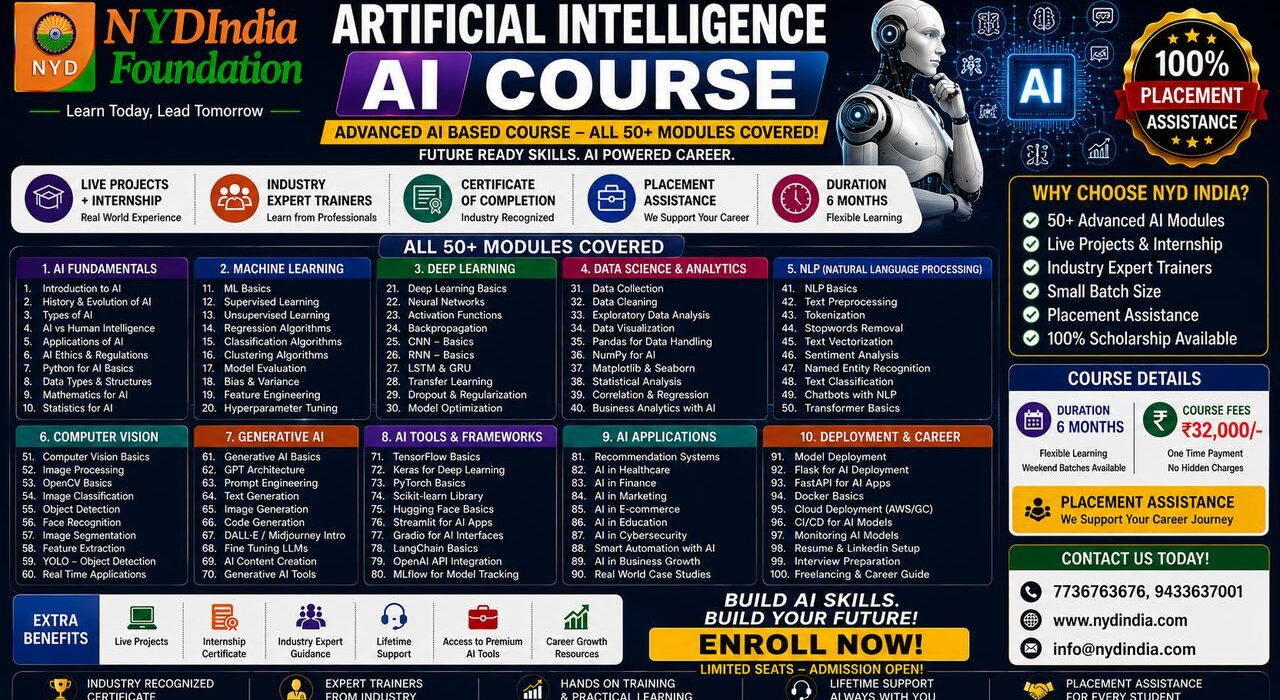
Artificial Intelligence Course by NYD India: Learn AI Skills for a Future-Ready Career
Artificial Intelligence is no longer just a concept discussed in technology labs. From chatbots and recommendation engines to automated business processes, content creation, data analysis, and intelligent applications, AI is becoming part of everyday professional life.
For students, graduates, working professionals, and career changers, this creates an important opportunity: learning practical Artificial Intelligence skills can open the door to a wide range of modern career paths.
The Artificial Intelligence Course by NYD India is designed for learners who want to understand AI concepts and develop practical skills through structured training and hands-on learning.
Why Learn Artificial Intelligence Today?
The way businesses work is changing rapidly. Companies across industries are using AI to automate repetitive tasks, understand large amounts of data, improve customer experiences, and make faster decisions.
However, knowing that AI is important is not enough. Employers increasingly value people who can actually use AI tools and technologies to solve real business problems.
Learning Artificial Intelligence can help you develop skills in areas such as:
- Machine Learning
- Generative AI
- AI-powered productivity tools
- Natural Language Processing
- Data analysis
- Prompt engineering
- AI automation
- Computer vision
- AI application development
- Responsible and ethical AI
The goal should not simply be to learn terminology. It should be to understand how AI works and where it can be applied effectively.
Artificial Intelligence Course by NYD India
NYD India offers an Artificial Intelligence course focused on developing practical knowledge alongside fundamental concepts.
The course is suitable for beginners as well as learners who want to expand their existing technical skills. Instead of treating AI as a purely theoretical subject, the learning approach can help students understand how different AI technologies are used in real-world situations.
From understanding the fundamentals to exploring modern AI applications, students can gradually build their knowledge and confidence.
What Can You Learn in an AI Course?
A well-structured Artificial Intelligence course should cover both fundamentals and current industry applications.
1. AI Fundamentals
Students can begin by understanding the basic concepts of Artificial Intelligence, including how intelligent systems work, common AI applications, and the difference between AI, Machine Learning, and Deep Learning.
Building this foundation is important because it makes advanced topics easier to understand later.
2. Machine Learning
Machine Learning is one of the most important areas of AI. It enables computers to identify patterns from data and make predictions or decisions without being explicitly programmed for every situation.
Learners can explore concepts such as:
- Supervised learning
- Unsupervised learning
- Classification
- Regression
- Clustering
- Model evaluation
- Data preparation
3. Generative AI
Generative AI has changed the way people create content, software, images, documents, and other digital assets.
Students can learn how modern generative AI systems work and explore practical applications of AI for content generation, research, automation, productivity, and business workflows.
4. Prompt Engineering
Knowing how to communicate effectively with AI systems is becoming an increasingly useful skill.
Prompt engineering teaches learners how to create clear, structured instructions to achieve better results from AI models.
Instead of simply asking an AI tool a question, learners can understand how to provide context, define objectives, establish constraints, and refine outputs.
5. AI Automation
Businesses often have repetitive processes that can be improved with automation.
AI can assist with tasks such as customer communication, data processing, content workflows, lead management, research, reporting, and internal productivity.
Learning AI automation can therefore be valuable for both technical and non-technical professionals.
Practical Learning Matters
One of the biggest challenges with technology courses is the gap between classroom knowledge and workplace requirements.
Reading about Machine Learning is different from actually working with data.
Understanding Generative AI is different from designing an AI-assisted workflow.
That is why practical assignments, projects, demonstrations, and real-world examples can make AI education more meaningful.
At NYD India, learners can explore AI concepts through a career-oriented learning approach designed to connect theory with practical applications.
Who Can Join an Artificial Intelligence Course?
An AI course isn’t limited to computer science graduates.
It can be useful for:
Students:
Students can begin developing technology skills before entering the job market.
Graduates:
Graduates from different educational backgrounds can explore AI as an additional career skill.
Working Professionals:
Professionals can use AI to improve productivity and expand their existing capabilities.
Digital Marketers:
AI can support content creation, research, customer analysis, campaign planning, and marketing automation.
Entrepreneurs:
Business owners can explore AI applications for operations, marketing, customer service, and decision-making.
Career Changers:
People looking to move toward technology-oriented careers can use structured AI training as a starting point.
Career Opportunities After Learning AI
Artificial Intelligence is a broad field, so career opportunities depend heavily on a learner’s skills, specialization, education, and practical experience.
Depending on their background and expertise, learners may explore roles such as:
- AI Developer
- Machine Learning Engineer
- AI Engineer
- Data Analyst
- Machine Learning Analyst
- AI Automation Specialist
- Prompt Engineer
- Generative AI Specialist
- Data Scientist
- AI Product Associate
Some learners may also use AI skills within existing professions rather than changing their job titles. For example, marketers, designers, analysts, developers, and business professionals can integrate AI into their current workflows.
Why Choose NYD India for Artificial Intelligence Training?
Choosing an institute is about more than simply finding a course syllabus. Learners should consider the teaching approach, practical exposure, projects, mentor support, learning environment, and career guidance.
NYD India focuses on providing career-oriented training for learners interested in emerging technologies.
A structured learning environment can help students move step-by-step from basic concepts toward practical applications rather than attempting to understand advanced AI topics all at once.
AI Skills Can Complement Your Existing Career
One of the interesting things about Artificial Intelligence is that it does not necessarily require everyone to become a full-time programmer.
A digital marketer can use AI for campaign research.
A content creator can use AI for ideation and workflow automation.
A business professional can use AI for analysis and reporting.
A developer can use AI-assisted programming tools.
A student can use AI to improve research and productivity.
This makes AI a versatile skill that can complement many existing career paths.
How to Choose the Right Artificial Intelligence Course
Before enrolling in any AI course, consider the following factors:
Look at the Curriculum
Check whether the course covers relevant AI concepts and modern applications rather than focusing only on outdated theory.
Check Practical Exposure
Projects and hands-on exercises can help you understand how AI works beyond textbooks.
Consider Mentor Support
Access to instructors and guidance can make a major difference when learners encounter difficult technical concepts.
Look for Career Guidance
A career-focused course should ideally help learners understand how their new skills can be presented in resumes, portfolios, interviews, and professional environments.
Focus on Skills, Not Just Certificates
A certificate can demonstrate course completion, but practical ability is what helps you build confidence and create meaningful career opportunities.
The Future Belongs to AI-Ready Professionals
Artificial Intelligence is likely to continue influencing the workplace across multiple industries. The professionals who learn how to work alongside AI may have an advantage as businesses adopt increasingly intelligent tools and workflows.
But learning AI should be approached as a continuous process.
Technology changes quickly. New models, tools, applications, and techniques appear regularly. Developing a strong foundation and learning how to adapt can therefore be more valuable than memorizing individual AI tools.
Artificial Intelligence Course by NYD India: A Practical Path to Building Future-Ready AI Skills
Artificial Intelligence is changing more than just the technology industry. It is influencing marketing, finance, healthcare, education, e-commerce, customer service, software development, media, and almost every other modern business sector.
As companies adopt AI-powered tools to improve efficiency and automate repetitive work, professionals who understand how to use these technologies can bring valuable skills to the workplace.
For students and professionals who want to enter this growing field, choosing the right training program can make the learning journey easier. The Artificial Intelligence Course by NYD India is designed for learners who want to understand AI fundamentals while exploring practical applications and modern AI technologies.
What Is Artificial Intelligence?
Artificial Intelligence refers to technologies that enable computers and software systems to perform tasks that normally require human intelligence.
These tasks can include:
- Understanding language
- Recognising images
- Analysing information
- Finding patterns
- Making predictions
- Generating content
- Automating decisions
- Learning from data
We already interact with AI in many parts of our daily lives. Search engines, voice assistants, recommendation systems, chatbots, navigation applications, fraud detection systems, and generative AI platforms are all examples of AI-powered technology.
The field is developing rapidly, which is why learning its fundamentals can be useful for people from a wide range of backgrounds.
Why Artificial Intelligence Is Becoming an Important Career Skill
The modern workplace is moving toward greater automation and data-driven decision-making.
Businesses are not simply asking whether they should use AI anymore. Many are exploring where AI can save time, reduce repetitive work, improve customer experiences, and support employees.
This creates demand for people who can understand AI and apply it responsibly.
For example, an organisation may need someone who can:
- Identify suitable AI use cases
- Automate repetitive workflows
- Work with AI-powered software
- Analyse data
- Create AI-assisted content
- Build or support AI applications
- Evaluate AI-generated results
- Improve business processes using AI
This is why AI education can be useful even for people who are not planning to become traditional software engineers.
Artificial Intelligence Course by NYD India
The Artificial Intelligence Course by NYD India focuses on helping learners develop an understanding of AI and its practical applications.
Rather than approaching Artificial Intelligence as a single technology, learners can explore the broader AI ecosystem, including Machine Learning, Generative AI, automation, data-driven systems, and other emerging applications.
The course can be particularly useful for learners who want a structured environment where they can gradually build their knowledge.
Build Your AI Foundation First
One common mistake beginners make is jumping directly into advanced AI tools without understanding the basics.
A strong foundation makes it easier to understand why AI systems behave differently from traditional software.
Learners can begin by exploring:
Artificial Intelligence Fundamentals
Understand what AI is, how it evolved, where it is used, and how different AI technologies solve different types of problems.
Machine Learning Fundamentals
Explore how machines learn patterns from data and use those patterns to make predictions or decisions.
Deep Learning
Understand the basic idea behind neural networks and their role in modern AI applications.
Natural Language Processing
Learn how computers process, analyse, and generate human language.
Computer Vision
Explore how AI systems can analyse and interpret images and visual information.
The Growing Importance of Generative AI
Generative AI has become one of the most visible developments in Artificial Intelligence.
Unlike traditional systems that primarily analyse existing information, generative AI can create new outputs such as:
- Text
- Images
- Audio
- Video
- Code
- Presentations
- Summaries
- Marketing content
Businesses are exploring generative AI for content development, customer support, research, internal documentation, software development, and productivity.
Understanding how these systems work and how to use them effectively can therefore become an important professional skill.
Learn Prompt Engineering
A powerful AI model is only as useful as the instructions and context provided to it.
Prompt engineering focuses on creating better instructions for AI systems.
Instead of writing a simple request, users can learn to structure prompts by specifying:
Role → Objective → Context → Instructions → Constraints → Desired Output
This approach can produce more consistent and useful results.
Prompt engineering can be valuable for marketers, researchers, content creators, entrepreneurs, developers, students, and business professionals.
AI and Business Automation
One of the biggest advantages of AI is its potential to reduce repetitive manual work.
Consider a typical business workflow.
A team may spend hours collecting information, organising data, preparing reports, answering common questions, or creating repetitive content.
AI-powered automation can potentially assist with parts of these processes.
Examples include:
- Automated customer responses
- Lead qualification
- Document summarisation
- Data classification
- Report generation
- Content workflows
- Email assistance
- Research automation
- Customer support systems
Learning how to identify these opportunities is an important part of becoming AI-ready.
Practical Projects Can Make AI Learning More Valuable
AI concepts can sometimes feel complicated when learned only through theory.
Projects provide a different experience.
When learners build or experiment with practical applications, they have the opportunity to understand how different concepts work together.
For example, an AI learner might explore projects involving:
- AI chatbots
- Text classification
- Recommendation systems
- Predictive models
- AI content workflows
- Image recognition
- Data analysis
- AI-powered automation
Project-based learning can also help learners build material that may later be useful for portfolios and interviews.
Who Should Consider an AI Course?
An Artificial Intelligence course can be useful for a wide variety of learners.
Students
Students can start building future-oriented skills before entering the professional world.
Graduates
Graduates can add AI knowledge to their existing academic qualifications and explore technology-oriented career opportunities.
Working Professionals
Professionals can learn how AI can improve productivity within their current roles.
Digital Marketing Professionals
AI can support keyword research, content planning, campaign analysis, customer insights, automation, and creative workflows.
Business Owners
Entrepreneurs can explore ways to use AI for marketing, customer service, research, operations, and business analysis.
Developers
Developers can explore AI-assisted coding, Machine Learning, Generative AI, and AI application development.
Career Changers
Learners interested in moving toward technology can use AI education as one possible pathway for developing new skills.
AI Skills for Digital Marketing
Artificial Intelligence and digital marketing are becoming increasingly connected.
Modern marketers can use AI for:
- Content ideas
- Keyword research
- Customer segmentation
- Competitor analysis
- Campaign planning
- Ad copy variations
- Social media content
- Data analysis
- Marketing automation
- Personalisation
This makes AI particularly relevant for professionals working in the digital economy.
A marketer who understands both marketing principles and AI tools may be able to create more efficient workflows than someone who understands only one side.
AI Skills for Entrepreneurs
Small businesses often operate with limited time and resources.
AI can help entrepreneurs streamline certain processes and focus more attention on strategic decisions.
For example, AI can assist with market research, content creation, customer communication, data organisation, business documentation, and repetitive administrative tasks.
The important point is that AI should be treated as a productivity tool rather than a replacement for business judgement.
Career Opportunities in Artificial Intelligence
AI is a broad field, and career options can vary according to your education, technical knowledge, portfolio, and specialisation.
Possible career paths include:
- Artificial Intelligence Engineer
- AI Developer
- Machine Learning Engineer
- Data Scientist
- Data Analyst
- AI Automation Specialist
- Generative AI Specialist
- Prompt Engineer
- NLP Specialist
- Computer Vision Engineer
- AI Product Associate
Some learners may also use AI skills within existing careers.
For example, a marketing professional could become an AI-enabled marketing specialist, while a business analyst could incorporate AI-based analysis into their workflow.
Why Practical AI Skills Matter More Than a Certificate Alone
A certificate can be useful as evidence that you completed training, but employers ultimately need people who can demonstrate their skills.
This is why learners should focus on:
Understanding:
Know why a particular AI technique works.
Practice:
Use AI tools and technologies regularly.
Projects:
Build practical examples.
Problem-solving:
Learn how to apply AI to real situations.
Communication:
Be able to explain what your AI solution does.
The combination of knowledge and practical ability can make an AI learner more confident when approaching professional opportunities.
Choosing an Artificial Intelligence Institute
Before choosing an AI training institute, don’t make the decision based only on advertisements or course certificates.
Consider several factors.
Course Curriculum
Does the syllabus cover current AI concepts and applications?
Practical Training
Will you get opportunities to work on projects and exercises?
Trainers
Do instructors explain complex concepts in a way beginners can understand?
Learning Support
Can students ask questions and receive guidance during the course?
Career Support
Does the institute provide guidance related to resumes, interviews, portfolios, and career preparation?
Industry Relevance
Does the curriculum reflect the technologies and skills currently being used in the industry?
These questions can help you make a more informed decision.
Why Choose NYD India?
NYD India aims to provide career-focused education in emerging technology areas, including Artificial Intelligence.
For learners, the value of an AI course should come from more than completing lessons. A useful learning experience should help students understand concepts, experiment with technologies, work on practical problems, and gradually become more confident.
NYD India’s AI training can be considered by learners looking for a structured environment to begin or strengthen their Artificial Intelligence journey.
How to Start Your AI Learning Journey
You don’t need to understand everything about AI on day one.
A better approach is to learn progressively.
Step 1: Understand the Basics
Learn AI terminology and fundamental concepts.
Step 2: Explore Machine Learning
Understand how data is used to train models.
Step 3: Learn Modern AI Tools
Experiment with Generative AI and other AI-powered technologies.
Step 4: Practice Regularly
Solve small problems instead of only watching tutorials.
Step 5: Build Projects
Create practical applications that demonstrate your skills.
Step 6: Create a Portfolio
Document your projects and explain the problems they solve.
Step 7: Keep Learning
AI changes quickly, so continuous learning is essential.
The Future of Artificial Intelligence
The future of AI is not limited to robots or futuristic machines.
Much of its impact will happen behind the scenes through software, automation, analytics, intelligent assistants, recommendation systems, and business applications.
As these technologies become more accessible, AI literacy may become useful across many professions.
People who learn how to work effectively with AI can potentially become more adaptable as the workplace evolves.
Final Thoughts
Artificial Intelligence is one of the most influential technologies shaping the modern digital world. Learning AI is no longer only relevant to people working in advanced technology companies. Its applications are spreading across marketing, business, education, finance, healthcare, media, software, and many other industries.
The Artificial Intelligence Course by NYD India can provide learners with a structured opportunity to explore AI fundamentals, modern technologies, practical applications, and career-oriented skills.
If you are serious about developing future-ready technology knowledge, the best time to start is before you are forced to catch up.
Learn the fundamentals. Practice with real tools. Build projects. Keep improving.
That is what can turn Artificial Intelligence from a buzzword into a practical professional skill.
Frequently Asked Questions About Artificial Intelligence Courses
Is Artificial Intelligence difficult to learn?
AI can appear complicated initially, but a structured learning path can make it easier. Beginners should start with fundamentals and gradually move toward advanced topics.
Can a non-technical student learn Artificial Intelligence?
Yes. Non-technical learners can start with AI concepts, applications, Generative AI, automation, and other areas before deciding whether they want to move deeper into programming and Machine Learning.
What programming languages are useful for AI?
Python is widely used in Artificial Intelligence and Machine Learning. Depending on the specialisation, learners may also encounter other programming technologies.
Is Generative AI part of Artificial Intelligence?
Yes. Generative AI is a branch of Artificial Intelligence focused on creating new content such as text, images, audio, video, and code.
Can AI skills help digital marketers?
Yes. AI can support marketing research, content creation, campaign analysis, customer insights, automation, and productivity.
What is the best way to learn AI?
A combination of structured education, hands-on practice, projects, experimentation, and continuous learning is generally more useful than relying on theory alone.
Can an AI course help with career development?
It can help learners develop relevant knowledge and practical skills. However, career outcomes depend on factors such as individual ability, education, experience, portfolio quality, interview performance, and the job market.
Start Your Artificial Intelligence Journey with NYD India
The AI revolution is already underway. You don’t need to become an AI expert overnight. Start with the fundamentals, understand the technology, practise consistently, and gradually build real-world skills.
With the right learning approach, Artificial Intelligence can become more than another qualification on your resume—it can become a valuable skill that changes the way you work.
Explore the Artificial Intelligence Course by NYD India and take the next step toward becoming an AI-ready professional.