
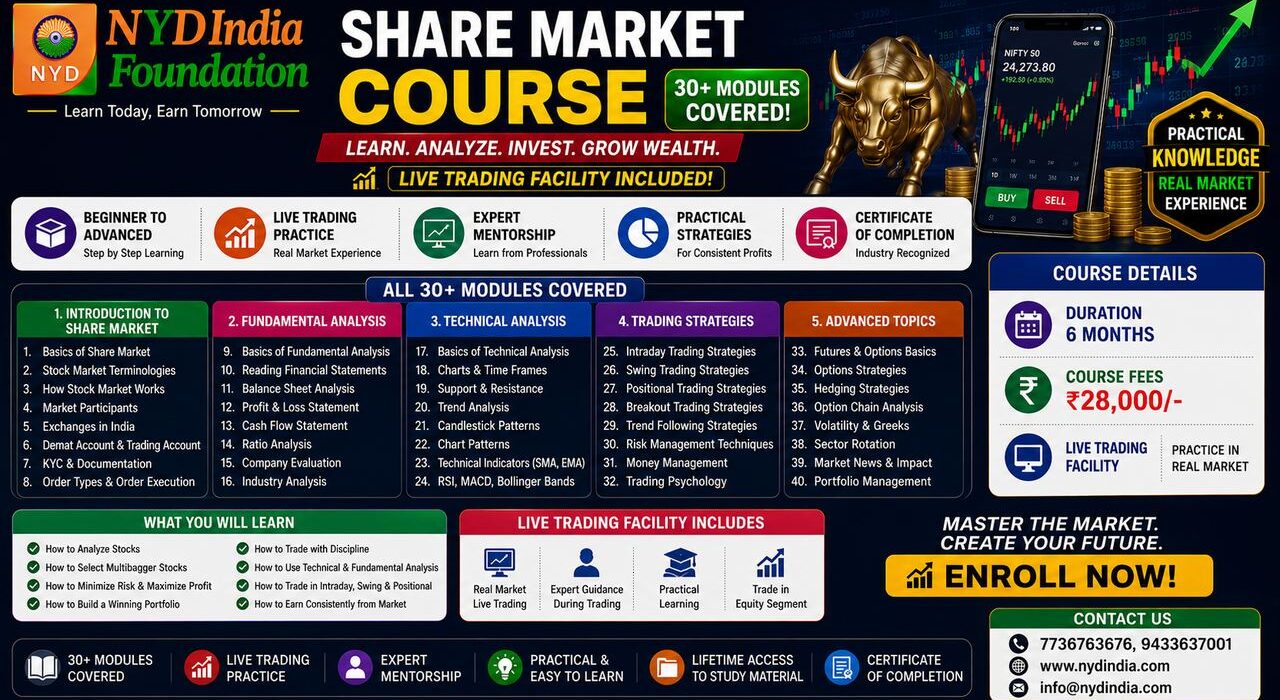
Share Market Course with Live Trading Facility by NYD India
The share market has become an increasingly popular career and investment option for people who want to understand how financial markets work. But successful trading is not simply about buying a stock when the price is rising or selling when it falls. It requires knowledge, discipline, market analysis, risk management, and practical experience.
That is where a well-structured Share Market Course with Live Trading Facility by NYD India can make a meaningful difference. Instead of limiting learning to books and theoretical concepts, the course focuses on understanding market movements and developing practical trading skills in a real-market environment.
Why Learn the Share Market Professionally?
Many beginners enter the stock market after watching social media videos, following market tips, or listening to friends. While these sources can provide basic information, they rarely offer a systematic understanding of trading.
A professional share market course can help learners understand:
- How the stock market works
- Equity and different market segments
- Demat and trading accounts
- Fundamental analysis
- Technical analysis
- Candlestick patterns
- Support and resistance
- Chart patterns
- Trading indicators
- Intraday trading concepts
- Swing trading strategies
- Risk management
- Trading psychology
- Portfolio management
- Market research and analysis
The objective is not to promise quick profits. Instead, proper education helps learners make more informed and disciplined decisions.
What Makes NYD India’s Share Market Course Different?
One of the major advantages of learning through NYD India is the focus on practical market exposure. Students can go beyond classroom explanations and understand how trading concepts are applied when the market is actually moving.
The live trading facility gives learners an opportunity to observe market movements and understand the decision-making process involved in trading.
Rather than simply memorizing definitions, students can learn how traders study charts, identify potential setups, evaluate risk, and plan their trades.
Learn Through Live Trading Experience
Reading about trading and actually watching the market behave are two very different experiences.
During live market sessions, learners can understand how quickly prices can change and why traders need to react carefully. Practical exposure can help students connect classroom concepts with real market situations.
The live trading environment can help learners understand:
- How market prices move
- How to read live charts
- How technical indicators behave
- How trading setups develop
- How entry and exit levels are planned
- How stop-loss strategies are used
- How traders manage risk
- How emotions can influence trading decisions
This practical approach can make the learning process more engaging, especially for beginners.
Technical Analysis: Understanding Price Action
Technical analysis is an important part of modern trading education. It involves studying price movements, charts, volume, patterns, and indicators to identify possible market opportunities.
Students can learn about concepts such as:
Candlestick Patterns
Candlesticks provide information about opening, closing, high, and low prices during a particular period. Understanding common candlestick formations can help traders interpret market sentiment.
Support and Resistance
Support and resistance levels are widely used when analyzing potential price movements. Learning how to identify these zones can help traders develop more structured trading plans.
Chart Patterns
Patterns such as triangles, channels, breakouts, and reversals can provide useful information when combined with other forms of analysis.
Technical Indicators
Indicators can help traders analyze trends, momentum, volatility, and market conditions. The important part is understanding when and how to use them rather than depending on an indicator blindly.
Fundamental Analysis for Better Market Understanding
Trading education should not focus only on charts.
Fundamental analysis helps investors understand the financial and business side of a company. Learners can explore concepts such as revenue, profit, earnings, valuation, business performance, industry trends, and other financial information.
Understanding both technical and fundamental analysis can provide a broader perspective of the market.
Risk Management: The Most Important Trading Skill
One of the biggest mistakes beginners make is focusing only on potential profit.
Professional trading education should also emphasize what can go wrong.
Risk management teaches traders to think about:
- Position sizing
- Stop-loss planning
- Risk-to-reward ratios
- Capital allocation
- Trading discipline
- Avoiding excessive leverage
- Managing consecutive losses
No course can eliminate market risk, and no trading strategy can guarantee profits. The purpose of risk management is to help traders control potential losses and approach the market more responsibly.
Trading Psychology Matters
A technically good strategy can still fail when emotions take control.
Fear, greed, impatience, overconfidence, and revenge trading can influence trading decisions. A good share market course should therefore introduce learners to trading psychology and disciplined decision-making.
Students can learn why following a predefined trading plan is often more useful than making impulsive decisions based on short-term market movements.
Who Can Join a Share Market Course?
A share market course can be useful for different types of learners, including:
- College students interested in financial markets
- Working professionals
- Aspiring traders
- Beginners wanting to understand stock trading
- Entrepreneurs
- Investors looking to improve their market knowledge
- People interested in developing finance-related skills
You do not necessarily need an advanced financial background to start learning. The important thing is having an interest in financial markets and being willing to learn consistently.
From Beginner Concepts to Practical Market Skills
A structured learning journey can make the stock market easier to understand.
Instead of trying to learn everything at once, students can gradually move from basic concepts to advanced topics.
A typical learning progression can include:
Market Basics → Trading Concepts → Technical Analysis → Fundamental Analysis → Strategy Development → Risk Management → Live Market Practice → Trading Psychology
This approach helps learners build their knowledge step by step.
Why Practical Learning Is Important
The biggest difference between theoretical knowledge and practical understanding becomes visible when the market opens.
A chart may look simple in a textbook. In a live market, however, prices can move rapidly and unexpected events can change market sentiment.
Live trading exposure helps students understand this difference.
It can also encourage learners to develop habits such as market observation, maintaining a trading journal, reviewing previous trades, and analyzing mistakes.
Building a Responsible Trading Mindset
The goal of share market education should not be to make someone believe that trading is an easy way to make money.
Instead, learners should understand that markets involve uncertainty.
A responsible trader understands:
Research before trading.
Plan before entering.
Manage risk before thinking about profit.
Follow the strategy instead of emotions.
Review every decision.
These habits can be more valuable in the long run than simply learning a collection of trading tips.
Why Choose NYD India?
NYD India focuses on practical, career-oriented learning across professional skill domains. Its share market training is designed for learners who want to understand trading beyond basic terminology.
With classroom learning combined with practical market exposure and live trading facilities, students can gain a more realistic understanding of how trading works.
For someone searching for a share market course with live trading facility, this practical approach can be particularly valuable.
Start Your Share Market Learning Journey
The stock market can offer opportunities, but it also involves significant risk. Education, preparation, and discipline are therefore essential before making financial decisions.
If you want to understand stock market concepts, technical analysis, fundamental analysis, trading strategies, risk management, and practical market behavior, a structured Share Market Course with Live Trading Facility by NYD India can be a useful starting point.
Learn the concepts. Observe the market. Practice your analysis. Develop discipline. Most importantly, understand that successful trading is a skill that requires continuous learning rather than a shortcut to guaranteed profits.
Share Market Course with Live Trading Facility by NYD India: Build Practical Trading Skills
The stock market is no longer limited to professional brokers and financial experts. Today, students, working professionals, entrepreneurs, and aspiring investors are increasingly interested in learning how financial markets operate.
However, opening a trading account and buying shares is easy. Understanding why a stock moves, when to enter or exit a trade, how much capital to risk, and how to control emotions is much more difficult.
This is why structured share market education can be valuable.
The Share Market Course with Live Trading Facility by NYD India is designed around the idea of combining market knowledge with practical exposure. Instead of learning trading concepts only from books or recorded videos, students can understand how those concepts work in actual market conditions.
Understanding the Share Market from the Ground Up
Before developing a trading strategy, beginners need to understand the market itself.
A professional learning program can introduce students to the basic structure of the Indian stock market, including how shares are traded, how orders work, and how investors and traders participate.
Students can gradually become familiar with concepts such as:
- Stock exchanges
- Equity shares
- Demat accounts
- Trading accounts
- Market orders
- Limit orders
- Stop-loss orders
- Intraday trading
- Delivery trading
- Swing trading
- Market indices
- Trading volume
- Price movements
Learning these fundamentals first creates a stronger foundation for more advanced topics.
Live Trading Facility: Learning Beyond Theory
One of the most useful aspects of practical trading education is the opportunity to observe the market in real time.
Markets don’t always behave exactly like examples shown in textbooks. A chart pattern that looks perfect may fail. A stock may suddenly become volatile. News can influence prices. Market sentiment can change within minutes.
A live trading facility helps learners see these situations as they happen.
Students can observe how experienced traders approach the market, how charts are analyzed, how potential trading setups are identified, and how risk is considered before a trade is taken.
This kind of exposure can help bridge the gap between knowing a concept and understanding how it behaves in the real market.
Learn How Traders Analyze the Market
Successful market participation involves research and analysis rather than random decisions.
A comprehensive share market course can introduce students to different methods of market analysis.
1. Price Action Analysis
Price action focuses on understanding market behavior through price movements and chart structures.
Students can learn to observe:
- Market trends
- Higher highs and lower lows
- Breakouts
- Reversals
- Consolidation
- Momentum
- Volatility
2. Technical Analysis
Technical analysis uses charts and indicators to study historical price and volume data.
Commonly discussed tools include:
- Moving averages
- RSI
- MACD
- Bollinger Bands
- Volume indicators
- Trendlines
- Support and resistance
The purpose of learning these tools is not to blindly follow signals. Instead, traders need to understand what the information means and how different factors can work together.
3. Fundamental Analysis
Fundamental analysis looks at the underlying business.
Learners may study:
- Company revenue
- Profitability
- Earnings
- Business growth
- Valuation
- Industry conditions
- Financial statements
- Economic factors
Combining different approaches can help learners develop a broader understanding of the market.
Intraday Trading: Understanding Short-Term Opportunities
Intraday trading involves buying and selling securities within the same trading session.
Because intraday markets can move quickly, traders need to understand timing, volatility, liquidity, risk management, and position sizing.
A practical course can help students understand the mechanics of intraday trading and the importance of having a predefined trading plan.
The focus should always remain on risk-aware decision-making, because short-term trading can involve substantial losses.
Swing Trading Concepts
Not everyone wants to sit in front of a screen throughout the trading day.
Swing trading generally focuses on capturing potential price movements over a longer period than intraday trades.
Students can learn how traders identify:
- Trends
- Breakout opportunities
- Pullbacks
- Support zones
- Resistance zones
- Momentum
- Potential entry and exit areas
Understanding different trading styles allows learners to identify which approach better suits their objectives, availability, and risk tolerance.
Risk Management Should Come Before Profit
One of the most important lessons for a beginner is that profit should never be the only objective.
Markets are uncertain. Even experienced traders can have losing trades.
Risk management can include:
Setting Stop-Loss Levels
A stop-loss can help limit potential losses when a trade moves against the trader’s expectation.
Position Sizing
Instead of putting a large portion of capital into one trade, traders can learn how position size affects overall portfolio risk.
Risk-to-Reward Planning
Before entering a trade, traders can compare potential risk with potential reward.
Avoiding Emotional Trading
Taking a trade simply because the previous trade was a loss can lead to unnecessary risk.
A strong trading education should make risk management an integral part of the learning process.
Trading Psychology: The Hidden Side of the Market
Trading is not only about numbers and charts.
Human psychology plays a major role.
A trader might understand a strategy perfectly but still make poor decisions because of:
- Fear of missing out
- Fear after a loss
- Greed
- Impatience
- Overconfidence
- Revenge trading
- Excessive trading
Learning to recognize these emotional patterns can help traders become more disciplined.
The objective is to build a mindset where decisions are based on analysis and a predefined plan rather than temporary emotions.
Learn to Build a Trading Plan
A trading plan provides a framework for making decisions.
A basic plan may define:
Entry: What conditions need to be present before entering?
Stop Loss: At what point should the trade be exited if the analysis is wrong?
Target: What is the potential profit objective?
Position Size: How much capital should be allocated?
Risk: How much can potentially be lost?
Exit Strategy: What conditions indicate that the position should be closed?
Learning to think in this structured way can help reduce impulsive trading.
Maintain a Trading Journal
A trading journal is another useful habit for developing practical skills.
After every trade, learners can record:
- Stock or instrument
- Entry price
- Exit price
- Trading setup
- Reason for entering
- Stop-loss level
- Target
- Result
- Emotional state
- Mistakes
- Lessons learned
Over time, this information can reveal patterns in a trader’s behavior.
For example, someone may discover that they frequently enter trades too early or take unnecessary positions during highly volatile periods.
Who Should Consider Joining?
The course can be suitable for people who want to build structured knowledge of the stock market.
It may be particularly useful for:
Students
Students interested in finance, business, economics, or entrepreneurship can gain practical exposure to financial markets.
Working Professionals
Professionals can learn market concepts alongside their existing careers and develop a better understanding of investing and trading.
Beginners
People who have never traded before can start with basic concepts before moving toward more advanced market analysis.
Aspiring Traders
Individuals who want to explore trading as a skill can use structured education to develop a foundation before making independent decisions.
Investors
Existing investors may also benefit from learning technical and fundamental analysis to better understand market movements.
What You Can Gain from Practical Market Training
A good course should not simply provide information. It should encourage learners to develop useful habits.
After completing structured training, learners can aim to improve their ability to:
- Read stock charts
- Understand market trends
- Analyze companies
- Identify potential setups
- Understand technical indicators
- Create trading plans
- Manage risk
- Control emotions
- Review trading decisions
- Follow disciplined processes
These skills can remain useful even as market conditions change.
Why Live Market Exposure Can Make Learning More Effective
Imagine learning how to drive entirely from a textbook without ever sitting inside a car.
The theory may explain steering, braking, acceleration, and traffic rules, but practical experience teaches you how these elements work together.
Trading education works in a similar way.
Charts, definitions, and strategies provide the theoretical foundation. Live market exposure adds context.
Students can see how market concepts behave under actual conditions and understand why flexibility and discipline are important.
Don’t Learn Trading from Tips Alone
Social media has made stock market information widely available. Every day, beginners can find hundreds of videos, posts, predictions, and trading calls.
But information is not the same as education.
A stock tip might tell you what someone else wants to buy. It does not necessarily teach you:
- Why the stock was selected
- What the risk is
- Where the trade could fail
- How the position should be sized
- What to do if the market changes
Professional learning encourages students to develop their own analytical thinking rather than simply following someone else’s call.
Career and Skill Development in Financial Markets
Knowledge of financial markets can also complement careers in areas such as:
- Stock market research
- Investment analysis
- Financial services
- Trading support
- Wealth management
- Market research
- Financial content creation
- Investment operations
However, career opportunities depend on individual qualifications, skills, experience, and applicable regulatory requirements.
A course can provide knowledge and practical exposure, but it should not be viewed as an automatic guarantee of trading profits or employment.
A Practical Learning Journey at NYD India
A learner’s journey can begin with basic market concepts and gradually progress toward practical analysis.
The learning process can broadly follow:
Market Fundamentals → Trading Basics → Chart Reading → Technical Analysis → Fundamental Analysis → Trading Strategies → Risk Management → Live Market Exposure → Psychology → Strategy Review
This gradual approach can make complicated market concepts easier to understand.
Important Things Beginners Should Remember
Before entering the market independently, every learner should understand a few basic principles:
- The stock market involves risk.
- Past performance does not guarantee future results.
- No trading strategy works in every market condition.
- Losses are a normal part of trading.
- Risk management is essential.
- Never trade only because someone gives you a tip.
- Avoid using money you cannot afford to lose.
- Continuous learning is important.
- Discipline is more valuable than impulsive decisions.
- Never assume that a course can guarantee trading profits.
Why Choose a Course with Live Trading Facility?
If your goal is simply to understand basic stock market terminology, online articles and videos may be enough to get started.
But if you want a more structured learning experience, practical market exposure can make a significant difference.
A Share Market Course with Live Trading Facility by NYD India provides learners with an opportunity to combine classroom concepts with real-time market observation.
The objective is to help students understand not only what happens in the market, but also how and why traders analyze those movements.
Final Thoughts
Learning the share market is a journey rather than a one-day process.
The market changes constantly, and strategies that work in one situation may not work in another. This makes education, practice, research, risk management, and discipline extremely important.
For beginners and aspiring traders, the right training environment can provide a structured path from basic concepts to practical market understanding.
With its focus on share market education and live trading exposure, NYD India can be considered by learners looking for a practical way to develop their understanding of trading and investing.
The ultimate goal should not be to chase quick profits. It should be to become a more informed, disciplined, and responsible participant in the financial market.
Learn the market. Understand the risk. Practice your analysis. Build discipline. Make informed decisions.
1 Comment-
Pingback: Top 10 Social Media Marketing Institutes in Ranchi with.