
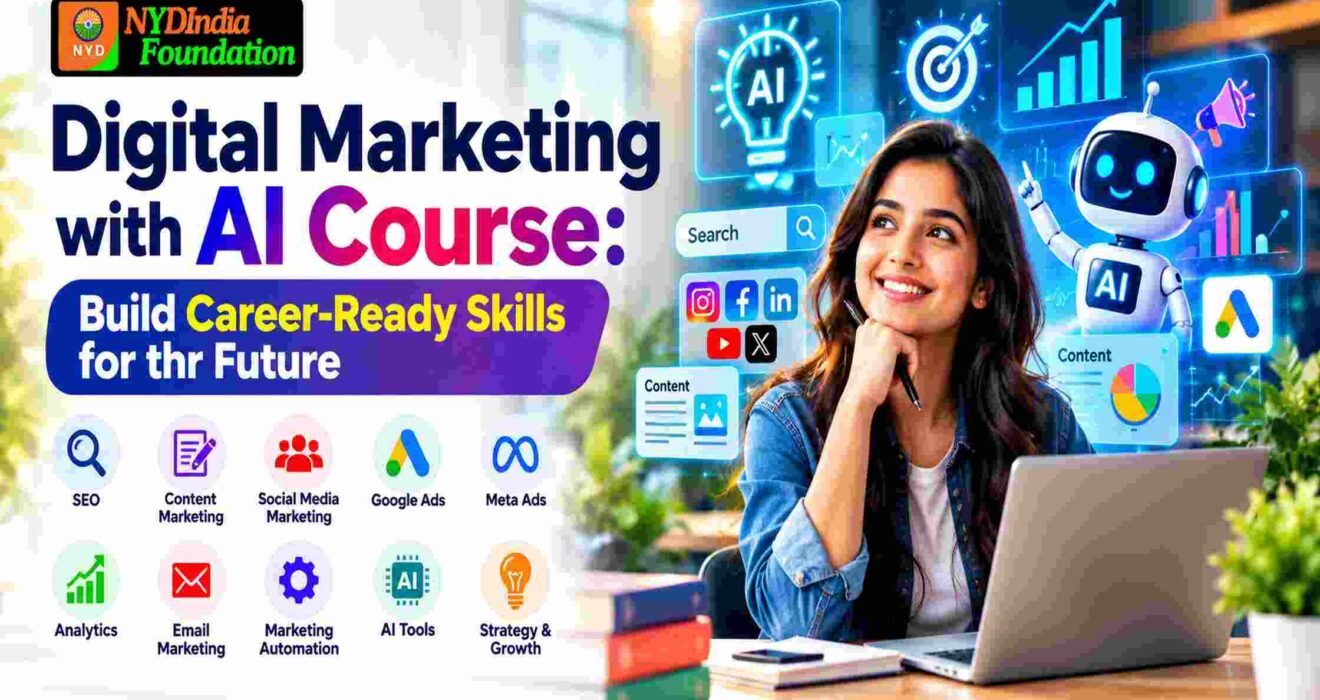
Digital Marketing with AI Course: Build Career-Ready Skills for the Future
Digital marketing is no longer limited to posting on social media or running simple advertisements. Businesses today need professionals who can understand customers, create engaging content, optimize websites, manage paid campaigns, analyze data, and use Artificial Intelligence to work faster and smarter.
That is why Digital Marketing with AI has become an important career skill for students, freshers, job seekers, freelancers, and business owners.
A well-designed Digital Marketing with AI Course combines traditional digital marketing fundamentals with modern AI-powered tools, automation, analytics, and content creation. The goal is not simply to learn AI tools, but to understand when, where, and how AI can improve marketing results.
Why Learn Digital Marketing with AI?
Artificial Intelligence is changing the way marketers research keywords, create content, analyze campaigns, understand audiences, and develop marketing strategies.
Modern courses increasingly integrate AI throughout SEO, content marketing, social media, advertising, and analytics instead of treating AI as a separate topic.
For students, this creates an opportunity to develop a combination of:
- Digital marketing knowledge
- AI tools skills
- Creative thinking
- Data analytics
- Advertising skills
- Content creation
- Marketing strategy
- Automation skills
This combination can help students prepare for a rapidly changing digital workplace.
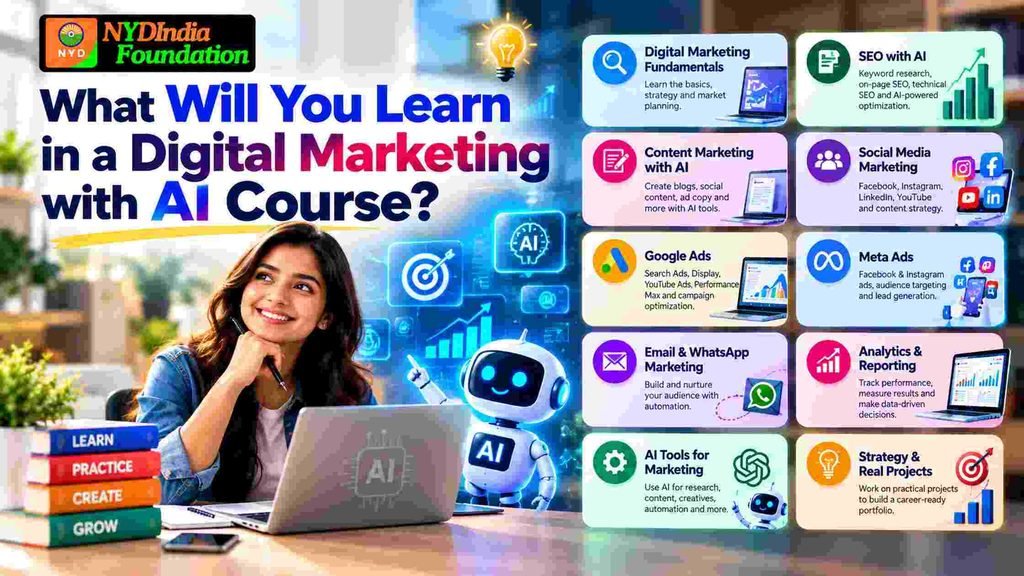
What Will You Learn in a Digital Marketing with AI Course?
1. Digital Marketing Fundamentals
Students first understand how digital marketing works.
You can learn:
- Digital marketing fundamentals
- Marketing funnels
- Customer journey
- Target audience research
- Buyer personas
- Online branding
- Lead generation
- Conversation strategies
- Organic vs paid advertising
- Marketing KPIs
Understanding the fundamentals is important because AI should support marketing decisions rather than replace strategic thinking.
2. AI Tools for Digital Marketing
AI can help marketers complete many tasks more efficiently.
Students can learn how to use AI for:
- Content ideas
- Keyword research
- Marketing research
- Ad copy
- Social media captions
- Email campaigns
- Content calendars
- Image concepts
- Video concepts
- Customer research
- Data analysis
- Marketing automation
The focus should be on practical AI workflows, rather than simply learning how to write prompts.
3. SEO with AI
Search Engine Optimization remains an important digital marketing skill.
An AI-focused SEO module can cover:
- Keyword research
- Search intent
- Competitor analysis
- On-page SEO
- Technical SEO
- Off-page SEO
- Local SEO
- Content optimization
- Internal linking
- SEO audits
- Search Console
- AI-assisted content workflows
- AEO and GEO concepts
The modern search environment is also expanding beyond traditional Google results, making optimization for AI-driven search increasingly relevant.
4. Content Marketing with AI
Content remains one of the foundations of digital marketing.
Students can learn how to create:
- Blog articles
- Website content
- Social media posts
- Reels scripts
- YouTube scripts
- Ad copy
- Landing page copy
- Email content
- Promotional campaigns
AI can help generate ideas and variations, but students should also learn editing, fact-checking, brand voice, and originality.
5. Social Media Marketing
Social media is an important channel for modern businesses.
A practical course can teach:
- Facebook marketing
- Instagram marketing
- LinkedIn marketing
- YouTube marketing
- Content calendars
- Reels strategy
- Hashtag research
- Community management
- Influencer marketing
- Social media analytics
- AI-assisted content planning
Students can create a complete social media strategy for a simple brand as a practical project.
6. Google Ads and Performance Marketing
One of the most valuable practical skills is learning how businesses generate leads and sales through paid advertising.
Students can learn:
- Google Search Ads
- Display advertising
- YouTube advertising
- Performance Max
- Keyword targeting
- Ad copyrighting
- Landing Pages
- Bidding strategies
- Conversion tracking
- Remarking
- Campaign optimization
Modern AI-focused marketing programmes increasingly connect advertising data, automation, and creative testing.
7. Meta Ads
Students can also learn how to plan and execute Facebook and Instagram advertising campaigns.
Topics may include:
- Campaign objective
- Audience targeting
- Custom audience
- Lookalike audiences
- Lead generation
- Creative testing
- Reels advertising
- Retargeting
- Budget management
- Performance analysis
The objective is to understand how to build campaigns – not just click buttons inside Ads Manager.
8. AI-Powered Creative Production
One of the exciting areas of modern marketing is AI-assisted creative production.
Students can explore workflows for creating:
- Social media graphics
- Ad creatives
- Video concepts
- Marketing images
- Product descriptions
- Short-form video scripts
- Presentation content
- Campaign variations
This can help marketers produce and test more creative ideas in less time.
9. Email and WhatsApp Marketing
Digital marketing is also about converting leads into customers.
Students can learn:
- Email campaign planning
- Lead nurturing
- Customer segmentation
- Welcome sequence
- Promotional campaigns
- WhatsApp marketing concepts
- Follow-up campaigns
- AI-assisted personalization
- Marketing automation
10. Analytics and Performance Tracking
A good marketer must understand numbers.
Students should learn important metrics such as:
| Metric | What It Shows |
|---|---|
| CTR | How many people click an ad or result |
| CPC | Cost per click |
| Conversion Rate | Percentage of visitors who convert |
| CPA | Cost to acquire a customer/action |
| ROAS | Revenue generated from advertising spend |
| Engagement Rate | Audience interaction |
| Traffic | Visitors reaching a website |
| Leads | Potential customers generated |
| Bounce/Engagement Signals | How visitors interact with content |
| ROI | Overall return on marketing investment |
Tools such as Google Analytics, Search Console, and Tag Manager can help students understand campaign performance.
11. Marketing Automation
AI becomes even more useful when combined with automation.
Students can understand workflows such as:
Lead Generation → Lead Capture → CRM → AI Lead Qualification → Follow-up → Conversion
Automation can reduce repetitive work and allow marketers to concentrate more on strategy and creative decisions.
12. Practical Projects
One of the important parts of a Digital Marketing with AI course should be practical learning.
Instead of learning only through theory, students can work on projects such as:
Project 1: Build a Website
Create and optimize a basic business website or landing page.
Project 2: SEO Project
Perform keyword research, competitor analysis, and on-page optimization.
Project 3: Social Media Campaign
Develop a 30-day content calendar and campaign strategy.
Project 5: Meta Ads Campaign
Create a Facebook/Instagram campaign with audience targeting and creative variations.
Project 6: AI Marketing Campaign
Use AI to develop a complete campaign including:
Research → Strategy → Content → Creative → Advertising → Analytics
Project 7: Final Capstone
Students can combine everything into an end-to-end marketing project that can become part of their portfolio.
Who Can Join a Digital Marketing with AI Course?
The course can be suitable for:
- Students
- Freshers
- Graduates
- Job seekers
- Career switchers
- Freelancers
- Entreprenuers
- Small business owners
- Social media managers
- Content writers
- Marketing professionals
- Website owners
You do not necessarily need a technical or programming background to begin learning digital marketing. Many AI-focused programmes are designed around marketing skills rather than coding.
Career Opportunities After The Course
After developing practical skills, students can explore roles such as:
- Digital Marketing Executive
- SEO Executive
- SEO Specialist
- Social Media Executive
- Performance Marketing Executive
- Google Ads Specialist
- Meta Ads Specialist
- Content Marketing Executive
- Email Marketing Executive
- Marketing Automation Executive
- Digital Marketing Analyst
- AI Marketing Executive
- Freelance Digital Marketer
The exact role and salary will depend on the student’s skills, portfolio, expeerience, location, and employer.
Why Practical Learning Matters
A certificate alone does not make someone a successful digital marketer.
Students should finish the course with evidence of what they can actually do:
Learn → Practice → Create → Analyze → Improve → Build Portfolio
A strong Portfolio might contain:
- SEO audit
- Keyword research report
- Website/landing page
- Social media strategy
- Google Ads campaign structure
- Meta Ads campaign
- Content calendar
- AI marketing workflow
- Analytics report
- Final marketing project
This gives students something concrete to discuss during interviews or with potential freelance clients.
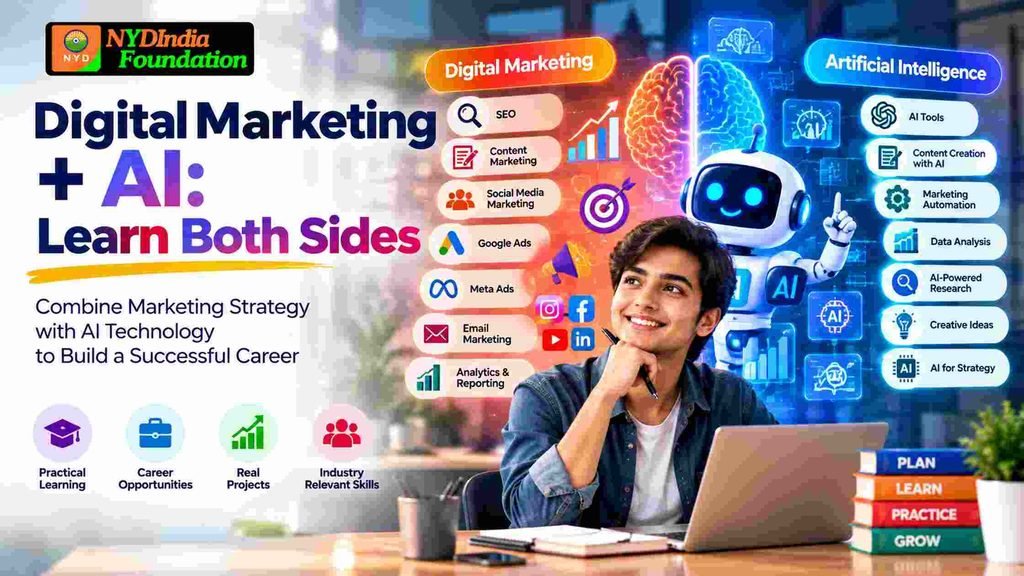
Digital Marketing + AI: Learn Both Sides
The biggest advantage of combining AI with Digital Marketing is that students learn both technology and marketing thinking.
AI can help with speed and scale.
Marketing knowledge helps with:
- Strategy
- Audience understanding
- Positioning
- Creativity
- Decision-making
- Camaign planning
- Business objectives
The future marketer is therefore not simply someone who knows AI tools. It is someone who knows how to use AI to solve real marketing problems.
Why Start Learning Now?
The digital marketing industry is evolving quickly. Educational programmes from institutions such as IIT Madras and IIT Kharagpur are already incorporating AI into areas including content, social media, search, analytics, and automation.
For students, starting early can provide more time to:
- Learn new tools
- Build projects
- Develop a portfolio
- Gain practical experience
- Understand advertising platforms
- Experiment with AI
- Prepare for interviews
- Explore freelancing opportunities
Your Learning Journey
A student can follow a simple progression:
Step 1: Learn Digital Marketing Fundamentals
↓
Step 2: Learn SEO & Content Marketing
↓
Step 3: Learn Social Media Marketing
↓
Step 4: Learn Google & Meta Ads
↓
Step 5: Learn AI Tools & Prompting
↓
Step 6: Learn Analytics & Automation
↓
Step 7: Complete Real Projects
↓
Step 8: Build Your Portfolio
↓
Step 9: Prepare for Jobs, Freelancing, or Business
Start Your Digital Marketing with AI Journey
If you are a student or beginner looking to enter the digital industry, a Digital Marketing with AI Course can give you a structured path to learn modern marketing skills.
Don’t choose a course only because it says “AI” in the title.
Look for a programme that combines SEO + Content + Social Media + Google Ads + Analytics + AI + Automation + Practical Projects.
Most importantly, choose learning that helps you create real work and build a portfolio.
Ready to Build Your Digital Marketing Career?
Start learning the skills businesses need in the AI-driven era and turn your knowledge into practical projects, career opportunities, and freelance possibilities.
Learn Digital Marketing. Learn AI. Build Real Skills. Build Real Skills. Build Your Future.
How AI Is Changing Digital Marketing
Artificial Intelligence is changing almost every stage of the digital marketing process. Earlier, marketers often spent hours researching keywords, preparing content ideas, analyzing competitors, and creating multiple versions of advertisements. Today, AI can assist with many of these activities and help marketers work more efficiently.
However, AI is not a replacement for a skilled marketer. The real advantage comes from knowing how to combine human creativity, marketing strategy, and AI technology.
For example, a marketer can use AI to generate several campaign ideas, but the marketer still needs to decide:
- Which audience should be targeted?
- Which message is most relevant?
- Which platform should be used?
- What offer should be promoted?
- Which creative is appropriate?
- How should the campaign budget be allocated?
- What does the campaign data indicate?
- What should be changed to improve performance?
This is why learning Digital Marketing + AI Together can be valuable for students who want to develop modern marketing skills.
AI for SEO and Search Marketing
Search behaviour is evolving rapidly. People are no longer relying only on traditional search results. They are increasingly using AI-powered tools and conversational search experiences to discover information.
Digital marketers therefore need to understand both traditional SEO and emerging search optimization concepts.
A modern AI-focused SEO learning path can include:
- Keyword research
- Search intent
- Competitor research
- Content planning
- On-page-SEO
- Technical SEO
- Local SEO
- Link-building fundamentals
- SEO auditing
- Search console
- Website analytics
- Content optimization
- Answer Engine Optimization
- Generative Engine Optimization
- AI-assisted research
Students who understand these areas can become better prepared for the changing search ecosystem.
AI for Social Media Marketing
Social media marketers have to continuously create fresh content. AI can make the planning and production process more efficient.
Students can learn how to use AI to support:
Research → Content Ideas → Captions → Scripts → Creatives → Scheduling → Analysis
For example, a student working for a student can create a monthly content strategy around:
- Product promotions
- Festival campaigns
- Customer testimonials
- Educational content
- Reels
- Offers
- Behind-the-scenes content
- User-generated content
The marketer then reviews the AI-generated ideas and adapts them to the brand’s audience and communication style.
AI for Google Ads and Meta Ads
Paid advertising requires continuous testing and optimization.
AI can assist marketers with generating different headlines, descriptions, creative concepts, audience ideas, and campaign variations.
Students can learn to think about advertising through the complete funnel:
Awareness → Interest → Consideration → Lead → Conversion → Retention
They can also learn how to evaluate campaign metrics and identify opportunities for improvement.
For example:
If an advertisement receives many impressions but very few clicks, the marketer may need to review the creative, headline, or audience targeting.
If an advertisement receives clicks but generates very few leads, the marketer may need to investigate the landing page, offer, form, or user experience.
This type of analytical thinking is more important than simply knowing how to launch an advertisement.
AI-Powered Content Creation
Content creation is one of the areas where AI can save considerable time.
Students can learn workflows for creating:
- Blog topics
- SEO outlines
- Website copy
- Social media posts
- Video scripts
- Email campaigns
- Advertisement copy
- Product descriptions
- Landing page content
- Content calendars
The goal should be AI-assisted content creation, not blindly publishing everything generated by AI.
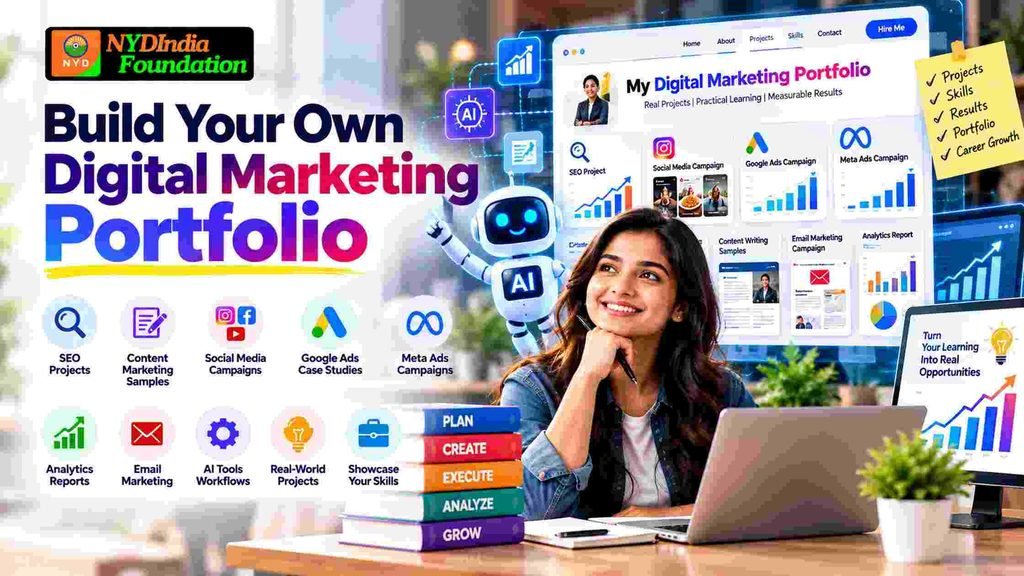
Build Your Own Digital Marketing Portfolio
One of the strongest ways for a student to demonstrate digital marketing skills is through a portfolio.
Instead of telling an employer, “I know SEO”, a student can show an actual SEO project.
A portfolio can include:
SEO Portfolio
- Keyword research
- Competitor analysis
- Website audit
- On-page optimization
- Content plan
Social Media Portfolio
- Instagram strategy
- Facebook campaign
- 30-day content calendar
- Reel concepts
- Social Media Creatives
Advertising Portfolio
- Google Ads campaign structure
- Meta Ads campaign
- Keyword research
- Ad copy
- Audience targeting
- Campaign performance report
AI Marketing Portfolio
- AI content workflow
- AI-powered research process
- Marketing prompt library
- AI creative concepts
- Automated marketing workflow
A portfolio can make a student’s learning more visible during interviews and freelance discussions.
Learn Through Real-World Marketing Problems
The best learning experience often comes from solving practical business problems.
For example:
Case Study: Local Restaurant
A restaurant wants more online orders.
A digital marketing student can create a strategy involving:
Google Search → Meta Ads → Social Media Content → Landing Page → WhatsApp Follow-up → Analytics
Case Study: Real Estate Company
A property company wants qualified leads.
The student can develop:
Audience Research → Google Ads → Meta Ads → Landing Page → Lead Form → Follow-up → Conversion Tracking
Case Study: Training Institute
An educational institute wants more student enquiries.
The strategy could include:
SEO → Blog Content → Social Media → Google Ads → Meta Ads → Lead Generation → Remarketing
These projects help students understand how individual marketing channels work together.
Freelancing Opportunities
Digital marketing can also provide opportunities for freelance work.
After developing sufficient skills and experience, a freelancer may offer services such as:
- SEO
- Social media management
- Google Ads management
- Meta Ads management
- Content writing
- Website optimization
- Local SEO
- Email marketing
- AI-assisted content creation
- Marketing strategy
- Lead generation
However, freelancing is not an instant-income opportunity. Students need to develop their skills, create a portfolio, communicate professionally, and build trust with clients.
A strong approach is:
Learn → Practice → Build Portfolio → Start Small → Get Experience → Build Client Base
Opportunities for Entrepreneurs and Business Owners
Digital marketing with AI is not only useful for people looking for jobs.
Business owners can also benefit from understanding digital marketing.
An entrepreneur who understands:
- SEO
- Social media
- Paid advertising
- Content
- Analytics
- AI
- Customer journeys
can make better decisions when promoting a business online.
Even when a company hires an external agency, basic digital marketing knowledge helps the business owner understand campaign reports, marketing proposals, and performance metrics.
Why Students Should Focus on Skills, Not Just Certificates
A certificate can demonstrate that a student completed a course, but practical skills demonstrate what the student can actually do.
Therefore, students should ask important questions before joining any digital marketing programme:
- Does the course include practical projects?
- Will I learn SEO?
- Will I learn Google Ads?
- Will I learn Meta Ads?
- Is AI integrated into the curriculum?
- Will I learn analytics?
- Will I create a portfolio?
- Will I receive practical assignments?
- Are trainers experienced in digital marketing?
- Is there career guidance?
- Does the course provide opportunities to work on real-world campaigns?
These questions can help students choose a programme based on learning value rather than marketing promises alone.
Skills You Can Develop During the Course
A comprehensive Digital Marketing with AI Course can help students develop a combination of technical, creative, and analytical skills.
| Skill Area | What Students Can Learn |
|---|---|
| SEO | Keyword research, on-page and technical SEO |
| Content | Blogs, landing pages, social content |
| Social Media | Strategy, content planning and analytics |
| Google Ads | Search campaigns and optimization |
| Meta Ads | Audience targeting and campaign management |
| AI | AI tools, prompting and marketing workflows |
| Analytics | Campaign measurement and reporting |
| Email Marketing | Campaigns, segmentation and automation |
| Automation | Lead and marketing workflows |
| Strategy | Funnels, targeting and conversion planning |
This combination makes the learning experience more practical and career-oriented.
A Complete Digital Marketing Learning Framework
Students can think of their learning journey as a complete marketing system:
Stage 1. Understand
Learn digital marketing fundamentals and customer behavior.
Stage 2. Research
Understand keywords, competitors, audience, and market trends.
Stage 3. Create
Develop content, campaigns, creatives, and marketing assets.
Stage 4. Promote
Use SEO, Google Ads, Meta Ads, and social media.
Stage 5. Identify industry issues
Analyze traffic, engagement, leads, and conversions.
Stage 6. Optimize
Industry problems and improve campaign performance.
Stage 7. Automate
Use AI and automation to reduce repetitive marketing tasks.
Stage 8. Build
Create a portfolio and prepare for employment, freelancing, or entrepreneurship.
This framework helps students understand that digital marketing is not a collection of unrelated tools. It is a complete business growth process.
The Future of Digital Marketing with AI
The future of digital marketing will likely require professionals who can combine marketing fundamentals with technology, creativity, and analytical thinking.
AI may make some marketing tasks faster, but businesses will still need people who understand customers and can make strategic decisions.
Future marketers may increasingly work with:
- Generative AI
- AI-powered analytics
- Marketing automation
- Conversational search
- Personalization
- Predictive insights
- Automated campaign optimization
- AI-generated creative concepts
- Customer data platforms
- Advanced attribution
Students who start developing these skills early can build a stronger foundation for adapting to future changes.
Start Your Career Journey with the Right Mindset
Learning digital marketing should not be treated as a shortcut to a job.
It should be treated as a process of developing valuable skills.
Start with the fundamentals.
Practice every concept.
Create projects.
Analyze your results.
Learn from mistakes.
Experiment with AI.
Build a portfolio.
Keep learning.
Digital marketing changes continuously, so successful professionals need to remain curious and adaptable.
Conclusion
Digital Marketing with AI is becoming an important combination for students who want to build careers in the modern digital economy. From SEO and social media to Google Ads, Meta Ads, analytics, content creation, and automation, today’s marketers need a wider range of skills than ever before.
AI can help marketers research faster, generate ideas, automate repetitive activities, and analyze information. But technology alone does not create successful marketing campaigns. Strategy, creativity, audience understanding, communication, and analytical thinking remain essential.
For students, the best approach is therefore to learn both sides: understand digital marketing fundamentals and learn how AI can make those skills more powerful.
A good course should provide more than lectures and a certificate. It should encourage students to practice, complete projects, build portfolios, and understand real-world marketing problems.
Whether your goal is to become a digital marketing professional, SEO specialist, social media manager, performance marketer, content creator, freelancer, or entrepreneur, learning Digital Marketing with AI can give you a structured foundation to start your journey.
The digital world will continue to change. New platforms, tools, and technologies will appear. The students who continue learning, experimenting, and adapting will be better prepared to take advantage of those opportunities.
Learn the Fundamentals. Master modern tools. Use AI intelligently. Build real projects. Create your portfolio. And take the first step toward your digital marketing career.
📩 Enquire About the Digital Marketing with AI Course
Ready to build career-ready digital marketing skills with AI? Get in touch with NYD India Foundation to learn more about the course, modules, practical projects, admission process, and upcoming batches.
Why Enquire With Us?
- Learn Digital Marketing + AI
- Practical, industry-focused learning
- SEO, Social Media, Google Ads & Meta Ads
- AI-powered content creation and marketing
- Analytics and marketing automation
- Real-world projects and portfolio building
- Career guidance and skill development
📞 Contact Us Today
Call/WhatsApp: 77 3676 3676 | 94 3363 7001
Email: info@nydindia.com
Website: www.nydindia.com | www.nydindia.org
🎓 Start Your Learning Journey
Don’t just learn digital marketing—learn how to use AI to make your marketing skills more powerful.
Enquire Now | Book Your Counselling Session | Join the Upcoming Batch