

SEO Course: Build Practical Search Engine Optimization Skills for a Successful Digital Marketing Career
Introduction
In today’s digital world, having a website is not enough to establish a strong online presence. Businesses need to ensure that their websites appear in front of the right audience when people search for relevant products, services, or information on Google and other search engines. This is where Search Engine Optimization (SEO) becomes essential.
An SEO Course is designed to help learners understand how search engines work, how websites achieve higher organic visibility, and how to attract relevant visitors without depending entirely on paid advertising. From keyword research and content optimization to technical SEO and performance analysis, a structured course introduces the techniques required to improve performance.
Whether you are a student, business owner, blogger, freelancer, or aspiring digital marketer, learning SEO can help you develop valuable skills for the growing digital marketing industry.
What is an SEO Course?
An SEO Course is a structured learning programme that teaches the principles, strategies, tools, and techniques used to improve a website’s visibility in organic search engine results.
The course generally covers different aspects of optimization, including website structure, keyword selection, content, link building, technical performance, and search engine guidelines.
Instead of focusing only on theoretical knowledge, the practical SEO training programme allows learners to understand how optimization works on real websites.
Some important areas covered in SEO Training include:
- Understanding search engine algorithms and ranking systems.
- Identifying relevant keywords based on search intent.
- Optimizing website pages for organic search.
- Improving website speed and technical performance.
- Developing effective content optimization strategies.
- Building quality backlinks and website authority.
- Analysing organic traffic and keyword performance.
- Understanding local SEO and business visibility.
Why is learning SEO Important in the Digital Marketing Industry?
Search engines play an important role in connecting businesses with potential customers. People regularly use search engines to discover information, compare products, find services, and make purchasing decisions.
For businesses, appearing in relevant search results can create opportunities to attract potential customers.
Learning SEO helps individuals understand how to build sustainable organic visibility instead of depending exclusively on advertising campaigns.
Here are some reasons why SEO Knowledge is valuable:
1. Develop Organic Marketing Skills
SEO teaches you how to attract visitors through unpaid search results. You learn to optimize website content, improve page relevance, and create strategies that support long-term organic growth.
2. Understand Customer Search Behaviour
Keyword research helps you discover what people are searching for online. Understanding search intent allows you to create content that answers users’ actual questions.
3. Improve Website Performance
SEO involves more than adding keywords to articles. It also includes improving website navigation, mobile usability, loading speed, internal linking, and technical structure.
4. Build a Strong Digital Marketing Foundation
SEO works alongside content marketing, social media marketing, online reputation management, and paid advertising. Understanding these connections helps learners develop a broader digital marketing perspective.
5. Explore Freelancing and Business Opportunities
Businesses, startups, bloggers, and agencies require SEO-related services. After developing practical experience, learners can explore freelance projects, consulting opportunities, or their own digital marketing services.
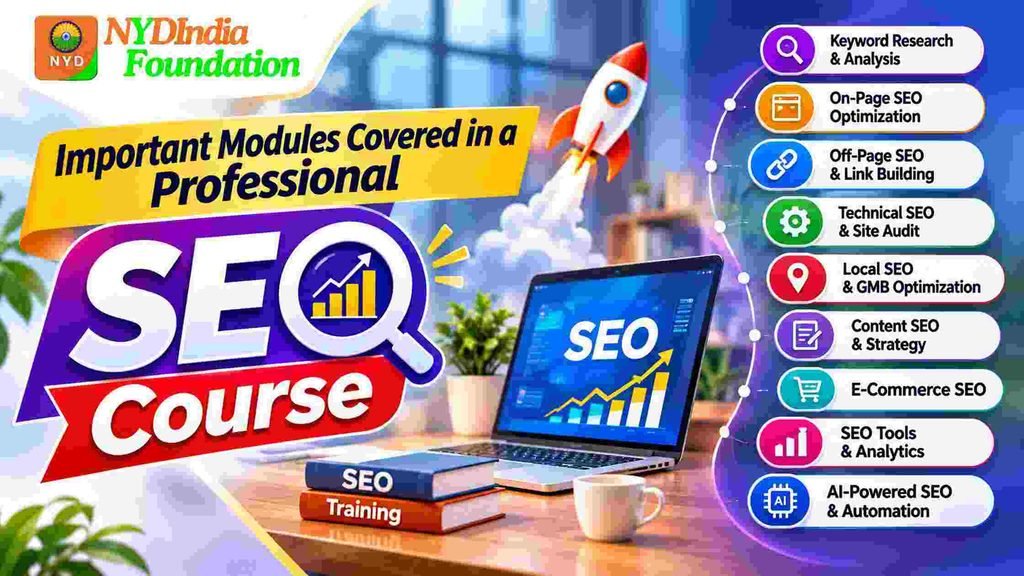
Important Modules Covered in a Professional SEO Course
A comprehensive SEO training programme should cover multiple areas of search engine optimization. Each module develops a different skill required to manage and improve website visibility.
1. Introduction to Search Engine Optimization
This module introduces the fundamental concepts of SEO and explains how search engines discover, understand, index, and rank web pages.
Topics include:
- Meaning and importance of SEO.
- How search engines operate.
- Crawling, indexing, and ranking.
- Organic versus paid search results.
- Introduction to Google Search.
- Understanding search engine guidelines.
2. Keyword Research and Search Intent Analysis
Keyword research is one of the most important parts of SEO. It helps marketers identify relevant search terms that potential visitors use.
Learners understand how to:
- Discover primary and secondary keywords.
- Identify long-tail keywords.
- Analyse keyword competition.
- Understand informational search queries.
- Identify commercial and transactional keywords.
- Group keywords into relevant topic clusters.
- Match content with user search intent.
3. On-Page SEO Optimization
On-page SEO focuses on improving individual website pages so that search engines and visitors can understand their content more effectively.
Important topics include:
- SEO-friendly title tags.
- Meta descriptions.
- Heading tag optimization.
- URL structure.
- Keyword placement and natural usage.
- Image alt text optimization.
- Internal linking strategies.
- Content readability and organization.
- Search intent-based content optimization.
4. Off-Page SEO and Link Building
Off-page SEO involves activities performed outside a website to improve its online reputation, authority, and visibility.
This module introduces:
- Understanding backlinks.
- Quality versus low-quality links.
- Guest posting strategies.
- Competitor backlink analysis.
- Digital PR fundamentals.
- Brand mentions and online reputation.
- Link-building opportunities.
- Identifying potentially harmful backlink patterns.
5. Technical SEO
Technical SEO focuses on the technical elements that help search engines access, crawl, and understand website content.
A practical technical SEO module should include:
- XML sitemap creation.
- Robots.txt configuration.
- Canonical tags.
- HTTPS and website security.
- Website loading performance.
- Mobile-friendly website optimization.
- Structured data and schema markup.
- Crawlability and indexability.
- Broken link identification.
- Redirect management.
- Core Web Vitals fundamentals.
6. Local SEO and Google Business Profile
Local SEO helps businesses improve their visibility for location-based searches.
For example, a physiotherapy clinic in Kolkata may want to appear when someone searches for physiotherapy services in nearby areas.
Learners explore:
- Google Business Profile optimization.
- Local keyword research.
- Business information consistency.
- Local citations.
- Customer review management.
- Location-based landing pages.
- Local search performance analysis.
7. Content SEO and Website Content Strategy
Content plays an important role in SEO because users and search engines need useful, relevant information.
This module focuses on developing content that addresses audience requirements.
Topics include:
- SEO-friendly blog writing.
- Topic research and content planning.
- Content clustering.
- Topic authority.
- Content optimization.
- Updating outdated articles.
- Content gaps and competitor research.
- Helpful, people-first content.
8. E-Commerce SEO
E-commerce SEO focuses on improving the organic visibility of online shopping websites.
The module may include:
- Product page optimization.
- Category page SEO.
- Product descriptions.
- Image optimization.
- Product schema markup.
- Faceted navigation considerations.
- Duplicate content management.
- E-commerce keyword research.
9. SEO Analytics and Reporting
An SEO professional must understand how to measure website performance and identify areas that need improvement.
Learners should become familiar with:
- Google Analytics 4.
- Google Search Console.
- Organic traffic analysis.
- Click-through rate monitoring.
- Search impressions and clicks.
- Keyword performance tracking.
- Landing page analysis.
- SEO reporting and performance evaluation.
10. AI-Powered SEO and Automation
Artificial intelligence is introducing new ways to research, organize, analyse, and optimize digital content.
An updated SEO course should introduce learners to responsible AI-assisted workflows.
Topics can include:
- AI-assisted keyword research.
- Content idea generation.
- SEO content briefs.
- AI-supported competitor research.
- Content optimization assistance.
- SEO workflow automation.
- Introduction to generative search and AI search experiences.
- Human editing, fact-checking, and content quality control.
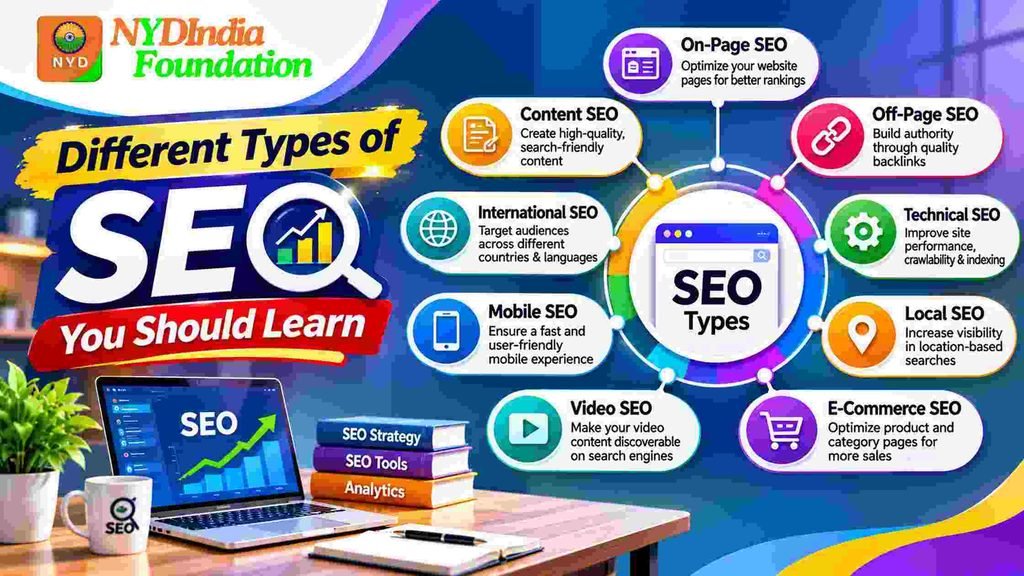
Different Types of SEO You Should Learn
SEO is not limited to a single optimization technique. Different website requirements demand different approaches.
| SEO Type | Primary Focus |
|---|---|
| On-Page SEO | Improving individual website pages |
| Off-Page SEO | Building website reputation and authority |
| Technical SEO | Improving crawling, indexing and technical accessibility |
| Local SEO | Increasing visibility in location-based searches |
| E-Commerce SEO | Optimizing online stores and product pages |
| International SEO | Targeting audiences across different countries and languages |
| Mobile SEO | Improving mobile search experience |
| Image SEO | Making images accessible and search-friendly |
| Video SEO | Improving video discoverability |
| Content SEO | Creating and optimizing relevant website content |
Understanding these categories helps learners select suitable optimization methods according to different business objectives.
Essential SEO Tools Every Learner Should Know
Practical SEO training should introduce learners to industry-relevant tools. These platforms help marketers research keywords, monitor website performance, analyse competitors, and identify technical problems.
Some important tools include:
- Google Search Console – Helps monitor search performance, indexing, and website-related search issues.
- Google Analytics 4 – Provides insights into website visitors and user behaviour.
- Google Keyword Planner – Supports keyword discovery and search demand research.
- SEMrush – Offers keyword research, competitor analysis, and SEO auditing features.
- Ahrefs – Helps analyse backlinks, keywords, and competing websites.
- Screaming Frog SEO Spider – Supports technical website crawling and auditing.
- Yoast SEO – Provides SEO assistance for WordPress websites.
- Google Trends – Helps explore changing search interest and trending topics.
Learners should understand not only how these tools work but also how to interpret their data and use it to make informed optimization decisions.
Practical Projects to Consider During SEO Training
Theoretical knowledge alone cannot prepare someone for every real-world SEO challenge. Practical projects help learners understand how different optimization techniques work together.
A quality SEO course should include assignments such as:
Project 1: Complete Website SEO Audit
Select a website and analyse its existing SEO condition. Identify technical issues, content gaps, missing metadata, and internal linking opportunities.
Project 2: Keyword Research for a Business
Choose a business category and prepare a keyword research report based on search intent, relevance, competition, and audience requirements.
Project 3: On-Page Optimization
Optimize selected website pages by improving titles, headings, meta descriptions, content structure, images, and internal links.
Project 4: Local SEO Campaign
Create an optimization strategy for a local business, including Google Business Profile improvements, local keyword targeting, and review management.
Project 5: Content Strategy Development
Prepare a monthly content calendar with blog topics, target keywords, search intent, and internal linking opportunities.
Project 6: SEO Performance Report
Use Google Search Console and Google Analytics 4 to analyse performance and prepare a report containing observations and recommended improvements.

Career Opportunities After Completing an SEO Course
SEO knowledge can support different career paths within the digital marketing industry. The opportunities available depend on practical ability, portfolio quality, experience, and communication skills.
Some potential career options include:
| Career Option | Main Responsibilities |
|---|---|
| SEO Executive | Managing routine website optimization activities |
| SEO Analyst | Researching keywords and analysing performance |
| SEO Specialist | Developing and implementing SEO strategies |
| Technical SEO Executive | Identifying and resolving technical SEO issues |
| Content SEO Strategist | Planning and optimizing website content |
| Local SEO Specialist | Managing location-based search visibility |
| SEO Consultant | Providing optimization recommendations to businesses |
| Freelance SEO Professional | Delivering SEO services to independent clients |
With additional experience, professionals may progress into SEO management, digital marketing strategy, or agency leadership roles.
How to Choose the Right SEO Course?
Selecting an SEO course requires more than comparing course fees or promotional offers. Learners should evaluate whether the programme provides updated knowledge, practical training, and exposure to industry tools.
Consider these factors before enrolling:
1. Updated Course Curriculum: Check whether the syllabus covers modern SEO practices, technical optimization, local SEO, content strategy, and AI-assisted workflows.
2. Practical Learning Opportunities: Choose a programme that includes live website audits, keyword research assignments, and optimization projects.
3. Industry-Relevant Tools: Check whether the training introduces commonly used SEO platforms and analytics tools.
4. Experienced Trainers: Learn from instructors who understand real-world website optimization and digital marketing challenges.
5. Performance Measurement: The course should teach you how to interpret SEO reports and evaluate results instead of focusing only on rankings.
6. Career Guidance: Check whether the institute offers portfolio development, interview preparation, internship opportunities, or placement assistance.
7. Post-Training Support: Access to learning resources and guidance after course completion can help learners continue developing their skills.
SEO Course vs. Self-Learning: Which Is Better?
Many people start learning SEO through free online resources, blogs, and video tutorials. Self-learning can be useful, but a structured training programme offers a more organized approach.
| Learning Factors | SEO Course | Self-Learning |
|---|---|---|
| Learning Structure | Organized syllabus | Depends on selected resources |
| Practical Assignments | Often included | Must be arranged independently |
| Trainer Guidance | Available in instructor-led programmes | Usually limited |
| Learning Progress | Structured | Self-managed |
| Doubt Resolution | Direct support may be available | Depends on the resource |
| Industry Exposure | Depends on the institute | Requires independent research |
Both approaches can be effective. The right choice depends on your learning style, available time, budget, and career objectives.
Future Scope of SEO in an AI-Driven Search Environment
Search technology continues to evolve. Artificial intelligence, conversational search, voice assistants, and generative search experiences are changing how users discover information online.
However, the importance of relevant, accessible, trustworthy, and useful website content remains significant.
Future-focused SEO professionals should develop skills in:
- Understanding AI-powered search experiences.
- Creating content that addresses genuine user requirements.
- Improving website information architecture.
- Developing topical expertise.
- Implementing structured data appropriately.
- Monitoring changing search behaviour.
- Combining SEO with content marketing and analytics.
- Evaluating organic visibility across different search experiences.
Rather than relying on outdated ranking tricks, learners should focus on building websites that provide meaningful value to their audiences.
Who Should Enrol in an SEO Course?
An SEO course can be useful for individuals from different educational and professional backgrounds.
- Students: Those interested in developing digital marketing skills before entering the job market.
- Freshers: Individuals looking for an entry point into the digital marketing industry.
- Content Writers: Writers who want to understand keyword research, search intent, and content optimization.
- Business Owners: Entrepreneurs interested in improving their websites’ organic visibility.
- Bloggers: Website owners who want to attract relevant organic visitors.
- Freelancers: Professionals interested in offering SEO services to clients.
- Marketing Professionals: Individuals looking to expand their existing digital marketing knowledge.
Prior coding knowledge is generally not necessary for learning SEO fundamentals, although basic website and HTML knowledge can be beneficial for technical SEO.
Conclusion
Search Engine Optimization is an important part of modern digital marketing. It connects businesses with people who are actively searching for relevant information, products, and services.
A professional SEO course can provide learners with a structured understanding of keyword research, on-page optimization, technical SEO, link building, content strategy, local SEO, analytics, and AI-assisted workflows.
However, becoming a capable SEO professional requires consistent practice, experimentation, and an understanding of changing search engine guidelines. Working on real websites and analysing actual performance data can help learners turn theoretical knowledge into practical skills.
Whether your goal is to pursue a digital marketing career, grow a business website, work as a freelancer, or establish your own agency, learning SEO can be a valuable step towards developing a strong foundation in online marketing.
Frequently Asked Questions (FAQs)
1. What is an SEO course?
An SEO course is a training programme that teaches website optimization techniques to improve organic search visibility, attract relevant visitors, and enhance website performance.
2. Can beginners learn SEO without coding knowledge?
Yes. Beginners can learn SEO without programming knowledge. However, basic HTML and website knowledge can be helpful when working with technical SEO.
3. How long does it take to learn SEO?
The learning duration depends on the course structure and individual practice. Basic concepts can be learned within a few weeks, while developing professional skills requires consistent practical experience.
4. What tools are commonly used in SEO?
Popular SEO tools include Google Search Console, Google Analytics 4, Google Keyword Planner, SEMrush, Ahrefs, Screaming Frog, and Yoast SEO.
5. Is SEO a good career option?
SEO can offer career opportunities in digital marketing agencies, businesses, e-commerce companies, consulting, and freelancing. Career growth depends on practical skills and industry experience.
6. Does an SEO course include practical training?
Many professional programmes include practical assignments such as keyword research, website audits, content optimization, and SEO reporting. Always verify the practical components before enrolling.
7. Can I start an SEO agency after completing a course?
Yes, you can work towards establishing an SEO agency after developing sufficient practical experience, client management skills, and the ability to deliver effective optimization services.
8. Is AI changing traditional SEO practices?
.
AI is influencing content research, search experiences, and optimization workflows. SEO professionals should learn how to use AI responsibly while maintaining content accuracy, originality, and usefulness