
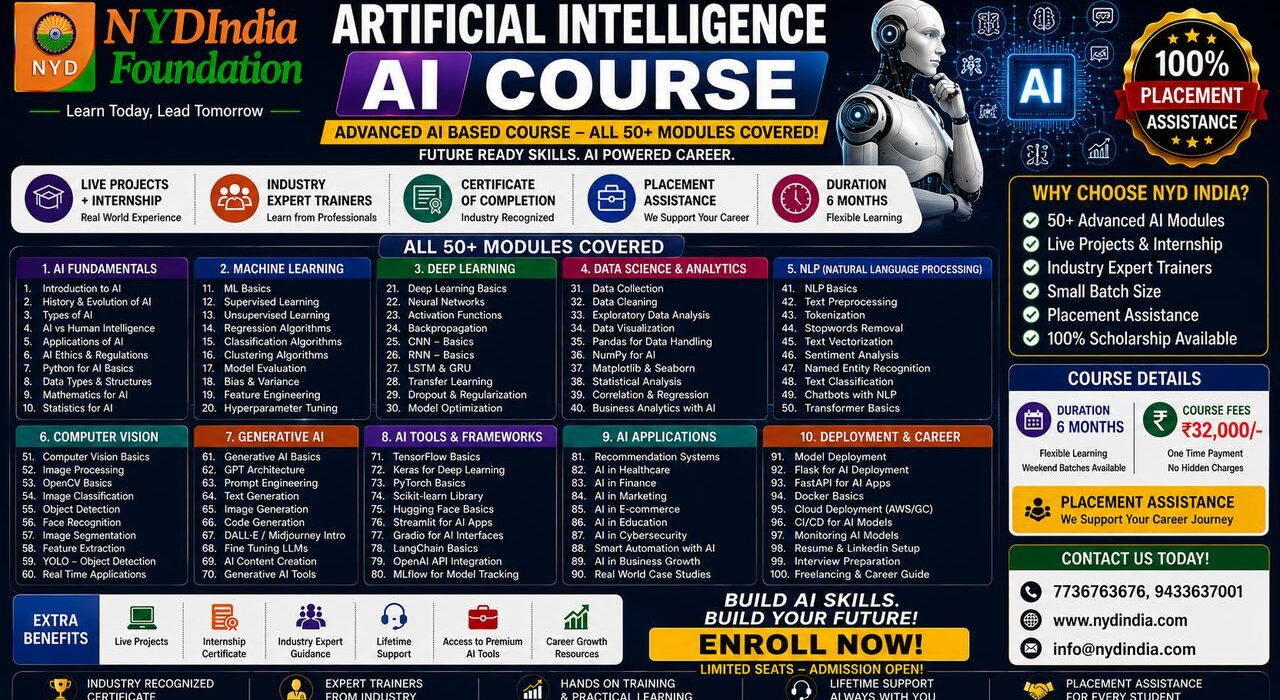
Artificial Intelligence Course by NYD India: Build Practical AI Skills for the Future
Artificial Intelligence is no longer a technology limited to research laboratories or large technology companies. From chatbots and recommendation systems to content creation, business analytics, automation, and smart applications, AI is becoming part of everyday professional life.
As businesses increasingly adopt AI-powered tools, professionals who understand how these technologies work—and, more importantly, how to use them effectively—are gaining a significant advantage. This is where an Artificial Intelligence course by NYD India can provide a practical starting point for students, working professionals, entrepreneurs, and anyone interested in building skills in this rapidly evolving field.
Why Learn Artificial Intelligence Today?
The demand for AI knowledge is growing across industries. Companies are using artificial intelligence to automate repetitive tasks, understand customer behaviour, improve decision-making, develop software, and create personalized experiences.
Learning AI can therefore be useful even if you are not planning to become a traditional AI researcher.
For example, a digital marketer can use AI for content research and campaign analysis. A business owner can explore AI automation for customer support. A developer can use machine learning concepts to build intelligent applications. A student can develop a foundation for a future career in data science, machine learning, or AI development.
The key is to learn AI as a practical technology rather than simply studying theoretical definitions.
Artificial Intelligence Course by NYD India
NYD India offers an Artificial Intelligence learning program designed to introduce learners to important AI concepts, tools, technologies, and practical applications.
The course can be particularly relevant for learners who want structured guidance instead of trying to understand the huge AI ecosystem entirely on their own.
A well-structured AI learning journey generally covers areas such as:
- Artificial Intelligence fundamentals
- Machine Learning concepts
- Deep Learning basics
- Neural networks
- Natural Language Processing
- Generative AI
- AI tools and applications
- Prompt engineering
- Data handling and analysis
- AI automation
- Practical projects
- Industry-oriented applications
The exact modules and course structure may vary, so prospective students should confirm the latest curriculum and training details directly with NYD India.
What Will You Learn in an AI Course?
Artificial Intelligence is a broad subject. A good course should gradually move from fundamentals to practical implementation.
1. Understanding AI Fundamentals
The first step is understanding what artificial intelligence actually means.
Students can learn about AI concepts, intelligent systems, automation, machine learning, and the difference between traditional programming and AI-based systems.
This foundation makes advanced topics easier to understand later.
2. Machine Learning
Machine Learning is one of the most important areas within AI.
Learners can explore how machines identify patterns from data and use those patterns to make predictions or decisions. Concepts such as supervised learning, unsupervised learning, classification, regression, and model evaluation form an important part of the learning journey.
3. Deep Learning
Deep Learning takes machine learning further by using neural networks to process complex information.
It has applications in areas such as image recognition, speech processing, recommendation systems, and natural language technologies.
Understanding the basic principles of neural networks can help learners appreciate how many modern AI applications function.
4. Generative AI
Generative AI has changed the way people think about artificial intelligence.
Modern AI systems can generate text, images, audio, code, and other forms of content. Learning how generative AI works and how to use it responsibly can be valuable for professionals across multiple industries.
Students can also learn how prompts influence AI-generated results and how to improve the quality and usefulness of AI outputs.
5. Prompt Engineering
Knowing how to communicate effectively with AI systems has become a valuable digital skill.
Prompt engineering involves creating clear and structured instructions that help AI models produce more useful results.
Instead of simply asking an AI tool a basic question, learners can understand how context, role, instructions, examples, constraints, and desired output formats can influence the response.
Practical Learning Matters More Than Theory
One of the biggest challenges when learning AI is the difference between understanding concepts and actually applying them.
Reading about machine learning is useful, but building something with it creates a completely different level of understanding.
That is why practical projects can play an important role in an Artificial Intelligence course.
Students may work on projects involving:
- AI-powered chatbots
- Predictive models
- Text classification
- Recommendation systems
- Generative AI applications
- AI content workflows
- Automation solutions
- Data analysis projects
- Intelligent business applications
Projects also give learners something concrete to discuss during interviews or professional discussions.
Who Can Join an Artificial Intelligence Course?
An AI course is not necessarily limited to computer science graduates.
It can be useful for:
Students
Students can use AI education to explore emerging career opportunities and build technical skills before entering the professional world.
Working Professionals
Professionals from marketing, finance, sales, operations, HR, technology, and other fields can learn how AI can improve their existing workflows.
Entrepreneurs
Business owners can explore AI applications for automation, customer service, research, marketing, and productivity.
Digital Marketers
AI is increasingly being used for keyword research, content ideation, campaign analysis, personalization, customer research, and workflow automation.
Beginners Interested in Technology
People without an advanced technical background can start with AI fundamentals and gradually move toward more technical concepts.
Career Opportunities After Learning AI
Artificial Intelligence is connected to a wide range of technology and business roles.
Depending on their skills, educational background, and practical experience, learners can explore career paths such as:
- AI Developer
- Machine Learning Engineer
- AI/ML Associate
- Data Analyst
- Junior Data Scientist
- AI Automation Specialist
- Prompt Engineer
- Generative AI Specialist
- Python Developer
- AI Application Developer
However, completing a course alone does not guarantee a particular job role or salary. Career outcomes depend on practical ability, portfolio quality, interview performance, experience, and the requirements of individual employers.
Why Choose Practical AI Training?
AI changes quickly. New models, tools, frameworks, and applications appear regularly.
Because of this, learning should not focus only on memorizing definitions.
A practical learning approach can help students understand how to:
Learn → Practice → Build → Test → Improve
This approach can turn theoretical knowledge into usable skills.
A learner who builds several small AI projects may develop a stronger portfolio than someone who only completes theoretical lessons.
Artificial Intelligence and the Future of Work
AI is likely to change many existing job roles rather than simply replace every human task.
Professionals who understand how to work alongside AI can potentially use technology to complete repetitive tasks faster and spend more time on activities requiring creativity, communication, strategic thinking, and decision-making.
For students and professionals, this makes AI literacy an increasingly valuable career skill.
The future may not simply belong to people who know AI or people who do not. It may increasingly favour people who know how to use AI effectively within their profession.
Why Consider NYD India for AI Training?
When selecting an Artificial Intelligence course, learners should look beyond the course name.
Important factors include:
- Curriculum depth
- Practical assignments
- Project-based learning
- Trainer experience
- Learning support
- Tools and technologies covered
- Course duration
- Class format
- Portfolio development
- Career guidance
NYD India positions its AI training around practical learning and industry-relevant skills. Before enrolling, students should review the current curriculum, class schedule, fees, project structure, and other course terms to make sure they match their individual goals.
How to Choose the Right Artificial Intelligence Course
Not every AI course will be suitable for every learner.
Before making a decision, ask yourself:
Do I want a technical or non-technical learning path?
If you want to develop AI applications, you may need stronger programming and mathematical foundations.
Do I want to use AI in my existing profession?
If your goal is productivity, automation, marketing, business, or content creation, an application-focused course may be more suitable.
Does the course include practical work?
Projects can help convert theoretical knowledge into real-world skills.
Is the curriculum updated?
AI evolves quickly, so current tools and concepts matter.
Artificial Intelligence Course by NYD India: Learn the Skills Behind the Next Generation of Technology
Artificial Intelligence has moved far beyond being a futuristic concept. Today, AI is being used to write and analyze content, understand customer behaviour, automate business processes, generate software code, detect patterns in data, create images and videos, and support important business decisions.
This rapid adoption has created a new demand for people who understand how to work with AI.
For students, working professionals, entrepreneurs, marketers, developers, and technology enthusiasts, learning Artificial Intelligence can be a valuable way to prepare for the changing digital workplace.
An Artificial Intelligence course by NYD India can provide learners with a structured environment to explore AI concepts, modern tools, practical applications, and project-based learning.
The Growing Importance of Artificial Intelligence
Think about how technology has changed over the last decade. Smartphones became smarter, businesses moved online, cloud computing became mainstream, and automation became part of everyday operations.
AI represents another major shift.
Businesses can now use intelligent systems to analyze large amounts of information, communicate with customers, automate repetitive work, and generate useful insights in a much shorter time.
This means AI knowledge is becoming useful in both technical and non-technical careers.
A marketing professional may use AI for customer research. A developer may use AI-assisted programming. A business owner may automate customer enquiries. A data professional may use machine learning to identify patterns.
The possibilities continue to expand.
What Makes AI Different From Traditional Software?
Traditional software generally follows instructions written by developers.
Artificial Intelligence introduces systems that can learn patterns from information and use those patterns to produce predictions, recommendations, classifications, or generated content.
For example, a traditional program might follow a fixed set of rules to identify a particular condition. A machine learning model can instead be trained using examples and learn patterns from the available data.
Understanding this difference is one of the first steps toward understanding modern AI.
A Structured Artificial Intelligence Learning Journey
A good AI learning program should not throw beginners directly into complicated algorithms.
Learning becomes easier when topics are introduced progressively.
A typical journey can look like this:
AI Fundamentals → Python & Data → Machine Learning → Deep Learning → NLP → Generative AI → Prompt Engineering → Projects → Practical Applications
This progression helps learners build knowledge step by step.
Artificial Intelligence Fundamentals
The foundation of an AI course begins with understanding the technology itself.
Students can explore concepts such as:
- What is Artificial Intelligence?
- Types of AI
- AI applications
- Machine learning vs AI
- Deep learning basics
- AI-based decision systems
- Automation
- Data and AI
- Real-world AI use cases
These fundamentals help learners understand where different AI technologies fit into the broader ecosystem.
Python for Artificial Intelligence
Programming is an important component of technical AI development.
Python has become particularly popular in the AI and data science ecosystem because of its readability and extensive collection of libraries and frameworks.
Learners may be introduced to:
- Python fundamentals
- Variables and data types
- Conditional statements
- Loops
- Functions
- Data structures
- Object-oriented programming basics
- Libraries used in AI and data analysis
The objective is not simply to learn Python syntax. It is to understand how programming can be used to work with data and build intelligent applications.
Understanding Data
AI systems depend heavily on data.
If the data is incomplete, inconsistent, biased, or poorly prepared, the resulting model may not perform as expected.
For this reason, learners should understand the basics of:
- Data collection
- Data cleaning
- Data preprocessing
- Data visualization
- Feature selection
- Training data
- Testing data
- Data interpretation
This foundation becomes especially important when moving into machine learning.
Machine Learning: The Core of Modern AI
Machine Learning is one of the most important areas of Artificial Intelligence.
Instead of manually programming every possible outcome, machine learning allows systems to learn patterns from data.
Students can explore concepts such as:
Supervised Learning
Models learn from labelled examples and use those examples to make predictions.
Unsupervised Learning
Algorithms look for patterns or structures in data without predefined labels.
Classification
Classification models can be used when the expected output belongs to specific categories.
Regression
Regression techniques are commonly used to predict numerical values.
Model Evaluation
A model must be evaluated to understand how well it performs on relevant data.
Learning these concepts gives students a foundation for understanding how real-world machine learning applications are created.
Deep Learning and Neural Networks
Deep learning is another major area of AI.
Neural networks are inspired loosely by the way biological neural systems process information. Modern deep learning architectures can handle complex tasks involving images, speech, text, and other forms of data.
Applications include:
- Image recognition
- Speech recognition
- Natural language processing
- Computer vision
- Recommendation systems
- Generative AI
Understanding the fundamentals of neural networks can help learners appreciate how advanced AI systems are developed.
Natural Language Processing
Natural Language Processing, commonly known as NLP, focuses on how computers interact with human language.
NLP technologies are used in:
- Chatbots
- Search systems
- Text classification
- Sentiment analysis
- Translation
- Voice assistants
- Document analysis
- Text summarization
As conversational AI becomes increasingly common, NLP knowledge can be valuable for people interested in language-based AI applications.
Generative AI: A New Era of Content Creation
Generative AI has brought Artificial Intelligence into the mainstream.
Unlike systems designed only to classify or predict information, generative AI can create new content based on user instructions.
Depending on the technology, this can include:
- Text
- Images
- Audio
- Video
- Computer code
- Presentations
- Marketing content
For professionals, the most important skill is learning how to use these tools thoughtfully rather than simply generating content automatically.
Prompt Engineering as a Modern AI Skill
The quality of an AI-generated response often depends on the quality of the instruction.
Prompt engineering teaches learners how to communicate with AI systems more effectively.
A well-designed prompt can specify:
- Context
- Objective
- Role
- Audience
- Tone
- Information requirements
- Restrictions
- Output format
- Examples
This can be particularly useful for marketers, content creators, researchers, business professionals, and developers.
AI Automation for Businesses
One of the most practical applications of AI is automation.
Businesses perform many repetitive tasks every day. Some of these workflows can be improved using AI-powered tools and automation platforms.
Examples include:
Customer Support: AI can assist with frequently asked questions.
Marketing: AI can help with research, content ideation, segmentation, and analysis.
Sales: AI can support lead analysis and customer communication.
Operations: AI can assist with repetitive information-processing tasks.
Content: AI can accelerate research, drafting, summarization, and content organization.
The goal is not to automate everything. The goal is to identify tasks where AI can improve efficiency while maintaining appropriate human oversight.
Why Projects Matter in an AI Course
One of the biggest differences between learning AI theoretically and learning it practically is the ability to build something.
A project forces students to think about:
- What problem needs to be solved?
- What data is required?
- Which AI technique is appropriate?
- How should the model or tool be tested?
- What happens when the system makes mistakes?
- How can the final solution be improved?
This problem-solving process is extremely valuable.
A project portfolio can also demonstrate practical ability to potential employers.
Examples of AI Projects
Depending on the curriculum and learner level, projects may include:
AI Chatbot
Create a conversational application that responds to user questions.
Recommendation System
Develop a basic system that recommends products, content, or other items based on available information.
Sentiment Analysis
Build a model that identifies whether text expresses positive, negative, or neutral sentiment.
Image Classification
Train a system to classify images into predefined categories.
AI Content Assistant
Create a workflow that uses generative AI to assist with content-related tasks.
Predictive Analytics
Use historical data to create a basic predictive model.
Projects like these allow students to connect classroom concepts with real-world problems.
AI Skills for Digital Marketing Professionals
Artificial Intelligence has a particularly strong connection with digital marketing.
Marketers can use AI for:
- Keyword research
- Competitor analysis
- Content planning
- Customer segmentation
- Ad copy ideation
- Social media content
- Campaign analysis
- Personalization
- Marketing automation
- Data interpretation
However, AI does not replace marketing strategy.
A marketer still needs to understand the audience, brand positioning, customer psychology, search intent, creative strategy, and business objectives.
AI becomes more powerful when combined with strong human judgement.
AI for Entrepreneurs and Business Owners
Small businesses can also benefit from understanding AI.
An entrepreneur does not necessarily need to become a machine learning engineer to use AI effectively.
Instead, they can learn how to identify opportunities where AI may reduce repetitive work, improve customer experiences, or provide useful business insights.
For example, an online business might use AI-assisted tools to organize customer enquiries, generate initial content drafts, analyze feedback, or automate parts of its internal workflow.
Building an AI Portfolio
A certificate can show that you completed a course, but a portfolio can demonstrate what you can actually do.
Learners should consider creating a collection of practical projects that demonstrate different skills.
A portfolio might contain:
- A machine learning project
- A data analysis project
- A chatbot
- A Generative AI application
- An automation workflow
- An NLP project
- A final capstone project
Documenting the problem, approach, tools used, results, and lessons learned can make a project more meaningful.
What Should You Look for in an AI Institute?
Choosing an AI institute is an important decision.
Before enrolling, compare different programs based on:
Curriculum
Check whether the syllabus covers the areas relevant to your career goals.
Practical Training
Look for assignments, projects, demonstrations, and hands-on activities.
Trainer Support
Guidance can make a significant difference when students encounter technical problems.
Updated Content
AI evolves quickly, so outdated course material may not provide enough value.
Project Opportunities
Real-world projects can help transform knowledge into practical experience.
Career Guidance
If your objective is employment, check what career support the institute actually provides and what terms apply.
Why NYD India Can Be Considered
NYD India offers professional training programs designed around modern digital and technology skills, including Artificial Intelligence.
For learners considering an AI course, NYD India can be evaluated based on its current curriculum, practical training approach, learning support, course structure, and project opportunities.
Students should always verify the latest information regarding:
- Course duration
- Fees
- Modules
- Class timings
- Training format
- Projects
- Certification
- Career support
- Admission requirements
This helps ensure that the course matches individual expectations.
Artificial Intelligence Is Not Only for Programmers
A common misconception is that AI is exclusively for highly technical professionals.
While programming, mathematics, statistics, and computer science are important for advanced AI development, there are also many ways to apply AI without becoming a specialist researcher.
Professionals from marketing, sales, design, finance, education, operations, content, and entrepreneurship can benefit from understanding AI applications relevant to their work.
The right learning path depends on the individual’s objective.
The Importance of Continuous Learning
Artificial Intelligence is not a subject where learning ends after completing one course.
New models, frameworks, applications, and techniques continue to emerge.
Therefore, an AI learner should develop the habit of:
- Reading about new developments
- Experimenting with AI tools
- Building small projects
- Testing different approaches
- Following industry trends
- Improving technical knowledge
- Understanding responsible AI practices
A course can provide the foundation. Continuous experimentation builds long-term capability.
Artificial Intelligence and Responsible Technology
Learning AI also means understanding its limitations.
AI systems can produce incorrect information, reflect biases in data, expose sensitive information if used improperly, or generate outputs that require human verification.
Responsible AI use involves:
- Checking important outputs
- Protecting sensitive information
- Understanding limitations
- Avoiding inappropriate automation
- Reviewing generated content
- Maintaining human oversight
These principles are becoming increasingly important as AI becomes part of professional workflows.
Final Thoughts
Artificial Intelligence is reshaping the way people work with technology.
From machine learning and deep learning to Generative AI, NLP, automation, and intelligent applications, the field offers a wide range of opportunities for learners with different backgrounds.
An Artificial Intelligence course by NYD India can be a useful option for individuals looking to build structured knowledge and practical exposure to AI.
But the real value of learning AI comes from what you do with that knowledge.
Don’t stop at watching lessons. Experiment with tools. Build projects. Solve problems. Create a portfolio. Understand the limitations of AI. Most importantly, learn how to combine artificial intelligence with your own creativity, experience, and decision-making.
The future of AI will not be built only by people who understand technology. It will also be shaped by people who know how to apply that technology to real-world problems.
Frequently Asked Questions About Artificial Intelligence Courses
Is AI a good career option?
AI is a rapidly developing technology field with applications across many industries. Career opportunities depend on skills, education, practical experience, and the requirements of individual employers.
Can beginners learn Artificial Intelligence?
Yes. Beginners can start with AI fundamentals and gradually progress toward programming, machine learning, Generative AI, and advanced applications.
Do I need mathematics to learn AI?
Basic mathematics and statistics can be helpful, especially for technical machine learning and data science paths. The amount of mathematics required depends on the level of AI you want to pursue.
Can non-technical professionals learn AI?
Yes. AI tools and applications can be useful for professionals in marketing, business, content, sales, operations, and many other fields.
What is the difference between AI and Machine Learning?
Artificial Intelligence is the broader field of creating systems capable of performing tasks associated with intelligent behaviour. Machine Learning is one important approach used to develop AI systems.
What is Generative AI?
Generative AI refers to AI systems capable of creating new content such as text, images, audio, video, or code based on learned patterns and user instructions.
Is a certificate enough for an AI job?
A certificate alone does not guarantee employment. Practical skills, projects, technical knowledge, communication ability, and interview performance are also important.
How can I start an AI career?
Start with the fundamentals, learn relevant programming and data concepts, choose a specialization, build practical projects, create a portfolio, and continuously improve your skills.
SEO Keywords
Primary Keyword:
Artificial Intelligence Course by NYD India
Secondary Keywords:
Artificial Intelligence course, AI course, AI training institute, Artificial Intelligence training, AI course in India, AI course for beginners, machine learning course, Generative AI course, AI certification course, Artificial Intelligence institute, AI career course, practical AI training, AI programming course.
Long-Tail Keywords:
- Best Artificial Intelligence course for beginners
- Artificial Intelligence course with practical training
- AI training course in India
- Artificial Intelligence course for working professionals
- Artificial Intelligence course for students
- Learn Generative AI and Machine Learning
- Artificial Intelligence training by NYD India
- AI course for career development
- Practical Artificial Intelligence course
- Artificial Intelligence course with projects