
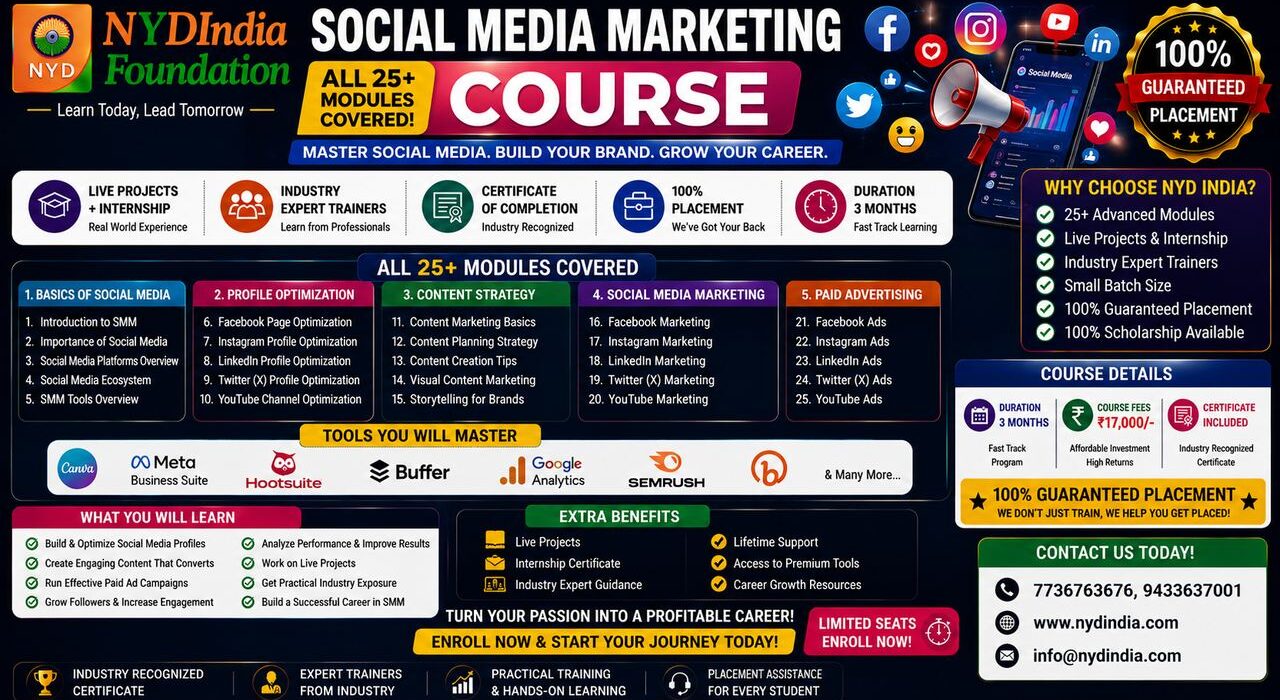
Social Media Marketing Course with Guaranteed Placement: Build a Career in the Digital World
Social media has changed the way businesses communicate with customers. From small local businesses to global brands, companies now depend on platforms like Instagram, Facebook, YouTube, LinkedIn, and other digital channels to attract customers and build their brand identity.
This growing demand has created exciting career opportunities for people who understand how social media works. If you are looking to start a career in digital marketing, a Social Media Marketing Course with guaranteed placement can be a practical way to develop industry-relevant skills and prepare for real job opportunities.
Why Learn Social Media Marketing?
Social media marketing is much more than simply posting photos or writing captions. Professional social media marketers need to understand audience behaviour, content strategy, advertising, analytics, branding, and campaign performance.
A structured course can help students learn these skills step by step instead of trying to understand everything through random online tutorials.
With the right training, you can explore career opportunities such as:
- Social Media Executive
- Social Media Manager
- Digital Marketing Executive
- Content Marketing Executive
- Social Media Advertising Specialist
- Influencer Marketing Executive
- Brand Marketing Executive
- Digital Marketing Consultant
What Makes a Good Social Media Marketing Course?
Choosing a course only because it has an attractive advertisement may not be enough. A useful programme should focus on practical learning and current industry requirements.
A professional Social Media Marketing Course should ideally cover:
1. Social Media Strategy
Students learn how businesses choose the right platforms, identify their target audience and create a long-term social media strategy.
2. Content Creation
Good content is at the heart of social media marketing. Students can learn how to develop ideas for posts, reels, videos, stories, carousels and other formats.
3. Facebook and Instagram Marketing
Facebook and Instagram remain important platforms for many businesses. Training can include organic marketing, content planning, audience targeting and campaign management.
4. Social Media Advertising
Running paid campaigns requires more than simply clicking the “Boost Post” button. A professional course should introduce students to campaign objectives, audiences, creatives, budgets, tracking and performance analysis.
5. YouTube Marketing
Video has become one of the strongest forms of online content. Students can learn about YouTube channel optimisation, content planning, titles, thumbnails, audience engagement and video promotion.
6. LinkedIn Marketing
LinkedIn is particularly useful for professional branding, B2B marketing and recruitment. Students can learn how businesses and professionals use LinkedIn to build credibility and generate opportunities.
7. Analytics and Reporting
A social media campaign cannot be judged only by likes and followers. Students should understand important performance indicators such as reach, engagement, clicks, conversions and return on advertising spend.
Practical Learning Matters
One of the biggest advantages of classroom or structured professional training is the opportunity to work on practical assignments.
Instead of only learning definitions, students can practise creating content calendars, developing campaign ideas, analysing social media pages and preparing marketing reports.
Projects can also help learners build a portfolio. A portfolio gives potential employers something concrete to evaluate when they are considering a candidate.
Social Media Marketing Course with Guaranteed Placement
For many students, learning is only the first step. The bigger question is: What happens after completing the course?
A course that offers placement assistance or a placement guarantee can provide additional career support. However, students should always understand exactly what the institute means by “guaranteed placement” and carefully check the terms, eligibility requirements and placement process before enrolling.
A strong placement-oriented programme should ideally include:
- Resume-building assistance
- Interview preparation
- Practical projects
- Portfolio development
- Mock interviews
- Job interview opportunities
- Industry-oriented training
- Career guidance
- Placement assistance
The goal should not simply be to complete a certificate. The real objective is to become confident enough to handle professional social media responsibilities.
Who Can Join a Social Media Marketing Course?
A social media marketing course can be suitable for a wide range of learners.
Students
Students can develop a practical skill alongside their academic education and explore digital career opportunities.
Freshers
People starting their careers can use social media marketing as an entry point into the broader digital marketing industry.
Working Professionals
Professionals who want to move into digital marketing can use social media skills to expand their career options.
Business Owners
Entrepreneurs can also benefit from learning social media marketing because it helps them understand how to promote their own products and services online.
Freelancers
Social media management is also suitable for freelancers who want to work with multiple clients and build a digital marketing portfolio.
Career Opportunities After the Course
The social media industry continues to create different types of roles. Depending on your skills and experience, you may work with marketing agencies, startups, e-commerce companies, educational institutions, healthcare brands, real estate companies, restaurants and many other businesses.
With experience, a social media executive can gradually move towards roles such as:
Social Media Executive → Social Media Manager → Digital Marketing Manager → Marketing Strategist
Freelancing and consultancy can also become possible career paths after developing sufficient practical experience.
Why Certification Alone Is Not Enough
A certificate can demonstrate that you completed a course, but employers generally want to know what you can actually do.
Can you create a content strategy?
Can you understand an audience?
Can you prepare an engaging content calendar?
Can you analyse campaign results?
Can you identify why an advertisement is not performing?
Can you communicate marketing ideas to a client?
These practical abilities can make a significant difference during a job interview.
Therefore, when selecting a Social Media Marketing Course, look beyond the certificate and focus on skills, projects, practical training and career support.
How to Choose the Right Institute
Before enrolling, compare different institutes based on several factors.
Check the course syllabus and make sure it covers current social media practices. Ask whether students receive practical assignments and whether they work on real or simulated campaigns.
You should also ask about:
- Course duration
- Class format
- Faculty experience
- Practical training
- Project work
- Certification
- Placement terms
- Interview preparation
- Batch size
- Course fees
- Student reviews and outcomes
Most importantly, understand the placement policy clearly before making a payment.
Start Building Your Digital Career
Social media marketing is no longer just about being active on social networking platforms. It has become an important part of modern business communication, branding and customer acquisition.
A well-designed Social Media Marketing Course with guaranteed placement can help learners move from basic social media knowledge to professional marketing skills while also providing structured career support.
If you are serious about entering the digital marketing industry, focus on learning, practising and building a strong portfolio. The combination of practical skills, creativity, analytical thinking and professional guidance can help you create a stronger foundation for a long-term career in social media marketing.
Social Media Marketing Course with Guaranteed Placement: A Practical Path to a Digital Marketing Career
The way people discover brands, communicate with businesses and make purchasing decisions has changed dramatically. Today, a customer may discover a company through an Instagram Reel, watch a YouTube video, read comments on Facebook, check a LinkedIn page and finally visit the company website before making a decision.
This is why businesses need professionals who understand how to use social media strategically.
A Social Media Marketing Course with guaranteed placement can help students, freshers, working professionals and aspiring freelancers develop the skills required to enter this growing field. The right course should combine marketing fundamentals with practical assignments, campaign planning, content creation, analytics and career preparation.
Social Media Marketing Is More Than Posting Content
Many people think social media marketing means uploading posts every day. In reality, professional social media marketing involves research, planning, creativity and analysis.
A social media marketer may be responsible for:
- Understanding the target audience
- Researching competitors
- Planning monthly content
- Creating engaging campaigns
- Managing social media pages
- Writing captions and promotional copy
- Coordinating creative content
- Running paid advertisements
- Tracking campaign performance
- Preparing reports
- Improving campaigns based on data
This combination of creative and analytical work makes social media marketing an interesting career option for people who enjoy both communication and technology.
Learn How Businesses Build Their Online Presence
A professional social media marketing course should teach students how to build a consistent online presence for a brand.
This includes understanding the brand’s personality, target customers, communication style and marketing objectives.
For example, a fashion brand may focus heavily on visual content and influencer collaborations, while a B2B software company may rely more on LinkedIn, educational content and lead-generation campaigns.
The strategy changes according to the business.
Learning this difference is one of the most important steps in becoming a professional social media marketer.
Content Strategy and Content Planning
Content is one of the foundations of social media marketing.
A good marketer does not simply ask, “What should we post today?”
Instead, the question becomes:
“What type of content will help this brand achieve its marketing objective?”
Students can learn how to develop content pillars and create monthly content calendars.
A content strategy may include:
- Educational posts
- Promotional content
- Customer testimonials
- Behind-the-scenes content
- Short-form videos
- Product demonstrations
- Industry updates
- Polls and interactive posts
- User-generated content
- Festival and seasonal campaigns
Learning how to balance different content types helps prevent a social media page from becoming repetitive.
Learn Social Media Advertising
Organic reach is useful, but businesses often use paid advertising to reach specific audiences.
A good Social Media Marketing Course should introduce students to the fundamentals of paid social campaigns.
Students can learn concepts such as:
- Campaign objectives
- Audience targeting
- Ad creatives
- Copywriting
- Budget planning
- Campaign optimisation
- Retargeting
- Conversion tracking
- Performance analysis
Practical advertising knowledge can be particularly valuable because companies want marketers who can understand both creative content and measurable business results.
Understanding Social Media Analytics
Numbers tell a story.
A post receiving thousands of views does not automatically mean it was successful. A campaign with fewer views might generate more leads or sales.
This is why social media analytics is an important part of professional training.
Students should learn how to evaluate metrics such as:
Reach: How many people saw the content?
Engagement: How actively did users interact with it?
Clicks: How many people visited the desired destination?
Conversions: How many users completed the desired action?
Cost per result: How efficiently did a paid campaign perform?
Understanding these metrics helps marketers make better decisions instead of relying only on likes and followers.
Build a Professional Social Media Portfolio
One of the smartest things a student can do during training is build a portfolio.
A portfolio can include sample work such as:
- Social media content calendars
- Instagram campaign concepts
- Facebook advertising plans
- YouTube channel strategies
- LinkedIn content plans
- Sample ad creatives
- Competitor analysis
- Social media audit reports
- Campaign performance reports
A strong portfolio can help demonstrate practical ability during interviews.
For a fresher with limited professional experience, this can be especially useful.
Placement Support Can Make the Transition Easier
Completing a course and finding the first job can sometimes be challenging. This is where placement-focused training can provide additional value.
A Social Media Marketing Course with guaranteed placement may offer career-oriented support such as interview preparation, resume development, portfolio guidance and opportunities to participate in recruitment processes.
However, students should always ask the institute for the exact terms of its placement guarantee.
Important questions include:
- What does “guaranteed placement” specifically mean?
- Are there eligibility requirements?
- Is there a minimum attendance requirement?
- What type of companies participate?
- What roles are offered?
- Is placement support available after course completion?
- Are salary expectations clearly explained?
Understanding these details helps students make an informed decision.
From Classroom Learning to Real-World Marketing
The biggest difference between theoretical learning and professional training is application.
Imagine receiving a project for a local restaurant.
You may need to:
- Identify its target customers.
- Analyse competing restaurants.
- Create a content strategy.
- Prepare a monthly content calendar.
- Develop promotional ideas.
- Design a social media campaign.
- Create sample advertisements.
- Analyse campaign performance.
- Prepare a final report.
This type of project gives students an understanding of how social media marketing works in a real business environment.
Social Media Marketing and AI
Artificial Intelligence is also changing the way marketers work.
Modern marketers can use AI-assisted tools for activities such as:
- Generating content ideas
- Brainstorming captions
- Researching topics
- Creating campaign concepts
- Analysing large amounts of data
- Developing creative variations
- Automating repetitive tasks
However, AI does not replace marketing strategy. A successful marketer still needs creativity, critical thinking, audience understanding and the ability to make strategic decisions.
Therefore, learning how to combine social media marketing with modern AI tools can be a valuable advantage for new professionals.
Freelancing Opportunities in Social Media Marketing
A social media marketing career does not necessarily have to begin with a full-time office job.
After gaining sufficient knowledge and experience, professionals can explore freelance opportunities.
Freelancers may provide services such as:
- Instagram management
- Facebook page management
- Content planning
- Social media advertising
- Influencer campaign management
- Social media audits
- Content strategy
- Monthly reporting
A freelancer can potentially work with clients from different industries and locations.
However, successful freelancing requires more than technical knowledge. Communication, client management, consistency and the ability to demonstrate results are equally important.
Who Should Consider This Course?
A Social Media Marketing Course can be a good option for people who:
- Enjoy creating digital content
- Are interested in marketing
- Want to start a digital career
- Want to learn advertising
- Prefer creative and technology-oriented work
- Want to become a freelancer
- Want to promote their own business
- Want to upgrade their existing marketing skills
You do not necessarily need to be an expert in technology to begin. A willingness to learn and practise is often more important.
Career Growth After Social Media Marketing Training
Social media marketing can provide an entry point into several areas of digital marketing.
A beginner may start as a Social Media Executive and gradually develop expertise in advertising, content strategy, analytics or brand marketing.
With experience, career progression may include:
Social Media Executive → Social Media Specialist → Social Media Manager → Digital Marketing Manager → Marketing Strategist
Some professionals eventually move into freelancing, consultancy or their own digital marketing agency.
What Makes a Course Truly Career-Oriented?
A career-focused programme should not stop at classroom lectures.
Ideally, it should combine:
Theory + Practical Training + Projects + Portfolio + Interview Preparation + Placement Support
This approach gives learners an opportunity to understand concepts and apply them.
Students should also continue practising after completing their course because social media platforms, algorithms, advertising features and content trends change regularly.
Final Word
Social media has become an essential part of modern marketing, and businesses need professionals who can turn online attention into meaningful engagement, leads and business growth.
A Social Media Marketing Course with guaranteed placement can provide a structured route for learners who want to enter this field. But the value of any course ultimately depends on the quality of its training, practical exposure, curriculum and career support.
If you are planning to build a career in digital marketing, start by developing real skills rather than focusing only on certificates. Learn how platforms work, understand audiences, create meaningful content, practise advertising, analyse results and build a portfolio that demonstrates what you can do.
The digital world rewards people who keep learning. With consistent practice and the right professional guidance, social media marketing can become a strong foundation for a long-term career in the digital industry.