
Artificial Intelligence Course: Learn AI Skills, Explore Career Opportunities, and Prepare for the Future
Artificial Intelligence (AI) is transforming how businesses operate, how people work, and how technology solves real-world problems. From chatbots and virtual assistants to predictive analysis, automation, and intelligent software, AI is becoming an essential part of the modern digital world.
As industries adopt AI-powered solutions, learning artificial intelligence can help students, freshers, working professionals, and aspiring entrepreneurs build valuable technical skills. An Artificial Intelligence Course provides a structured way to understand AI concepts, explore practical applications, and prepare for emerging opportunities across different industries.
What is an Artificial Intelligence Course?
An Artificial Intelligence course is a structured learning AI programme designed to introduce learners to the technologies and techniques that enable computers to perform tasks associated with human intelligence.
These tasks may include understanding language, recognising images, analysing data, identifying patterns, making predictions, and supporting decision-making.
Depending on the course level, learners may explore topics such as:
- Fundamentals of Artificial Intelligence
- Machine Learning and Deep Learning
- Natural Language Processing (NLP)
- Generative AI and large language models (NLP)
- AI tools and automation
- Data analysis and visualisation
- Python programming for AI
- Computer vision and intelligent systems
- Real-world AI applications and projects
Some introductory courses focus on AI tools and practical applications, while advanced programmes may include programming, mathematics, model development, and deployment.
Choosing the right course depends on your existing knowledge, learning objectives, and future career plans.
Why Should You Learn Artificial Intelligence?
Artificial Intelligence is no longer limited to research laboratories or large technology companies. Businesses across healthcare, education, finance, retail, manufacturing, marketing, and customer service are exploring ways to use AI.
Learning about AI can help you understand these changes and identify where your skills may be useful.
1. Develop Future-Ready Skills
AI literacy is becoming valuable in many professional roles. Understanding how AI works, where it performs well, and where human judgement is necessary can help you adapt to changing workplace requirements.
2. Improve Productivity
AI tools can assist with research, content organisation, data analysis, customer support, coding, and repetitive tasks. Learning to use these responsibly can improve efficiency and free up time for more complex work.
3. Explore Different Career Paths
AI education can support entry into several technology-related fields depending on the depth of training and practical experience you gain. These may include machine learning, data science, AI application development, automation, and AI product support.
4. Support Business Innovation
Entrepreneurs and business owners can learn how AI may support customer service, data analysis, workflow automation, demand forecasting, and business planning.
5. Build Practical Projects
A well-designed course should give learners opportunities to apply their knowledge. Projects help demonstrate problem-solving ability and provide evidence of practical skills when applying for internships or jobs.

What Will You Learn in an Artificial Intelligence Course?
The syllabus varies by institute and course level. However, a comprehensive AI programme may cover the following modules.
Module 1: Introduction to Artificial Intelligence
Learn what AI is, how it has developed, and how intelligent systems are used in everyday life. Explore the differences between traditional software, machine learning, and generative AI.
Module 2: Fundamentals of Machine Learning
Understand how computers learn patterns from data. Study supervised learning, unsupervised learning, model training, testing, and basic evaluation techniques.
Module 3: Python Programming for AI
For technical programmes, Python provides a foundation for working with data and building AI applications. Learners may study variables, functions, and data structures. They will also learn about libraries and basic programming logic.
Module 4: Data Analysis and Preparation
AI systems depend on data. Learn how to organise datasets, handle missing values, explore patterns, and prepare information for analysis or model training.
Module 5: Deep Learning
Explore artificial neural networks and how deep learning supports applications such as image recognition, speech processing, and advanced language technologies.
Module 6: Natural Language Processing
Understand how AI systems process and generate human language. Potential applications include chatbots, text classification, document summarisation, and language translation.
Module 7: Generative AI
Learn the fundamentals of tools that generate text, images, code, and other content. Explore prompting techniques, practical use cases, output evaluation, and the limitations of AI-generated results.
Module 8: AI Tools and Workflow Automation
Discover how AI-powered tools can support repetitive tasks and business workflows. Depending on the programme, this may include integrating tools, automating processes, and creating simple AI-assisted applications.
Module 9: Responsible and Ethical AI
Study important concerns such as data privacy, bias, misinformation, copyright, transparency, and responsible use of AI systems.
Module 10: Practical Projects and Portfolio Development
Apply your learning through projects such as a basic chatbot, a data analysis dashboard, a document summarisation workflow, or an AI-assisted business solution.
Practical assignments help connect theoretical knowledge with real-world applications.
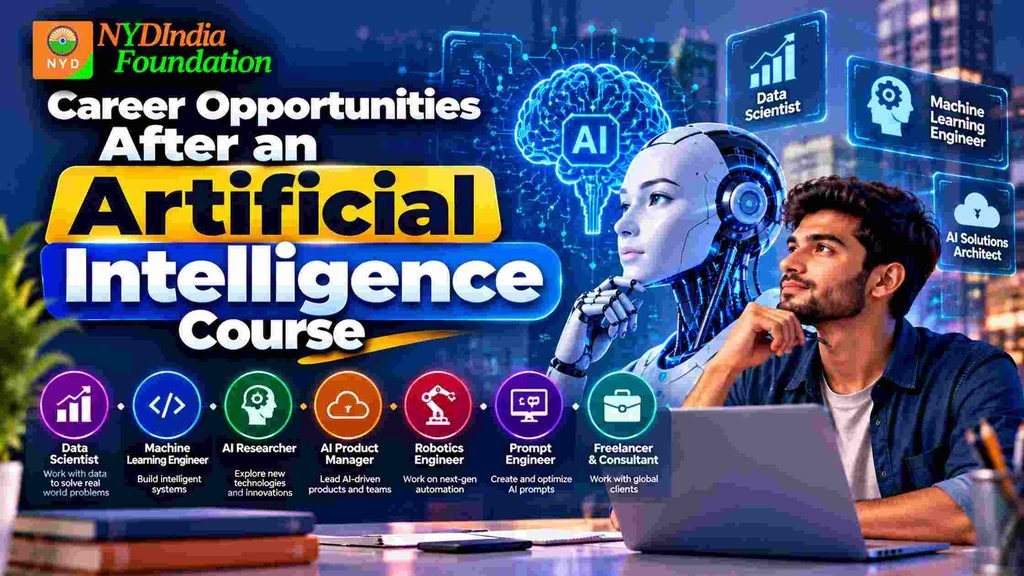
Career Opportunities After an Artificial Intelligence Course
Artificial Intelligence offers several potential career directions. However, the opportunities available to you will depend on your technical skills, educational background, project experience, and the requirements of individual employers.
Some possible career paths include:
AI Engineer: Develop and integrate AI-powered applications and systems. Many positions require strong programming and software development skills.
Machine Learning Engineer: Build, evaluate, and deploy machine learning models. These roles typically require experience in programming, mathematics, and data handling.
Data Analyst: Analyse information, identify trends, and communicate findings to support business decisions. AI and data tools can complement traditional analytical skills.
Data Scientist: Apply statistical methods, programming, and machine learning to solve complex data problems. Many roles require substantial analytical and technical preparation.
NLP Specialist: Work with language processing systems, text analysis, and conversational AI. Advanced roles often require substantial analytical and technical preparation.
AI Automation Specialist: Help businesses streamline processes using AI-enabled software, integrations, and automation platforms.
AI Application Developer: Build software applications that use existing AI models or services. Software development fundamentals are particularly important for this path.
Generative AI Specialist: Develop workflows and applications using generative AI tools. Responsibilities range from evaluating tools to building advanced applications.
An introductory AI course does not automatically qualify someone for every role listed above. Learners should review job requirements and build relevant projects before choosing a career specialization.
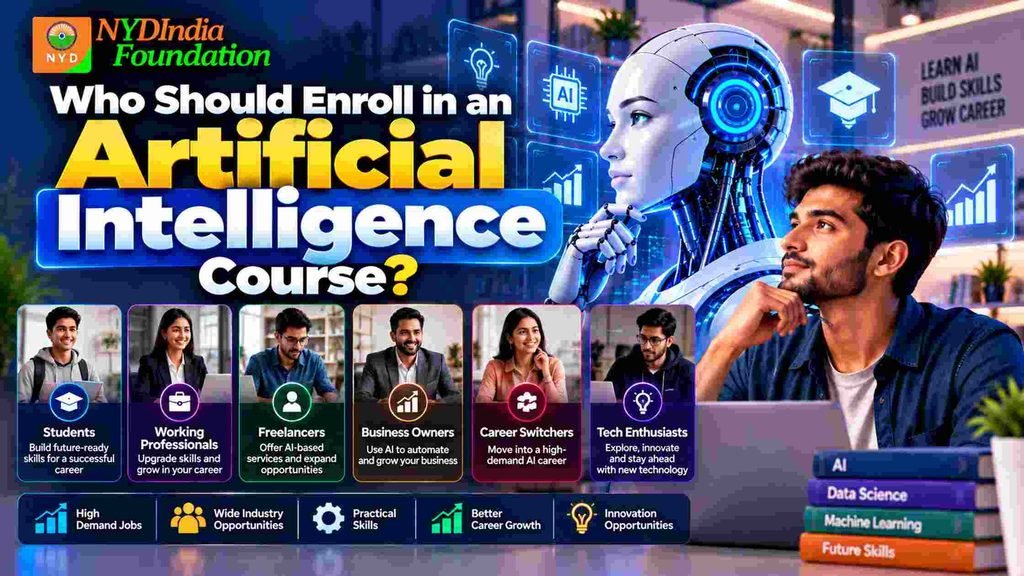
Who Should Enroll in an Artificial Intelligence Course?
AI courses are available for learners with different backgrounds and experience levels.
- Students: Develop an understanding of emerging technologies and explore future study options.
- Freshers: Build foundational skills and begin developing a portfolio of practical projects.
- Working Professionals: Learn how AI may improve existing workflows and support career development.
- Entrepreneurs: Explore ways to automate business processes and improve operational efficiency.
- Digital marketers and content creators: Understand AI-assisted research, content workflows, customer highlights, customer insights, and campaign analysis.
- Developers and IT Professionals: Explore machine learning and generative AI concepts clearly. Advanced technical programmes may require prior knowledge of programming, mathematics, or data analysis.
Beginners can start with an introductory course that explains AI concepts clearly. Advanced technical programmes may require prior knowledge of programming, mathematics, or data analysis.
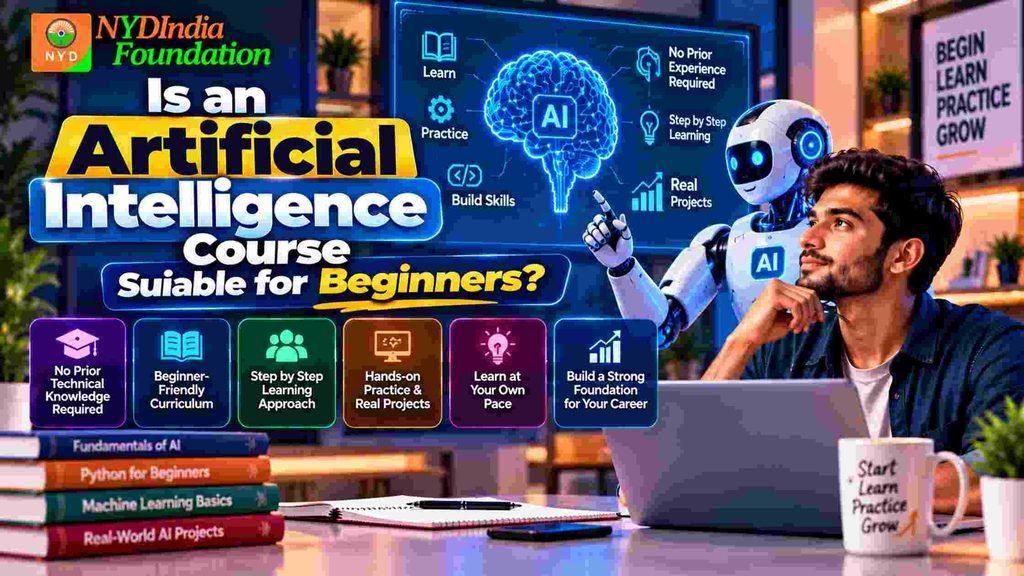
Is an Artificial Intelligence Course Suitable for Beginners?
Yes. Many introductory courses explain AI concepts clearly. Advanced technical programmes may require prior knowledge of programming, mathematics, or data analysis.
A beginner-friendly programme should explain fundamental concepts in simple language, provide guided demonstrations, and gradually introduce practical exercises.
If you want to pursue technical AI development, learning Python and basic mathematics will be helpful. If your primary goal is to use AI tools for productivity or business, you may begin with practical applications before progressing to programming.
Before enrolling, check the entry requirements and syllabus, teaching approach, practical assignments, and level of support provided by the institute.
How to Choose the Right AI Training Institute
Selecting a suitable institute is an important step in your learning journey. Rather than choosing a course based only on advertisements or a certificate, evaluate the quality of the training.
Consider the following factors:
- Updated curriculum: Check whether the syllabus covers relevant AI concepts and current applications.
- Practical learning: Look for hands-on exercises, assignments, and projects.
- Experienced trainers: Review the instructor’s relevant knowledge and teaching experience.
- Beginner support: Confirm whether the course matches your existing skills.
- Project guidance: Find out whether learners receive feedback on their work.
- Career assistance: Ask about portfolio development, interview preparation, and internships and placement assistance, if offered.
- Transparent fees: Understand the total course fees, payment conditions, certificate details, and any additional costs.
- Student feedback: Review credible testimonials and, where possible, examples of completed student projects.
A certificate can demonstrate course completion, but employers may also evaluate your technical ability, portfolio, communication skills, and problem-solving approach.
Why Practical AI Projects Matter
Learning concepts is important, but applying them is equally valuable. Practical projects help you understand the challenges involved in using AI and give you work to discuss with potential employers.
Here are a few project ideas for beginners:
- Create a simple FAQ chatbot for a business website.
- Build a document summarisation workflow.
- Analyse a dataset and present the findings in a dashboard.
- Develop a basic text classification model.
- Create an AI-assisted customer feedback analysis system.
- Build a workflow that uses AI to organise information.
When developing projects, document the problem, tools used, steps followed, limitations, and final results. This makes your portfolio more informative and demonstrates your understanding beyond simply using an AI tool.
The Future of Artificial Intelligence
AI technology is evolving rapidly, with new models, tools, and applications appearing across industries. As adoption grows, professionals may increasingly need a combination of technical knowledge, critical thinking, domain expertise, communication, and ethical awareness.
However, AI adoption does not mean every AI-related job will grow at the same rate, and completing a course does not guarantee employment. Technology changes quickly, so continuous learning and practical experience remain important.
A strong foundation in AI can help learners evaluate new technologies, adapt to different tools, and make informed decisions about their professional development.
Additional Unique Points About Artificial Intelligence Course
1. Understanding the Difference Between AI, Machine Learning, and Deep Learning
An effective Artificial Intelligence course should explain how AI, machine learning, and deep learning are connected. Artificial Intelligence is the broader field, while machine learning enables systems to learn from data. Deep learning uses multi-layered neural networks to solve more complex tasks. Understanding these differences helps learners choose the right specialization.
2. Learn Prompt Engineering for Better AI Results
Prompt engineering involves writing clear instructions to obtain more useful results from generative AI tools. Learners can practise providing context, defining objectives, setting output formats, and refining instructions. These skills can improve AI-assisted research, content creation, brainstorming, and problem-solving without requiring advanced programming knowledge.
3. Explore AI Applications in Different Industries
Artificial Intelligence is being applied across a wide range of industries. Healthcare organisations use AI-assisted analysis, financial institutions explore fraud detection, retailers use demand forecasting, and manufacturers apply predictive maintenance. Studying these applications helps learners understand how to adapt AI skills to different professional environments.
4. Develop Critical Thinking and Problem-Solving Skills
AI tools can produce useful suggestions, but their outputs may contain errors or incomplete information. A good learning programme should teach students to question results, verify facts, compare alternatives, and identify limitations. These skills help learners use AI as a supporting technology rather than relying on it without evaluation.
5. Understand AI Model Evaluation
Building or using an AI system is only one part of the process. Learners should also understand how to evaluate its performance. Depending on the application, this may involve accuracy, precision, recall, response time, quality, reliability, and error analysis. Evaluation helps determine whether an AI solution is appropriate for its intended purpose.
6. Learn the Basics of AI Integration
Modern AI applications often connect models with websites, databases, software platforms, or business tools. Technical courses may introduce API’s, data formats, and application integration. These concepts help learners understand how AI capabilities can be incorporated into existing digital products and workflows.
7. Build an AI Portfolio That Demonstrates Your Skills
A portfolio allows learners to demonstrate what they can actually do with their knowledge. Instead of listing only completed courses, Students can showcase projects, explain their development process, and discuss the problems they solved. A well-documented portfolio can support internship applications, entry-level opportunities, and freelance proposals.
8. Understand Data Privacy and AI Security
Responsible AI use requires careful handling of confidential information, chatbot configuration, data analysis, AI-assisted research, and content operations. However, clients generally expect useful results rather than familiarity with tools alone. Developing a specialisation, building demonstrable projects, and learning client communication are important steps towards offering these services professionally.
10. Explore Open-Source AI Technologies
Some courses introduce open-source models, frameworks, and development libraries. These technologies allow learners to explore how AI applications are created, customised, and tested. Depending on the tools involved, students may also learn about computing requirements, model limitations, licensing, and the practical differences between hosted and locally operated systems.
11. Learn How to Combine AI With Existing Skills
AI can become more valuable when combined with knowledge of another field. For example, marketers can use AI for campaign analysis, designers can explore AI-assisted creative workflows, and business professionals can investigate process automation. Combining domain expertise with AI knowledge can help learners develop solutions tailored to specific industry needs.
12. Prepare for Continuous Learning in AI
Artificial Intelligence is a rapidly changing field. New tools, models, and development techniques can change how particular tasks are performed. Learners should develop the habit of reading documentation, testing new approaches, reviewing project results, and updating their skills. Continuous learning helps maintain the relevance of their knowledge over time.
Conclusion
An Artificial Intelligence course offers more than an introduction to emerging technology. It can help learners develop practical problem-solving abilities, understand intelligent systems, explore industry applications, and discover ways to combine AI with their existing skills.
The most valuable learning experience combines theoretical knowledge, hands-on projects, responsible AI projects, and continuous skill development. Learners should choose a programme that matches their current experience and long-term objectives, not just course duration, certificates, or promotional promises.
Whether your goal is to explore a technical career, improve workplace productivity, develop AI-powered applications, or investigate freelance opportunities, building a strong foundation is an important first step.
The future of AI belongs to people who can understand the technology, evaluate its limitations, and apply it thoughtfully to real-world problems. By choosing the right course and practising consistently, you can develop relevant skills and prepare to explore the opportunities that Artificial Intelligence may offer.
1 Comment-
Pingback: Social Media Marketing Course | NYD India