
Digital Marketing with AI Course: Master the Future of Intelligent Marketing
Introduction: Marketing Is No Longer Just About Being Seen
Imagine launching a marketing campaign without spending hours searching for ideas, analysing competitors, or preparing multiple versions of an advertisement. Now imagine using the time you saved to understand customers better, develop creative strategies, and improve business results.
This is where artificial intelligence is changing digital marketing.
A Digital Marketing with AI Course introduces learners to a new way of approaching marketing. Human creativity works alongside intelligent technology. Instead of simply learning how to promote a product online, students discover how to research smarter and communicate more effectively, analyze performance, and make informed marketing decisions.
From Digital Marketer to Intelligent Marketing Strategist
The role of a digital marketer is changing. Earlier, professionals often spent significant time completing repetitive tasks, including preparing content drafts, organising keywords, and reviewing campaign reports.
AI can now assist with many of these activities. However, technology alone cannot determine what makes a brand memorable, why a customer trusts a business, or which message will genuinely connect with a particular audience.
That’s why modern marketing education should focus on more than software training.
A well-designed Digital Marketing with AI Course helps learners understand the reasoning behind marketing decisions while teaching them how to use AI as a practical assistant. The goal is to develop professionals who can combine creative thinking, business understanding, and data analysis.
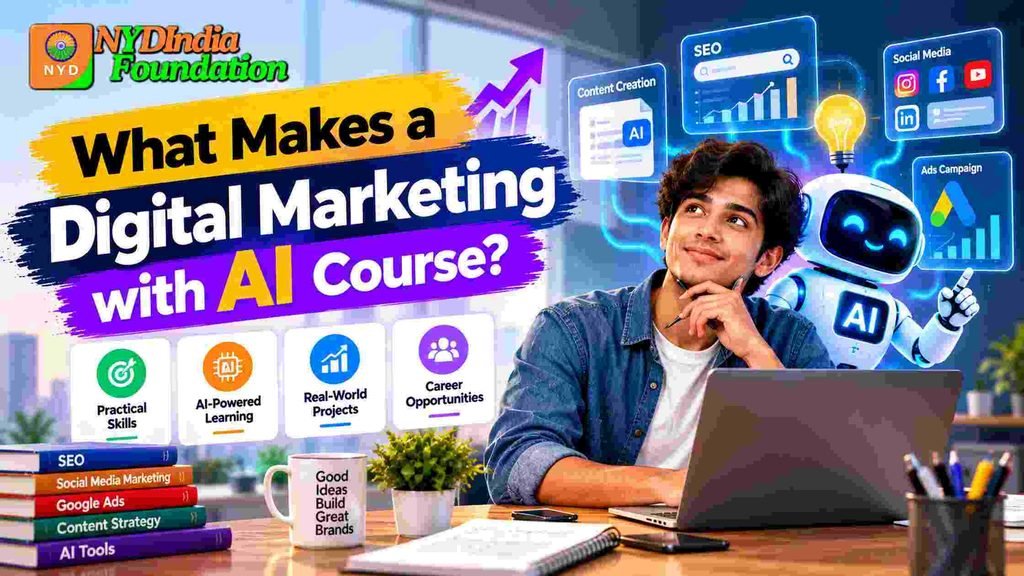
What Makes a Digital Marketing With AI Course Different?
The real difference is how learners tackle everyday marketing challenges.
1. Turning Customer Questions into Marketing Opportunities
Every search query reveals something about a customer’s needs. Someone searching for a course syllabus may be comparing learning options, while someone searching for course fees may be closer to making an enrollment decision.
AI-assisted research can help organise these queries into meaningful groups. Marketers can then create relevant blog posts. Landing pages, advertisements, and FAQs for different stages of the customer journey.
This approach connects content creation with customer intent rather than producing articles to fill a website.
2. Creating Content with Strategy, Not Just Speed
Publishing more content does not automatically produce better marketing results. Content must answer real questions, communicate a clear message, and offer something useful to its intended audience.
AI can help generate initial ideas, develop outlines, and suggest alternative headlines. Human marketers must contribute original examples, verify facts, maintain brand consistency, and improve the content with genuine insights.
A strong course should teach students how to direct AI effectively instead of accepting its first response.
3. Making Advertising More Experimental
Successful advertising often comes from testing different ideas rather than relying on assumptions.
For Example, an online clothing brand could test advertisements focused on design, comfort, seasonal trends, or value. AI can assist with developing creative variations while the campaign runs. Analytics help. marketers evaluate. Which approaches perform best.
Learners should understand how to form a hypothesis, establish a suitable measurement plan, compare results, and recommend improvements.
4. Connecting Marketing Data With Business Decisions
Website traffic, social media engagement, and advertising clicks are useful indicators, but they do not always represent business success.
AI-assisted analytics can help marketers summarise reports and identify patterns worth investigating. Students must also learn to distinguish meaningful findings from misleading correlations and incomplete data. The important question is not simply how many people viewed the campaign, but whether it contributed to meaningful outcomes such as qualified leads, purchases, enquiries, or customer retention.
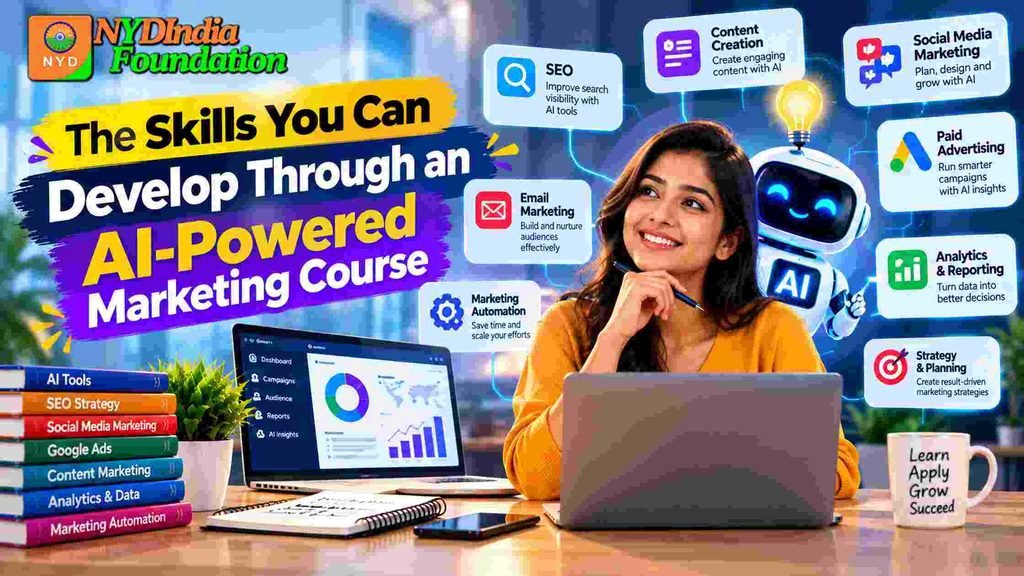
The Skills You Can Develop Through an AI-Powered Marketing Course
A comprehensive programme may cover several interconnected skill areas.
Search Engine Optimization: Understand search intent, keyword research, on-page optimization, technical SEO fundamentals, and content planning.
Performance Marketing: Learn campaign structure, audience targeting, budget allocation, conversion tracking, and advertising performance measurement.
AI-Assisted Content Strategy: Develop content briefs, campaign concepts, blog outlines, social media calendars, and brand-specific messaging.
Marketing Automation: Explore email sequences, lead nurturing, audience segmentation, and automated customer communication.
Analytics and Reporting: Learn to interpret campaign social media, evaluate key performance indicators, and communicate actionable recommendations.
Prompt Engineering: Practise writing clear instructions, supplying relevant context, setting output requirements, and checking AI-generated responses.
The combination of these skills can help learners understand how different marketing activities contribute to a broader business strategy.
Practical Projects: Where Learning Becomes Experience
One of the most valuable parts of digital marketing education is the opportunity to solve realistic marketing problems.
Instead of studying concepts only through presentations, learners can develop projects that demonstrate how they apply their knowledge.
Possible projects include:
- The SEO Growth Blueprint: Prepare a keyword map, competitor review, content plan, and basic website optimization recommendations for a sample business.
- The AI Content Studio: Create a content calendar, develop platform-specific moments, and establish a content brand voice.
- The Advertising Experiment: Design alternative ad creatives, define campaign objectives, and establish metrics for evaluating performance.
- The Customer Journey Project: Map the steps from initial awareness to enquiry or purchase and suggest relevant content for each stage.
- The Marketing Intelligence Report: Analyse a sample dataset and turn the findings into clear, practical recommendations.
These Projects can become portfolio pieces that help learners explain their capabilities during interviews or when approaching freelance clients. Any results included should come from actual work and verified data.
Who Can Benefit from Learning Digital Marketing with AI?
This learning path can be useful for people with different professional goals.
Students can use it to develop foundational marketing knowledge and prepare for entry-level opportunities. Business owners can explore ways to improve their online visibility and understand customer acquisition. Freelancers can expand their service offerings, while working professionals can investigate how AI-assisted workflows fit into their existing responsibilities.
Beginners do not necessarily need advanced technical knowledge to start. They do, however, need curiosity, consistent pricing, and a willingness to learn how marketing decisions affect real people and businesses.
Choosing a Course That Teaches More Than AI Tools
AI platforms change frequently. A tool that is popular today may offer different features tomorrow. For this reason, choosing a course based entirely on the number of tools it teaches can be misleading.
Look for a curriculum that explains marketing fundamentals, includes practical assignments, teaches data interpretation, and encourages responsible AI use. Ask whether students receive feedback on their work and whether they complete projects suitable for a portfolio.
It is also worth checking the trainer’s experience, software access requirements, the total fees, and the specifics of any career support provided.
A valuable course should prepare learners to adapt when technologies change, not simply memorise the steps for using one platform.
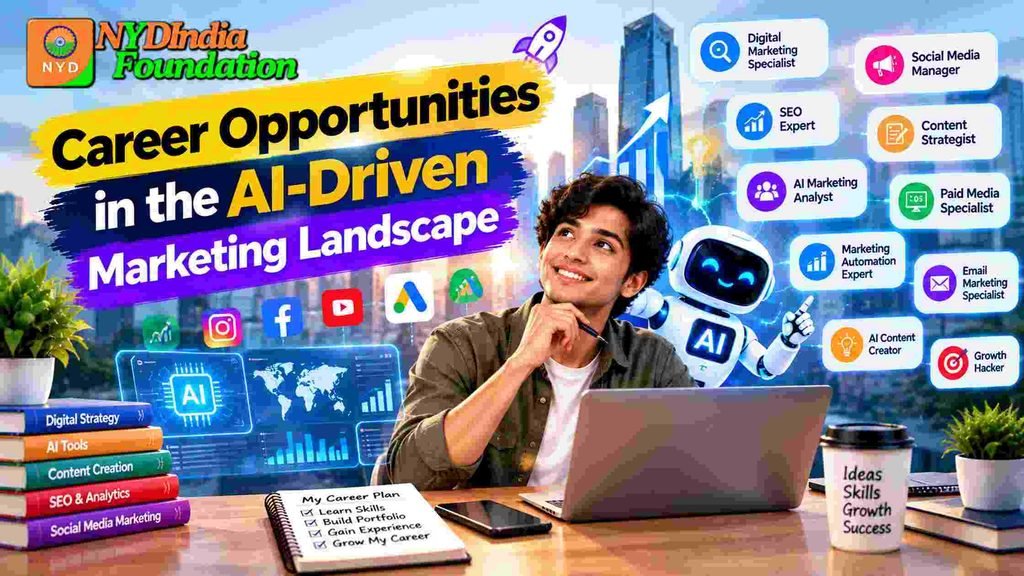
Career Opportunities in the AI-Driven Marketing Landscape
Learning digital marketing alongside AI can support preparation for roles such as SEO Executive, Digital Marketing Executive, Social Media Specialist, Performance Marketing Executive, Content Marketing Specialist, and Marketing Analyst.
Some positions may also involve automation, campaign reporting, or AI-assisted content operations.
Career outcomes depend on practical ability, communication, experience, portfolio quality, and employer requirements. Completing a course does not automatically guarantee a job.
Students can strengthen their profiles by completing relevant projects, understanding marketing metrics, practising presentations, and learning the rationale behind their campaign decisions.
The Future Belongs to Marketers Who Know How to Think
Artificial Intelligence can generate ideas, organise information, and assist with repetitive tasks. But effective marketing still requires empathy. It also requires judgement, originality, and a deep understanding of customer needs.
The most valuable professionals will not necessarily be those who use the greatest number of AI tools. They will be those who know which problem needs solving, which information can be trusted, which message deserves attention, and how to measure the outcome.
A Digital Marketing with AI Course can provide a starting point for developing this combination of abilities.
How AI Is Changing the Way Marketers Understand Customers
Understanding customer behaviour is one of the most important parts of successful marketing. AI-assisted tools can help marketers organise customer feedback, identify recurring questions, and examine patterns in audience interactions. These insights can support more relevant campaigns and better communication. However, understanding the reasons behind customer decisions still requires human judgement, research, and real-world context.
The Role of AI in Search Intent Analysis
Not every search represents the same customer need. Some people want information, others compare available options, and some are ready to purchase. AI can help marketers group search queries according to their likely intent and develop content for each stage of the customer journey. This approach allows businesses to create more relevant landing pages, educational articles, product pages, and enquiry-focused content.
Creating Smarter Marketing Campaigns Through Prompt Engineering
Prompt engineering is the process of giving AI systems clear instructions and useful context to obtain more relevant outputs. In digital marketing, a well-structured prompt can specify the target audience, campaign objective, brand voice, platform, and desired action. Students can practise improving prompts through repeated testing and evaluation. This develops a more systematic approach to using AI rather than relying on generic, one-line instructions.
How AI Can Support Content Gap Analysis
A website may contain many articles but still fail to answer important questions that potential customers have. Content gap analysis helps identify subjects that are missing, underdeveloped, or insufficiently explained. AI can assist with organising existing website content, comparing topic coverage, and generating research questions. Marketers can use these findings to prioritise useful new content instead of publishing repetitive articles without a clear purpose.
The Connection Between AI, SEO, and User Experience
Search engine optimisation is not limited to inserting keywords into a webpage. Visitors also need clear information, easy navigation, useful answers, and a positive browsing experience. AI can help identify potential content improvements and organise website audit findings, while analytics tools provide evidence about how visitors interact with the site. A balanced SEO strategy considers relevance, technical accessibility, content quality, and user needs together.
Building a Consistent Digital Brand Across Multiple Platforms
A business may communicate through its website, Instagram account, email campaigns, advertisements, and other channels. Maintaining a consistent identity across these platforms can be challenging. AI-assisted workflows can help adapt a central campaign message into different content formats while following established brand guidelines. Marketers must review each version to ensure that the tone, information, and message remain appropriate for the intended audience.
AI for Understanding Customer Pain Points
Customers often explain their problems through product reviews, enquiries, support messages, and online discussions. When collected and analysed appropriately, this information can reveal common frustrations and unmet expectations. AI can help categorise feedback into themes, making it easier for marketing teams to identify areas for improvement. Businesses can then use these insights to develop clearer messaging, more useful content, and better customer experiences.
How Small Businesses Can Use AI in Digital Marketing
Small businesses often operate with limited budgets and small teams. AI-assisted tools can help them prepare content drafts, brainstorm promotional campaigns, organise keyword research, and summarise performance reports. For example, a neighbourhood restaurant could use these workflows to plan local content and promote seasonal offers. The greatest benefit comes from choosing practical tools that solve genuine business problems rather than adopting technology simply because it is popular.
The Importance of Human Creativity in AI-Powered Marketing
AI can generate multiple ideas within seconds, but the quantity of ideas does not guarantee originality or emotional connection. Effective marketing often depends on cultural understanding, storytelling, humour, timing, and knowledge of the audience. Students should learn how to use AI as a creative partner while developing their own ability to recognise strong concepts, challenge weak suggestions, and produce distinctive brand communication.
Using AI to Improve Customer Retention Strategies
Acquiring a new customer is only one part of business growth. Companies also need to maintain relationships with existing customers and encourage repeat engagement. AI-assisted analysis may help identify patterns in purchase history, customer feedback, and engagement data. Businesses can use appropriate insights to plan follow-up communication, relevant product recommendations, and loyalty campaigns without overwhelming customers with unnecessary messages.
Understanding Marketing Metrics Beyond Clicks and Impressions
Clicks and impressions help describe campaign activity, but they do not explain the complete business outcome. Marketers also need to understand lead quality, conversion rates, customer acquisition costs, revenue contribution, and customer retention. AI can assist with report summaries and exploratory analysis, but learners must understand what each metric measures and whether the available data supports a conclusion. This helps turn marketing reports into useful business recommendations.
How AI Can Help Develop Better Landing Pages
A landing page should communicate a clear offer, explain its value, address customer concerns, and guide visitors towards a relevant action. AI can help marketers draft alternative headlines, organise frequently asked questions, and suggest improvements to page structure. These suggestions should be tested against actual user behaviour wherever possible. A persuasive landing page is built through a combination of clear communication, credible information, good design, and continuous improvement.
The Growing Importance of First-Party Data
Businesses increasingly need to understand information they collect directly and appropriately through their own websites, customer relationships, subscriptions, and transactions. This is commonly known as first-party data. AI may help organise permitted data and identify broad patterns, but organisations must follow applicable privacy laws, consent requirements, and data security practices. Learning these principles helps future marketers balance personalisation with customer trust.
Developing a Data-Driven Marketing Mindset
A data-driven marketer does not make every decision based on intuition or follow every automated recommendation without question. Instead, they identify a business problem, examine the available evidence, develop a hypothesis, and measure the outcome. AI can support this process by summarising information and suggesting possible explanations. The marketer remains responsible for checking assumptions and deciding which actions are justified by the evidence.
How AI Can Support Marketing Research for New Businesses
Before launching a new business, marketers need to investigate their audience, competitors, pricing environment, and potential positioning. AI can help organise publicly available information, generate interview questions, and structure research findings. However, it can also produce unsupported claims or outdated information. A reliable research process combines AI assistance with credible sources, direct customer feedback, and careful verification before strategic decisions are made.
Why Practical Training Matters in an AI Marketing Course
Understanding the features of a marketing tool is different from knowing how to apply it in a business situation. Practical training gives learners opportunities to work through campaign objectives, research tasks, content briefs, analytics reports, and optimisation exercises. Feedback helps students recognise mistakes and improve their decision-making. A course that connects concepts with realistic projects can provide a stronger learning experience than one focused mainly on demonstrations.
Preparing for a Marketing Environment That Keeps Changing
Digital marketing platforms regularly introduce new features, AI capabilities, reporting options, and campaign formats. This means that professional growth requires continuous learning rather than dependence on a fixed set of tools. Learners should develop habits such as reading platform documentation, reviewing campaign performance, experimenting carefully, and updating their skills. Strong marketing fundamentals make it easier to adapt when the technology changes.
Turning AI Knowledge into Measurable Business Value
The value of AI in digital marketing should be evaluated through its contribution to specific objectives. A useful workflow might reduce time spent preparing initial content drafts, improve the organisation of research, or help a team investigate campaign performance more efficiently. Businesses should compare the results with a suitable baseline and consider the cost of tools, review time, and possible errors. This ensures that AI adoption remains connected to genuine business needs.
Conclusion: Build Marketing Skills That Go Beyond Automation
A Digital Marketing with AI Course should prepare learners to combine technology with strategic thinking, creative communication, and analytical skills. AI can support research, content planning, audience analysis, and campaign optimisation, but its usefulness depends on how intelligently it is applied.
The long-term opportunity lies in learning to ask better questions, evaluate information critically, understand customers, and measure outcomes. By developing these abilities alongside practical digital marketing knowledge, learners can prepare for a field where adaptability and thoughtful decision-making remain essential.
Enquiry & Contact Details – Digital Marketing with AI Course
Interested in learning Digital Marketing with AI at NYD India? Contact our team to learn more about the course syllabus, fees, duration, batch timings, practical projects, scholarships, and career assistance.
Contact NYD India
Phone / WhatsApp:
- +91 77 3676 3676
- +91 94 3363 7001
Email: info@nydindia.com
Website: https://nydindia.com/
Foundation Website: https://nydindia.org/
Kolkata Office: 130/7, Dum Dum Road, Kolkata – 700074, West Bengal, India.
Head Office: 155, Dum Dum Road, Kolkata – 700074, West Bengal, India.