

Social Media Marketing Course: Build the Skills to Turn Digital Creativity into a Professional Career
Introduction
Social media has transformed the way businesses communicate, promote products, and build relationships with customers. Platforms such as Instagram, Facebook, LinkedIn, YouTube, and TikTok have become powerful marketing channels for businesses of every size.
However, simply posing pictures, creating reels, or uploading videos is not enough to achieve meaningful business results. Successful social media marketing requires creativity, strategic planning, audience understanding, advertising knowledge, and performance analysis.
This is where a professional Social Media Marketing Course becomes valuable. It helps learners understand how social platforms work as marketing channels and how to use them to build brands, generate leads, increase engagement, and support business growth.
What Makes Social Media Marketing a Valuable Skill Today?
Social media marketing is no longer limited to maintaining business profiles. It has evolved into a complete marketing discipline that combines branding, communication, advertising, customer engagement, and data analysis.
Businesses need professionals who can understand customer behaviour and create content that encourages people to take action.
Some important reasons why social media marketing skills are valuable include:
- Brand Visibility: Helps businesses reach potential customers across multiple platforms.
- Customer Engagement: Build meaningful relationships through comments, messages, stories, and interactive content.
- Lead Generation: Convert social media audience into potential customers.
- Business Promotion: Introduce products and services through organic and paid campaigns.
- Performance Tracking: Understand which marketing activities generate the best results.
What is a Professional Social Media Marketing Course?
A Social Media Marketing Course is a structured training programme designed to develop practical knowledge of social media platforms, marketing strategies, content development, advertising, and analytics.
Unlike basic tutorials that focus only on individual platform features, a comprehensive course teaches learners how different social media channels work together within a larger digital marketing strategy.
A professional training programme may cover:
- Social media marketing fundamentals.
- Facebook and Instagram marketing.
- LinkedIn marketing strategies.
- YouTube channel marketing.
- Content planning and development.
- Social media advertising.
- Audience research and targeting.
- Influencer marketing.
- Social media analytics.
- AI-Powered content creation and automation.
The objective is to help students develop skills that can be applied to real business marketing requirements.
Understanding the Major Social Media Platforms
Every social media platform has its own audience, content format, and marketing opportunities. Learning how to use each platform strategically is an important part of professional training.
1. Facebook Marketing
Facebook remains an important platform for business promotion, community building, and advertising.
Students can learn how to create business pages, manage communities, develop promotional campaigns, and use Meta Ads Manager.
2. Instagram Marketing
Instagram provides opportunities for visual storytelling, brand awareness, and product promotion.
Training generally focuses on:
- Instagram reels and stories.
- Content calendars.
- Hashtag research.
- Instagram SEO.
- Influencer collaborations.
- Instagram advertising.
- Engagement strategies.
3. LinkedIn Marketing
LinkedIn is particularly useful for professional networking, B2B marketing, recruitment, and business development. Learners explore personal branding, managing company pages, creating professional content, and LinkedIn advertising.
4. YouTube Marketing
YouTube marketing involves more than uploading videos. It requires an understanding of audience retention, video SEO, thumbnails, titles, channel optimization, and content strategy.
Students can learn how to build and promote a YouTube channel effectively.
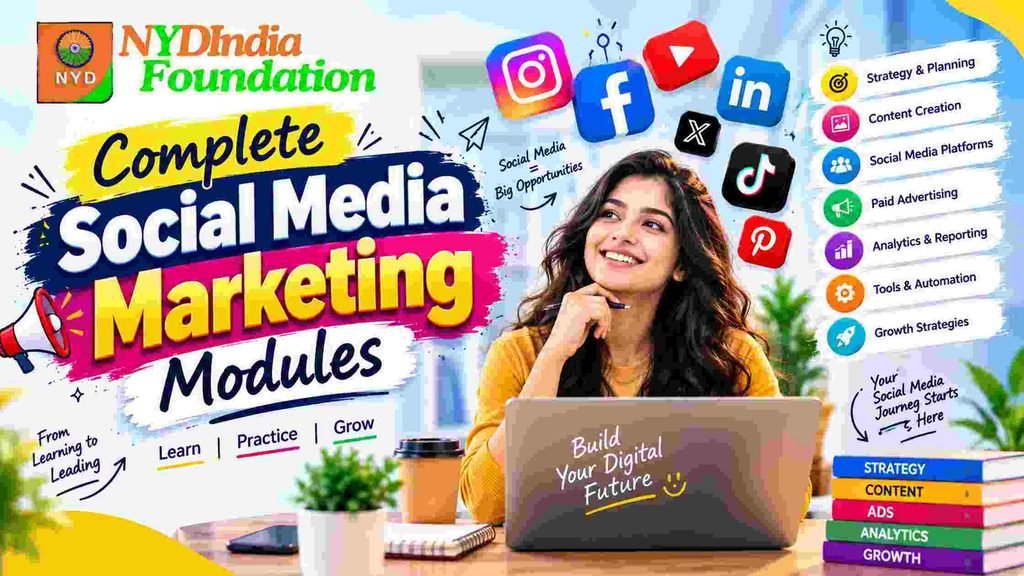
Complete Modules Covered in a Social Media Marketing Course
A well-structured course should combine foundational knowledge with practical implementation.
Here are some important learning areas that can help students develop professional expertise.
| Module | Learning Focus |
|---|---|
| 1. Marketing Fundamentals | Understanding digital marketing |
| 2. Social Media Strategy | Planning marketing campaigns |
| 3. Facebook Marketing | Business page and community management |
| 4. Instagram Marketing | Reels, Stories and engagement |
| 5. LinkedIn Marketing | Professional and B2B promotion |
| 6. YouTube Marketing | Channel growth and video SEO |
| 7. Content Strategy | Developing content plans |
| 8. Graphic Design | Creating social media creatives |
| 9. Video Editing | Editing short-form videos |
| 10. Copywriting | Writing engaging captions |
| 11. Hashtag Research | Discovering relevant hashtags |
| 12. Social Media SEO | Improving content discoverability |
| 13. Meta Ads | Running paid advertising campaigns |
| 14. Audience Targeting | Identifying potential customers |
| 15. Lead Generation | Generating business enquiries |
| 16. Influencer Marketing | Managing creator collaborations |
| 17. Social Media Analytics | Measuring campaign performance |
| 18. Competitor Analysis | Understanding market competition |
| 19. Content Automation | Scheduling and managing content |
| 20. AI-Powered Marketing | Using AI tools for marketing activities |
The exact modules and practical coverage may vary depending on the institute and course structure.
How AI is Changing Social Media Marketing
Artificial Intelligence is introducing new possibilities in social media marketing. Tasks that previously required significant manual effort can now be completed more efficiently with AI-powered tools.
Modern marketers are increasingly using AI to improve productivity and generate creative ideas, analyse information, and manage repetitive activities.
Some important applications include:
AI Content Generation: Develop content ideas, captions, promotional messages, and social media calendars.
AI Image Generation: Create original marketing visuals and campaign graphics.
AI Video Generation: Produce short promotional videos, advertisements, and social media reels.
AI Chatbots: Automate customer conversations and respond to frequently asked questions.
Marketing Automation: Schedule posts, organise workflows, and automate repetitive marketing activities.
AI Analytics: Identify audience patterns and understand campaign performance.
Learning how to combine traditional marketing knowledge with AI tools can help students become more adaptable in the evolving digital marketing industry.
Practical Projects You Should Experience During Training
Theoretical knowledge alone cannot prepare someone for professional marketing responsibilities. Practical assignments help students understand how marketing decisions affect actual business performance.
A quality Social Media Marketing Course should include projects such as:
- Creating and optimizing a Facebook business page.
- Developing a 30-day Instagram content calendar.
- Designing promotional social media posts.
- Creating Instagram Reels for a business.
- Planning a Facebook and Instagram advertising campaign.
- Developing a LinkedIn personal branding strategy.
- Creating a YouTube channel optimization plan.
- Conducting competitor research.
- Analysing Social Media engagement reports.
- Preparing a complete social media marketing strategy for a local business.
For example, Students could work on a hypothetical restaurant business and develop a complete social media campaign covering content creation, promotional offers, audience targeting, and lead generation.
This type of experience helps learners understand how to apply their knowledge beyond classroom assignments.
Career Opportunities After Completing a Social Media Marketing Course
Social media marketing offers several career possibilities across digital agencies, startups, established companies, e-commerce businesses, and independent projects.
Some potential career paths include:
Social Media Manager
Responsible for managing business accounts, planning content calendars, monitoring engagement, and maintaining brand communication.
Social Media Strategist
Develops marketing strategies based on business objectives, target audience, competitors, and platform performance.
Content Creator
Creates engaging graphics, videos, captions, reels, and other digital content.
Social Media Advertising Specialist
Plans and manages paid campaigns to improve brand awareness, generate leads, and achieve marketing objectives.
Influencer Marketing Exclusive
Coordinates influencer partnerships, promotional campaigns, and creator collaborations.
Freelance Social Media Marketer
Works independently with clients to manage their social media presence and marketing campaigns.
Digital Marketing Agency Owner
Uses social media marketing expertise to build an agency offering content creation, advertising, account management, and other digital marketing services.
How to Choose the Right Social Media Marketing Institute?
Choosing the right institute is an important decision because the quality of training can influence your practical knowledge and professional development.
Before enrolling, consider the following factors:
1. Updated Course Syllabus
Check whether the course covers current social media platforms, advertising practices, and AI tools.
2. Practical Training
Look for live projects, assignments, campaign planning, and hands-on activities.
3. Experienced Trainers
Learn from professionals who understand real-world marketing challenges.
4. AI Tool Training
Check whether the programme includes AI content creation, video generation, automation, and other relevant tools.
5. Portfolio Development
A good programme should help you develop practical work samples that demonstrate your skills.
6. Internship and Placement Assistance
Understand what career support is provided and ask for clear details about internship opportunities, placement assistance, and eligibility.
Who Should Enroll in a Social Media Marketing Course?
Social media marketing is a versatile skill that can benefit people from different educational and professional backgrounds.
It can be particularly useful for:
- Students interested in digital marketing careers.
- Freshers looking for practical marketing skills.
- Business owners who want to promote their products online.
- Freelancers interested in offering digital services.
- Content creators who want to understand marketing strategies.
- Entrepreneurs planning to establish digital marketing agencies.
You do not necessarily need an advanced technical background to begin learning social media marketing. Basic computer knowledge, creativity, communication skills, and a willingness to learn can provide a good starting point.
The Future of Social Media Marketing
The future of social media marketing will increasingly combine creativity, technology, data, and automation.
Short-form videos, social commerce, personalised advertising, influencer partnerships, AI-generated content, and automated customer engagement are changing how brands interact with audiences.
However, technology alone cannot create an effective marketing strategy. Understanding customer needs, developing meaningful communication, and creating valuable content will remain essential.
Professionals who can combine creative thinking with analytical skills and AI-powered tools will be better prepared to adapt to changing industry requirements.
1. The Psychology Behind Successful Social Media Campaigns
Successful social media marketing is not just about attractive designs or catchy captions. It also involves understanding why people stop scrolling, engage with content, trust a brand, and eventually make purchasing decisions.
A professional marketer needs to understand the psychology behind digital interactions.
Important psychological principles include:
- Emotional Marketing: Creating content that connects with happiness, excitement, curiosity, or inspiration.
- Social Proof: Using customer reviews, testimonials, and user-generated content to build credibility.
- FOMO Marketing: Creating genuine urgency around limited-time offers and exclusive opportunities.
- Storytelling: Communicating brand messages through relatable stories instead of direct promotional messages.
- Personalisation: Delivering relevant messages based on customer interests and preferences.
- Visual Attention: Using colours, layouts, and creative elements to capture audience attention.
Understanding these principles helps marketers create campaigns that connect with people rather than simply promoting products.
2. Social Listening: Discover What People Are Saying About Your Brand
Social listening is an important marketing practice that helps businesses understand online conversations about their brands, products, competitors, and industries.
Instead of focusing only on likes and comments, social listening examines what audiences are discussing across digital platforms.
A marketer can use social listening to:
- Identify customer complaints and expectations.
- Discover trending conversations within an industry.
- Monitor brand reputation.
- Understand competitor feedback.
- Find opportunities for new products or services.
- Identify potential brand advocates.
- Discover common questions asked by customers.
This knowledge can help businesses improve their marketing communication and make more informed decisions.
3. Building a Strong Brand Identity Across Multiple Platforms
A business may operate across Instagram, Facebook, LinkedIn, YouTube, and other platforms. However, its identity should remain consistent everywhere.
Professional social media marketers need to understand how to maintain a recognisable brand image.
Some important elements include:
- Brand voice and communication style.
- Consistent colour combinations.
- Typography and visual guidelines.
- Logo placement and creative design.
- Platform-specific content presentation.
- Consistent messaging and brand positioning.
For example, a luxury real estate company may use elegant typography, premium photography, and professional communication, while a youth fashion brand may prefer energetic visuals and conversational messaging.
4. Understanding Social Media Algorithms and Content Distribution
One of the most interesting areas of social media marketing is understanding how platforms distribute content to users.
Social media algorithms use different signals to determine which posts, videos, and recommendations appear in users’ feeds.
Marketers should understand concepts such as:
- Audience interests and content relevance.
- Watch time and video retention.
- Meaningful interactions.
- Content originality.
- User behaviour signals.
- Search and recommendation systems.
- Platform-specific content discovery.
Rather than relying on shortcuts or artificial engagement, marketers should focus on producing original content that provides genuine value to their target audience.
5. Social Commerce: Turning Social Media Platforms into Sales Channels
Social commerce combines social media engagement with online shopping experiences.
Customers can discover products through videos, influencer recommendations, advertisements, product demonstrations, and brand communities.
A social media marketing professional should understand how to support the customer journey from product discovery to purchase.
Key learning areas include:
- Product-focused content development.
- Social media product catalogues.
- Shopping campaign strategies.
- Influencer product demonstrations.
- Customer reviews and testimonials.
- Social media-driven website traffic.
- Conversion-focused promotional campaigns.
This knowledge is especially useful for fashion, beauty, electronics, lifestyle, and e-commerce businesses.
6. Crisis Management and Online Reputation Protection
A negative review, customer complaint, controversial post, or misleading comment can affect a brand’s reputation if it is not handled properly.
Social media marketers should understand how to respond professionally during difficult situations.
Important areas include:
- Identifying potential reputation risks.
- Responding to customer complaints.
- Handling negative feedback professionally.
- Preparing brand communication guidelines.
- Escalating sensitive issues to the appropriate team.
- Monitoring public conversations.
- Maintaining transparency in brand communication.
Crisis management is an important skill for professionals responsible for representing businesses online.
7. Conversion Rate Optimisation for Social Media Traffic
Getting thousands of visitors to a website does not necessarily mean a marketing campaign is successful. The real challenge is encouraging visitors to complete meaningful actions.
Conversion Rate Optimisation (CRO) focuses on improving the percentage of visitors who take a desired action.
A social media marketer should understand:
- Landing page relevance.
- Call-to-action placement.
- Website user experience.
- Lead form optimisation.
- Ad message consistency.
- Audience intent.
- Conversion tracking.
For example, a coaching institute receiving enquiries through Instagram advertisements can improve lead quality by creating a dedicated landing page with course information, eligibility details, and an enquiry form.
8. Social Media Marketing for Different Industries
Every industry has different customers, marketing objectives, and communication requirements. A strategy that works for a fashion brand may not work for a healthcare organisation or real estate company.
Students should understand how social media strategies change across different business sectors.
| Industry | Social Media Marketing Approach |
|---|---|
| Real Estate | Property showcases, virtual tours and project updates |
| Education | Course promotions, student stories and educational videos |
| Healthcare | Health awareness and informative content |
| Fashion | Styling videos, product launches and influencer campaigns |
| Restaurants | Food photography, menu highlights and customer experiences |
| Travel | Destination storytelling and travel guides |
| Fitness | Workout videos, fitness education and community building |
| E-commerce | Product demonstrations and promotional campaigns |
This industry-based knowledge helps marketers work with different types of clients.
9. Understanding Social Media Marketing KPIs and Business Performance
A professional marketer must understand how to measure the actual business impact of social media activities.
Key Performance Indicators (KPIs) help evaluate whether marketing campaigns are achieving their objectives.
Important metrics include:
- Reach: Number of unique people who see content.
- Impressions: Total number of times content is displayed.
- Engagement Rate: Level of audience interaction.
- CTR: Percentage of people who click an advertisement or link.
- CPC: Average cost per click.
- CPL: Cost required to generate a lead.
- Conversion Rate: Percentage of users completing a desired action.
- ROAS: Revenue generated in relation to advertising expenditure.
Learning to interpret these metrics helps marketers understand campaign effectiveness and identify areas for improvement.
10. Creating a Personal Brand as a Social Media Marketing Professional
Your own social media presence can become a valuable professional asset.
Instead of only learning how to promote other businesses, students can also learn how to establish their own professional identity online.
A personal branding strategy may include:
- Sharing marketing knowledge on LinkedIn.
- Publishing educational Instagram Reels.
- Creating social media case studies.
- Sharing campaign experiments.
- Developing a professional portfolio.
- Publishing industry-related opinions.
- Building connections with marketing professionals.
A strong personal brand can help professionals demonstrate their expertise and attract potential employers, clients, and business opportunities.
11. Understanding Customer Journey Mapping Through Social Media
Customers rarely make purchasing decisions immediately after seeing a single social media post. They may first discover a brand, research its services, compare alternatives, and eventually become customers.
Customer journey mapping helps marketers understand this process.
| Customer Stage | Marketing Objective | Example Content |
|---|---|---|
| Awareness | Introduce the brand | Educational reels |
| Interest | Generate curiosity | Product demonstrations |
| Consideration | Build confidence | Reviews and comparisons |
| Conversion | Encourage action | Offers and lead campaigns |
| Retention | Maintain relationships | Customer updates |
| Advocacy | Encourage recommendations | Testimonials and referrals |
Understanding this journey allows marketers to create suitable content for customers at different stages of their buying decisions.
12. Ethical Marketing and Responsible Social Media Practices
Professional social media marketing also requires an understanding of responsible communication.
Brands need to maintain customer trust while promoting their products and services.
Important practices include:
- Avoiding misleading advertisements.
- Respecting customer privacy.
- Using genuine testimonials.
- Disclosing paid influencer partnerships.
- Obtaining permission before using customer content.
- Respecting copyright and intellectual property.
- Following platform advertising policies.
- Avoiding fake engagement and manipulated statistics.
Ethical marketing helps businesses establish long-term credibility and maintain healthy customer relationships.
13. Developing a Social Media Marketing Portfolio That Attracts Clients
A professional portfolio provides evidence of what a marketer can actually do. It can be particularly valuable for freshers, freelancers, and people applying for digital marketing positions.
A strong portfolio can include:
- Sample Instagram marketing campaigns.
- Facebook advertising campaign plans.
- Social media content calendars.
- Brand identity projects.
- Short-form video samples.
- Competitor analysis reports.
- Audience research documents.
- Social media performance reports.
- Before-and-after profile optimisation examples.
- Complete industry-specific marketing strategies.
Even if someone has not worked with paying clients, they can create clearly labelled demonstration projects using hypothetical brands.
14. How to Prepare for Real Social Media Marketing Client Requirements
One of the biggest differences between learning social media marketing and working professionally is understanding client expectations.
Clients generally want business outcomes rather than simply attractive social media posts.
A marketer should learn how to:
- Understand a client’s business model.
- Identify the target customer.
- Establish measurable campaign objectives.
- Prepare monthly content proposals.
- Estimate advertising budgets.
- Set realistic expectations.
- Communicate campaign progress.
- Present performance reports.
- Recommend improvements based on data.
These professional skills can make a significant difference when working in an agency or handling independent projects.
Conclusion
Social media marketing has developed into an important professional skill for businesses and individuals looking to establish a strong digital presence.
A structured Social Media Marketing Course can help learners understand platform management, content development, paid advertising, analytics, and AI-powered marketing techniques.
More importantly, practical experience allows students to turn theoretical knowledge into skills that can be used in employment, freelancing, or business development.
Whether your goal is to become a social media manager, work with a digital marketing agency, or establish your own marketing business, investing time in learning the right strategies can be a valuable step towards building a career in the digital industry.
Frequently Asked Questions (FAQs)
1. What is taught in a Social Media Marketing Course?
A Social Media Marketing Course generally covers Facebook, Instagram, LinkedIn, YouTube, content creation, social media advertising, audience targeting, analytics, and marketing automation.
2. How long does it take to learn social media marketing?
The duration depends on the training programme. A structured course may take between 2 and 6 months, depending on its syllabus and practical training requirements.
3. Is social media marketing a good career option?
It can be a promising career option for people interested in content creation, advertising, branding, audience engagement, and digital business development.
4. Can beginners learn social media marketing?
Yes. Beginners can start with the fundamentals and gradually develop practical knowledge of different social media platforms and marketing strategies.
5. Do I need coding knowledge for social media marketing?
No. Coding is generally not required. Most social media marketing activities involve content planning, creative development, advertising platforms, analytics, and communication.
6. Can I become a freelancer after completing the course?
Yes. With sufficient practical knowledge and a strong portfolio, you can offer social media management, content creation, and advertising services to clients.
7. Why should I learn AI tools with social media marketing?
AI tools can help streamline content creation, generate marketing ideas, produce visuals, automate repetitive tasks, and improve workflow efficiency.