
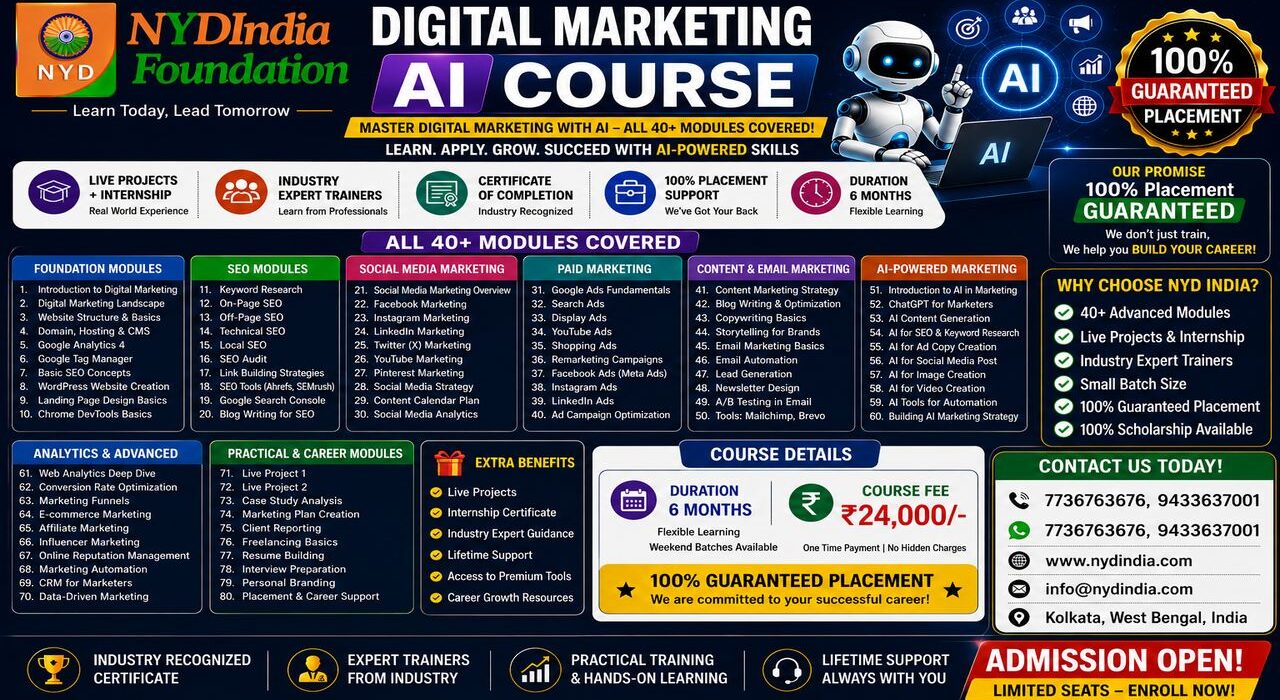
Digital Marketing with AI Course with 100% Guaranteed Placement: Build a Future-Ready Career
Digital marketing has changed dramatically in recent years. Businesses no longer depend only on traditional advertising to reach customers. Today, brands use search engines, social media, content, paid advertising, email marketing, analytics, automation, and artificial intelligence to attract and convert their audiences.
This transformation has created a growing demand for professionals who understand both Digital Marketing and AI-powered tools. A Digital Marketing with AI course can help students, freshers, entrepreneurs, freelancers, and working professionals develop practical skills that are relevant to the modern digital economy.
For learners looking beyond theoretical education, choosing a course with live projects, practical training, industry exposure, and 100% guaranteed placement support can make the learning journey more career-focused.
What Is a Digital Marketing with AI Course?
A Digital Marketing with AI course combines traditional digital marketing techniques with modern artificial intelligence tools and workflows.
Instead of learning SEO, social media marketing, advertising, or content marketing separately, students learn how these areas work together and how AI can make marketing processes faster and more effective.
A well-structured course may cover areas such as:
- Search Engine Optimization (SEO)
- Social Media Marketing
- Google Ads and paid advertising
- Content marketing
- Email marketing
- Affiliate marketing
- Website and landing page optimization
- Google Analytics and marketing analytics
- Lead generation
- Conversion optimization
- AI-assisted content creation
- AI-powered SEO research
- Marketing automation
- AI tools for social media
- Prompt engineering for marketers
- Chatbot and conversational marketing
- Performance marketing
- Freelancing and client management
The goal is not simply to teach students how to use individual tools. It is to help them understand how to create, execute, measure, and improve a complete digital marketing strategy using AI.
Why Learn Digital Marketing with AI?
AI is becoming an important part of modern marketing. Marketers can use AI to research audiences, generate ideas, analyze data, personalize communication, automate repetitive tasks, and improve campaign performance.
However, AI does not replace the need for marketing knowledge.
A person who understands marketing fundamentals can use AI much more effectively than someone who simply generates content with an AI tool.
That is why learning Digital Marketing + AI together can be valuable for today’s job market.
Students can learn how to combine human creativity and strategic thinking with AI-powered productivity.
100% Guaranteed Placement: What Should Students Look For?
Placement is one of the biggest concerns for students before enrolling in a professional course.
A course advertised with 100% guaranteed placement should ideally provide more than a certificate. Students should look for a structured career-support system that may include:
Resume Development
A professional resume helps candidates present their skills, projects, certifications, and practical experience effectively.
Interview Preparation
Mock interviews and interview guidance can help students become more comfortable answering common digital marketing and HR questions.
Practical Projects
Employers generally want candidates who can demonstrate what they have actually done. Real or simulated projects can give learners examples to discuss during interviews.
Portfolio Development
A digital marketing portfolio can include SEO projects, social media campaigns, advertising plans, content samples, analytics reports, and other practical work.
Job Interview Assistance
Placement assistance can connect trained candidates with relevant job opportunities and help them prepare for recruitment processes.
Career Guidance
Professional guidance can help learners identify suitable roles according to their skills and career goals.
Important: Students should always check the exact terms and conditions of any placement guarantee before enrolling, including eligibility requirements, documentation, attendance criteria, interview participation, and the meaning of “100% placement.”
Who Should Join a Digital Marketing with AI Course?
One of the biggest advantages of digital marketing is that it is not limited to students from one academic background.
The course can be useful for:
Freshers
Students who want to enter the digital industry can build job-ready skills without necessarily having a technical degree.
College Students
Learning digital marketing alongside formal education can help students develop practical skills before graduation.
Working Professionals
Professionals from sales, business development, advertising, communication, and other fields can use digital marketing and AI skills to expand their career opportunities.
Entrepreneurs
Business owners can understand how to promote their products or services online, generate leads, and communicate with customers.
Freelancers
Digital marketing skills can open opportunities to work with clients on SEO, social media, advertising, content, and other services.
Career Changers
People looking to move into a fast-growing digital profession can use structured training to develop a new skill set.
Practical Learning Matters More Than Theory
Reading about SEO is different from optimizing a website.
Understanding Google Ads is different from creating and managing an actual campaign.
Learning social media marketing is different from building a content calendar and analyzing engagement.
That is why practical training should be a major part of a Digital Marketing with AI course.
Students should ideally get opportunities to work on:
- SEO audits
- Keyword research
- Website optimization
- Content strategies
- Social media calendars
- Paid advertising campaigns
- Lead generation campaigns
- Analytics reports
- AI-powered marketing workflows
- Marketing presentations
- Client-style assignments
These practical experiences can make it easier for students to understand how digital marketing works outside the classroom.
Career Opportunities After a Digital Marketing with AI Course
After completing professional training, students can explore several career paths depending on their interests and specialization.
Possible roles include:
- Digital Marketing Executive
- SEO Executive
- SEO Specialist
- Social Media Executive
- Social Media Manager
- Performance Marketing Executive
- PPC Executive
- Content Marketing Executive
- Digital Advertising Specialist
- Email Marketing Executive
- Marketing Automation Executive
- Digital Marketing Analyst
- AI Marketing Specialist
- Growth Marketing Executive
- Content Strategist
- Freelance Digital Marketer
The exact job title, salary, and responsibilities can vary depending on experience, skills, location, company, and specialization.
How AI Can Improve a Digital Marketer’s Work
AI can help marketers reduce repetitive work and spend more time on strategy and creativity.
For example, an SEO professional can use AI-assisted workflows for research and content planning. A social media marketer can use AI to generate content ideas and variations. A performance marketer can use data analysis tools to identify campaign trends.
AI can support:
Research: Finding topics, audience questions, competitors, and content opportunities.
Content: Developing outlines, ideas, variations, and content briefs.
SEO: Supporting keyword research, topic clustering, content optimization, and analysis.
Social Media: Creating content ideas, captions, calendars, and campaign concepts.
Advertising: Generating creative variations and assisting with campaign analysis.
Analytics: Identifying patterns in marketing data and preparing useful insights.
The marketer still needs to verify information, understand the audience, maintain brand quality, and make strategic decisions.
Digital Marketing with AI vs Traditional Digital Marketing Training
Traditional digital marketing courses generally focus on core marketing channels such as SEO, social media, paid advertising, email marketing, and content.
A modern Digital Marketing with AI course adds another layer: AI-assisted marketing workflows.
This can help students understand not only what to do, but also how modern tools can improve the speed and efficiency of completing marketing tasks.
The strongest approach is therefore not replacing marketing fundamentals with AI, but combining both.
What Makes a Good Digital Marketing Course?
Before choosing an institute, prospective students should evaluate the course carefully.
Look for:
- Updated curriculum – Digital marketing changes frequently, so the syllabus should reflect current tools and practices.
- Practical assignments – Students should get opportunities to apply what they learn.
- Live projects – Real-world-style projects can provide valuable experience.
- Experienced trainers – Trainers should understand both marketing fundamentals and current digital tools.
- AI-focused learning – The course should teach practical AI applications rather than simply mentioning AI.
- Career support – Resume preparation, interview training, and placement assistance can be valuable.
- Portfolio building – Students should finish the course with work they can demonstrate to potential employers.
- Industry-oriented training – The curriculum should focus on skills businesses actually use.
Why a Career-Focused Course Can Make a Difference
A certificate alone does not automatically create a successful career.
What matters is the combination of knowledge, practical experience, communication, problem-solving ability, portfolio quality, and interview readiness.
A career-focused Digital Marketing with AI course can bring these elements together in a structured learning environment.
For a beginner, this can provide a clear path from learning fundamentals to completing projects and preparing for employment.
For an experienced professional, it can help add AI-powered capabilities to an existing marketing skill set.
Start Building Your Digital Future
Digital marketing is no longer just about posting on social media or ranking a website on Google. Modern marketing involves data, creativity, technology, automation, customer psychology, and increasingly, artificial intelligence.
A Digital Marketing with AI course with 100% guaranteed placement can be an attractive option for learners who want structured training along with career support. However, students should always evaluate the curriculum, practical training, placement terms, trainer experience, and actual career support before making a final decision.
The digital industry rewards people who keep learning. By developing strong marketing fundamentals and learning how to use AI responsibly and effectively, aspiring marketers can prepare themselves for a changing professional landscape.
Digital Marketing with AI Course: A Practical Path to a Modern Marketing Career
The digital world is changing every day, and businesses are constantly looking for better ways to reach customers. Search engines, social media platforms, online advertising, websites, email campaigns, and data analytics have become essential parts of business growth.
At the same time, Artificial Intelligence is changing the way marketing teams work. From creating content ideas to analyzing customer behavior, AI is helping marketers save time and make more informed decisions.
This is why a Digital Marketing with AI course with 100% guaranteed placement can be an interesting career option for students and professionals who want to enter the digital industry.
Rather than focusing only on traditional marketing techniques, modern training can introduce learners to the combination of digital marketing strategy, practical implementation, analytics, automation, and AI-powered tools.
The Growing Importance of Digital Marketing Skills
Consumers today spend a significant amount of time online. They search for products on Google, discover brands through social media, watch videos before making purchasing decisions, and compare businesses online.
For companies, this creates both an opportunity and a challenge.
Having an online presence is no longer enough. Businesses need professionals who understand how to attract the right audience, create useful content, generate leads, run advertising campaigns, analyze results, and improve marketing performance.
This demand has created career opportunities in areas such as:
- SEO
- Social media marketing
- Paid advertising
- Content marketing
- Email marketing
- Performance marketing
- Marketing analytics
- Lead generation
- Conversion optimization
- Marketing automation
Adding AI knowledge to these skills can make the learning process even more relevant to today’s marketing environment.
AI Is Becoming a Marketing Skill
Artificial Intelligence is not simply another technology that marketers should know about. It is increasingly becoming part of everyday marketing workflows.
A marketer may use AI to brainstorm campaign concepts, analyze large amounts of information, create content variations, organize research, summarize reports, develop customer personas, or automate repetitive tasks.
However, successful AI-powered marketing requires more than knowing how to type prompts.
A professional needs to understand:
What should be created?
Who is the target audience?
Why should the audience care?
Which platform should be used?
How should performance be measured?
How can the campaign be improved?
These are marketing questions. AI simply provides additional tools to help answer them.
Learn AI as a Marketing Professional, Not Just as a Tool User
One common mistake beginners make is trying to learn dozens of AI tools without understanding marketing fundamentals.
Tools change quickly. The fundamental principles of marketing remain much more stable.
For example, an AI tool may help generate ten social media captions, but the marketer still needs to decide:
- Which caption matches the brand?
- Which one speaks to the target audience?
- Which platform is appropriate?
- What action should the customer take?
- How will engagement be measured?
This is why a quality Digital Marketing with AI course should teach strategy first and tools second.
SEO and AI: A Powerful Combination
Search Engine Optimization remains an important part of digital marketing.
SEO professionals need to understand search intent, keyword research, technical optimization, content quality, internal linking, website structure, backlinks, user experience, and performance measurement.
AI can assist with several parts of this workflow.
For example, marketers can use AI-assisted processes to:
- Generate content topic ideas
- Organize keyword clusters
- Analyze search intent
- Create content briefs
- Identify content gaps
- Develop FAQs
- Improve content structures
- Brainstorm internal linking opportunities
- Analyze competitor content
- Create SEO reporting summaries
But AI-generated content should not simply be published without review. Human expertise, fact-checking, originality, search intent, and usefulness remain important.
Social Media Marketing with AI
Social media has become one of the most visible parts of digital marketing.
A social media professional may be responsible for content planning, captions, creatives, audience engagement, campaign management, influencer coordination, and performance reporting.
AI can support many of these activities.
A marketer can use AI-assisted workflows for:
- Content calendars
- Caption ideas
- Campaign concepts
- Audience research
- Creative variations
- Video script ideas
- Hashtag research
- Content repurposing
- Performance summaries
The best results come when AI is used as a creative assistant rather than a complete replacement for human judgment.
Google Ads and Performance Marketing
Paid advertising is another important component of digital marketing.
Businesses invest in advertising because they want measurable results such as leads, sales, registrations, app installs, or website traffic.
Students learning performance marketing should understand:
- Campaign structure
- Keyword targeting
- Audience targeting
- Ad copy
- Landing pages
- Conversion tracking
- Budget management
- A/B testing
- Campaign optimization
- Performance reporting
AI can assist marketers with brainstorming ad copy, identifying patterns in campaign data, generating creative variations, and improving workflow efficiency.
However, advertising decisions still require proper strategy and continuous performance analysis.
Content Marketing in the AI Era
Content remains one of the foundations of digital marketing.
Businesses need blogs, social media posts, videos, newsletters, landing pages, product descriptions, case studies, and educational resources.
AI has made content production faster, but faster does not always mean better.
Modern marketers need to understand how to create content that is:
- Useful
- Original
- Relevant
- Audience-focused
- Easy to understand
- Brand-appropriate
- Factually accurate
- Designed around a clear objective
Learning how to combine AI assistance with human editing and creative thinking can therefore become a valuable professional skill.
Marketing Automation
Automation can help businesses reduce repetitive marketing tasks.
For example, businesses can create automated workflows for:
- Lead follow-ups
- Email campaigns
- Customer onboarding
- Appointment reminders
- Newsletter distribution
- Customer segmentation
- Marketing notifications
- Lead nurturing
A Digital Marketing with AI course can introduce students to the concept of automation and show how different marketing activities can work together.
This is particularly useful for businesses that receive large numbers of leads or customers and need an organized communication process.
Analytics: Turning Data Into Decisions
Digital marketing produces a huge amount of data.
Marketers can track impressions, clicks, engagement, leads, conversion rates, cost per acquisition, website traffic, and many other metrics.
But collecting data is only the beginning.
The real skill is understanding what the numbers mean.
For example:
If website traffic increases but leads remain unchanged, the marketer needs to investigate why.
If an advertisement receives many clicks but produces very few conversions, the problem could be related to the audience, offer, ad message, landing page, or conversion process.
AI-assisted analytics can help identify patterns and summarize information, but marketers still need the ability to interpret results and make business decisions.
Live Projects Can Improve Career Readiness
One of the biggest differences between classroom learning and professional work is practical responsibility.
A student may understand the definition of SEO but struggle when asked to audit an actual website.
Similarly, someone may understand social media marketing theoretically but find it difficult to create a complete campaign.
Live projects can help bridge this gap.
A practical course may allow students to work on projects such as:
SEO Project
Analyze a website, conduct keyword research, identify optimization opportunities, and prepare an SEO strategy.
Social Media Project
Develop a monthly content calendar, create campaign ideas, and analyze social media performance.
Google Ads Project
Build a sample campaign structure, select relevant keywords, write advertisements, and define conversion goals.
Content Marketing Project
Create a content strategy based on customer intent and business objectives.
AI Marketing Project
Develop an AI-assisted workflow for content research, campaign planning, reporting, or customer communication.
These projects can become useful portfolio pieces when applying for jobs.
Placement Support and Career Preparation
For many students, learning is only one part of the journey. The next challenge is finding a suitable job.
This is where structured placement support can be useful.
A course offering a 100% guaranteed placement should clearly explain how its placement program works.
Students should ask about:
- Placement eligibility
- Number of interview opportunities
- Partner companies
- Job roles
- Salary ranges
- Internship opportunities
- Resume support
- Interview preparation
- Portfolio development
- Placement duration
- Terms and conditions
A transparent placement process helps students understand exactly what support they can expect.
Build a Strong Digital Marketing Portfolio
A portfolio can sometimes communicate a student’s capabilities better than a certificate.
A beginner can create a portfolio containing:
SEO: Keyword research and website audit samples.
Social Media: Content calendars and campaign concepts.
Advertising: Sample Google Ads campaign structures.
Content: Blog posts, landing pages, and social media content.
Analytics: Sample performance reports and marketing dashboards.
AI: Examples of AI-assisted marketing workflows.
A strong portfolio demonstrates that the student knows how to apply concepts rather than simply remember them.
Digital Marketing for Freelancing
Digital marketing can also provide opportunities beyond traditional employment.
Businesses frequently require freelancers for services such as:
- SEO
- Social media management
- Content writing
- Paid advertising
- Email marketing
- Lead generation
- Website optimization
- Marketing consulting
Students who develop multiple skills can potentially build freelance service packages instead of offering only one isolated service.
For example, a freelancer might offer a combination of SEO content, social media management, and monthly performance reporting.
AI can help freelancers improve productivity, but quality control and client communication remain essential.
Digital Marketing for Entrepreneurs
Business owners can also benefit from learning digital marketing.
Understanding online marketing allows entrepreneurs to make more informed decisions about advertising agencies, freelancers, content strategies, SEO, social media, and customer acquisition.
Even when an entrepreneur does not personally manage every marketing activity, understanding the fundamentals can help them communicate more effectively with their marketing team.
Skills Students Can Develop
A comprehensive Digital Marketing with AI program can help learners develop a combination of technical, creative, analytical, and professional skills.
Technical Skills
- SEO
- Website optimization
- Analytics
- Advertising platforms
- Marketing automation
- AI marketing tools
Creative Skills
- Content creation
- Campaign ideas
- Copywriting
- Social media planning
- Creative strategy
Analytical Skills
- Data interpretation
- Campaign analysis
- Conversion analysis
- Customer research
- Performance reporting
Professional Skills
- Communication
- Presentation
- Client handling
- Problem solving
- Team collaboration
- Interview preparation
This combination can make a learner more versatile in the digital marketing workplace.
Is Digital Marketing with AI a Good Career Choice?
There is no single career path that is perfect for everyone.
However, digital marketing can be attractive to people who enjoy a combination of creativity, technology, communication, research, and business.
Adding AI skills can help learners understand how modern marketing teams are adopting new technology.
The key is to avoid treating the course as a shortcut to instant success.
A successful digital marketing career generally requires continuous learning, practical experience, experimentation, and the ability to adapt to changing platforms and customer behavior.
Final Word
The marketing industry is entering a new phase where human creativity and AI-powered technology work together.
A Digital Marketing with AI course can provide a structured way to learn SEO, social media marketing, paid advertising, content marketing, analytics, automation, and AI-assisted workflows under one learning program.
For students and professionals looking for career support, a course with 100% guaranteed placement may offer additional value—but the placement terms should always be reviewed carefully before enrollment.
The real advantage comes from developing practical skills, completing meaningful projects, building a professional portfolio, and learning how to use AI intelligently.
If you are serious about entering the digital marketing industry, don’t focus only on collecting a certificate. Focus on becoming someone who can understand a marketing problem, develop a strategy, execute the campaign, analyze the results, and improve performance using modern technology.
That is the kind of skill set that can remain valuable as digital marketing continues to evolve.